
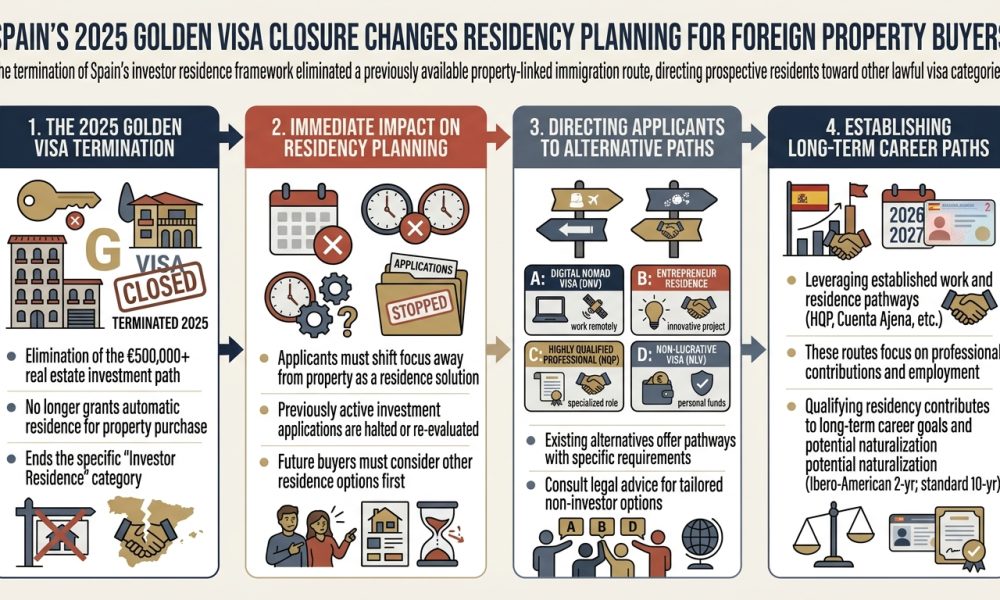
Spain’s termination of its investor residence framework eliminated a previously available property-linked immigration route, requiring Mexican and other foreign investors to examine alternative residence authorizations, existing permit protections and the separate legal requirements governing Spanish citizenship.
WASHINGTON, DC, November 21, 2026 — Foreign investors considering residential property purchases in Spain can no longer obtain a new Golden Visa simply by acquiring qualifying real estate, following the April 3, 2025, termination of the country’s investment-based residence program.
The legislative change ended a previously available immigration route that linked substantial property acquisitions to Spanish residence authorization, requiring prospective buyers to evaluate employment, financial independence, entrepreneurship, or other legally recognized immigration categories.
For Mexican entrepreneurs, retirees, and internationally mobile families, the closure means owning an apartment in Madrid, Barcelona, Valencia, or another Spanish destination no longer provides an independent basis for investor residence under the former program.
Spain Officially Ended Its Golden Visa on April 3, 2025
Organic Law 1/2025, published in Spain’s Official State Gazette on January 3, 2025, eliminated Articles 63 through 67 of Law 14/2013, which previously established residence visas and authorizations for qualifying foreign investors.
The closure took effect on April 3, 2025, ending the possibility of submitting new applications under the former investor residence framework, although transitional provisions preserved certain rights for applicants and permit holders already in the system.
The change affected the broader investment residence framework, not just the property purchase category, so it is incorrect to advertise alternative financial investments under the abolished investor provisions as currently available Golden Visa routes.
BOE
The Former Property Threshold Was €500,000
Before the closure, qualifying non-European Union investors could pursue Spanish residence by purchasing eligible real estate worth at least €500,000, subject to conditions concerning ownership, financing and the required investment amount.
The program attracted international buyers seeking a Spanish residence option while maintaining business interests and principal homes elsewhere, particularly because investor residence involved different physical presence requirements than ordinary residence categories.
However, the €500,000 threshold is now a historical eligibility figure rather than a current immigration opportunity, making older property advertisements potentially misleading if they still link that purchase amount to automatic residence eligibility.
Spain’s Housing Debate Influenced the Decision
The Spanish government announced its intention to eliminate property-linked Golden Visas amid concerns about housing affordability and the effect of investment incentives in markets experiencing substantial pressure on residential property supply.
In an April 2024 Reuters report on Spain’s plans to abolish investor residence visas, Prime Minister Pedro Sánchez said the government intends to prioritize housing as a social necessity rather than a speculative investment opportunity.
The reporting also presented a competing assessment from the property industry, which argued that Golden Visa purchases represented a small share of total property transactions and were unlikely to explain Spain’s wider affordability problems.
Reuters
The Closure Did Not Prohibit Foreign Property Ownership
Spain’s elimination of investor residence did not establish a general prohibition on foreign nationals purchasing residential or commercial property, meaning Mexican citizens can still pursue lawful acquisitions under applicable property legislation.
A Mexican investor may therefore purchase a holiday apartment, retirement residence or rental property without holding Spanish citizenship, provided the transaction satisfies relevant ownership, financial, anti-money-laundering and administrative requirements.
However, the property purchase and the immigration application must now be evaluated independently, because the acquisition itself no longer provides eligibility for the former Golden Visa residence authorization.
Investors Can Own Homes Without Becoming Spanish Residents
A foreign individual can own property in Spain while maintaining ordinary residence in Mexico, the United States, or another country, since ownership and immigration status are separate legal relationships.
An overseas owner who visits the property periodically remains subject to the entry rules applicable to the person’s nationality and circumstances, rather than acquiring unrestricted residence rights through the title deed.
Mexican buyers should consequently distinguish the legal ability to purchase a home from permission to remain in Spain for extended periods, especially when retirement or family settlement forms part of their objectives.
Existing Golden Visa Holders Received Transitional Protection
Spain’s transitional legislation preserves the validity of investor visas and residence authorizations that were in force when the program closed, allowing qualifying holders to retain their existing permissions for the periods originally granted.
The law also provides that renewal applications be examined under the rules in force when the initial authorization was issued, creating important Protection for investors who previously entered the program lawfully.
Existing holders should nevertheless verify continued compliance with their original investment and residence conditions, because transitional Protection does not provide unconditional renewal regardless of the circumstances affecting an individual application.
Ciudadanía Española en el Exterior
Earlier Applications May Still Be Examined Under Previous Rules
The first transitional provision addresses investors and qualifying relatives who submitted their applications before the April 3, 2025, deadline, allowing those files to be decided under the rules in effect when submitted.
A property buyer who completed the necessary purchase but failed to submit the qualifying immigration application before the deadline should not automatically assume that the earlier investment creates protected application rights.
The key distinction concerns the qualifying application history and official filing records, so documentary confirmation is essential before relying on the transitional regime in a pending or disputed case.
A Property Deposit Does Not Establish Transitional Eligibility
Spain’s administrative guidance distinguishes qualifying applications from preliminary commercial arrangements, including certain reservation contracts and deposits that do not establish the completed investment or application required under the former rules.
Foreign buyers who signed property agreements shortly before the deadline should therefore have their documents examined independently, rather than assuming that a developer’s acknowledgment or payment receipt automatically preserves access to the abolished program.
This distinction is particularly important when a transaction involved staged payments or unfinished construction, because the legal timing of the investment and application can materially affect the buyer’s immigration position.
Family Members May Face Different Transitional Rules
Existing investor residence holders and relatives who already held qualifying authorization at the time of closure may retain rights under the applicable transitional provisions. However, newly arising family circumstances require separate examination.
Spain’s June 2025 administrative criteria indicated that subsequent applications involving newly added family members may need to proceed through ordinary family immigration arrangements rather than the former investor framework.
Consequently, an investor who married after the program closed should not assume that the new spouse automatically qualifies for an investor residence permit based exclusively upon the original property acquisition.
Investment Rights Cannot Simply Be Transferred.
Spain’s administrative guidance also addresses attempts to transfer investor residence benefits through inheritance, gifts, or other property transactions completed after the program’s closure, emphasizing that immigration authorization is personal to the qualifying holder.
A Mexican family inheriting property from an earlier Golden Visa investor cannot automatically inherit the deceased person’s immigration permission simply because the property remains within the household.
The property may pass under applicable succession legislation, but the immigration rights associated with the former investor program require a separate legal assessment.
Non-Lucrative Residence Offers an Alternative for Financially Independent Applicants
Spain continues to offer non-lucrative residence authorization to qualifying foreigners with sufficient financial resources to support themselves without working or engaging in professional activity during their stay.
This route may suit Mexican retirees, financially independent individuals, and households supported by qualifying savings, pensions, or passive investment income, provided they meet financial, health insurance, and documentary requirements.
However, non-lucrative residence does not authorize remote employment simply because the employer or client is located outside Spain. Hence, the applicant’s actual economic activities are central to choosing the right immigration category.
The Non-Lucrative Financial Threshold Depends on IPREM
Spain generally requires principal non-lucrative residence applicants to demonstrate resources equal to at least 400% of the monthly Public Multiple Effects Income Indicator (IPREM), with additional resources required for accompanying family members.
Using the €600 monthly IPREM benchmark, the principal applicant’s minimum financial requirement corresponds to €2,400 monthly or €28,800 over 12 months, although applicants should verify the current official figure when filing.
Meeting the financial threshold does not guarantee approval, because officials must also evaluate the applicant’s insurance, Identification, immigration history, and proposed non-working residence circumstances.
Remote Workers Should Examine Spain’s Digital Nomad Framework
Mexican professionals who intend to continue working for employers or clients outside Spain should evaluate the international teleworking authorization, commonly called the digital nomad visa, rather than relying upon non-lucrative residence.
The specialized framework permits qualifying remote professional activity under separate conditions governing employment relationships, financial resources, professional qualifications, and compliance with applicable employment and social security rules.
A software engineer working remotely for a Mexican technology company may therefore require a different immigration assessment than a retired business owner receiving dividends without active professional work.
The Digital Nomad Route Has Its Own Restrictions
Spain’s international teleworking framework generally distinguishes salaried employees working for eligible foreign companies from qualifying independent professionals, whose permitted activities involving Spanish customers are subject to additional conditions.
Applicants must document genuine professional relationships and show that the proposed work can lawfully be performed remotely, rather than assuming that any online commercial activity qualifies for a specialized residence permit.
A Spanish apartment or local property investment does not override these professional requirements, although suitable accommodation can support the practical arrangements associated with genuine relocation.
Entrepreneur Residence Remains Available for Innovative Projects
Spain’s entrepreneur residence provisions under Law 14/2013 remain separate from the abolished investor chapters, allowing eligible foreign founders to pursue residence based upon innovative projects presenting recognized economic interest.
The entrepreneur route requires an appropriate project assessment, including the applicant’s professional background, the proposed business model, and the venture’s potential economic contribution.
Mexican entrepreneurs should not confuse the purchase of an existing ordinary business with automatic eligibility, because the specialized authorization focuses upon qualifying entrepreneurial activity rather than passive acquisition of commercial assets.
Company Formation Alone Does Not Guarantee Residence
A foreign investor may establish or acquire an interest in a Spanish company without automatically receiving immigration authorization, because different legal provisions govern company ownership and personal residence permission.
Applicants seeking residence through business activity must determine whether entrepreneur authorization, ordinary self-employment, or another immigration route matches their actual work and investment arrangements.
This analysis should occur before signing substantial contracts, especially when the proposed venture depends on the founder being legally permitted to reside in and conduct professional activity in Spain.
Highly Qualified Employment Provides Another Route
Spain also maintains specialized residence authorization for highly qualified professionals, including qualifying national authorizations and European Union Blue Card arrangements involving appropriate employment offers and professional credentials.
These pathways may suit Mexican engineers, executives, and technology specialists recruited by Spanish employers, provided the position, qualifications, and compensation meet the relevant statutory conditions.
Unlike the former Golden Visa, these arrangements depend upon qualifying employment rather than simply transferring capital into a property acquisition, creating different obligations and long-term residence considerations.
Ordinary Employer Sponsorship Remains Relevant
Foreign nationals who receive eligible employment offers may pursue ordinary residence and work authorization under Spain’s immigration regulations, subject to employer responsibilities, contractual conditions, and applicable labor market provisions.
The sponsoring employer typically participates in the authorization process, while the prospective employee must establish personal eligibility and complete the required documentation before beginning professional activity.
A Mexican property buyer who later receives a legitimate Spanish job offer may therefore pursue employment-based residence independently, without treating the earlier real estate purchase as the basis for immigration approval.
Family Relationships Can Support Residence Applications
Qualifying family relationships with Spanish citizens or lawful residents may provide separate immigration pathways, including arrangements involving spouses, partners, children and other eligible relatives under the applicable legislation.
For example, a Mexican citizen married to a Spanish national may qualify for a family residence procedure distinct from investor immigration, subject to legally recognized relationship and documentary requirements.
Property ownership can help establish accommodation arrangements but does not replace the relationship, immigration and eligibility conditions governing the relevant family residence authorization.
Retirement Property Purchases Require Financial Planning
Mexican retirees considering homes along Spain’s Mediterranean coast should examine the total financial consequences of ownership, including purchase taxes, legal fees, property maintenance, insurance and recurring local charges.
These obligations exist regardless of immigration status, so it’s important to separate money reserved for living expenses from funds committed to buying and maintaining a Spanish home.
A household should also assess whether adequate liquid resources will remain available to meet the financial requirements of any proposed non-lucrative residence application after completing the property purchase.
Foreign Buyers Must Verify Property Titles and Restrictions
Spanish real estate transactions require careful examination of the property’s registered ownership, legal classification, outstanding charges, and applicable municipal planning or building requirements before the buyer accepts financial obligations.
Purchasers should use independent legal representation rather than relying exclusively on a seller, developer, or immigration intermediary whose compensation depends on completing the transaction.
The abolition of the Golden Visa makes this separation particularly important, because a buyer no longer receives the former immigration opportunity merely by satisfying a specified real estate purchase price.
Property Ownership Does Not Eliminate Schengen Entry Limits
Mexican passport holders generally have visa-free access for qualifying short visits to the Schengen area, but this travel privilege is distinct from permission to establish permanent or extended residence.
The U.S. Department of State’s guidance on European travel also explains the distinction between short visits and travel requiring an appropriate national visa, an important consideration for American-Mexican dual nationals.
Owners of Spanish properties should therefore verify the entry conditions applicable to their nationality and circumstances before planning extended stays, regardless of the property’s value or duration of ownership.
Spanish Residence Does Not Confer Immediate European Union Citizenship
A Spanish residence permit allows qualifying foreign nationals to live in Spain under the applicable immigration conditions. Still, it does not immediately grant Spanish nationality or the full European Union citizenship rights associated with a Spanish passport.
Mexican investors should distinguish residence rights within Spain from the ability to work or settle permanently in other European countries, because a residence authorization does not automatically create unrestricted rights throughout the European Union.
The same distinction applies to children and spouses, whose residence and eventual nationality may differ based on their individual immigration histories and legally recognized family relationships.
Mexican Nationals by Origin May Benefit From a Two-Year Citizenship Rule
Spain’s Civil Code generally permits qualifying Mexican nationals by origin to apply for citizenship after two years of legal, continuous residence immediately preceding the nationality application, creating a potential advantage over the ordinary naturalization period.
However, the preferential provision concerns Mexican nationality by origin rather than anyone who later acquired a Mexican passport, making the applicant’s underlying nationality history relevant to eligibility.
The two-year period establishes the opportunity to apply rather than an automatic right to a Spanish passport, because good civic conduct, integration, and government review remain necessary.
Golden Visa Ownership Previously Created a Different Residence Pattern
The former investor residence framework allowed qualifying holders to maintain authorization under conditions different from ordinary immigration categories, making it attractive to investors who spent substantial periods outside Spain.
However, maintaining an investor permit did not automatically establish the continuous residence required for Spanish nationality, particularly when the investor’s principal household and professional activities remained abroad.
Existing permit holders seeking naturalization must therefore review their actual residence history separately from the validity of the investment authorization, rather than assuming that years of property ownership automatically count toward citizenship.
International Travel Can Affect Naturalization Eligibility
Mexican entrepreneurs who maintain substantial commercial interests outside Spain should examine whether frequent international travel is compatible with the legal and continuous residence required for eventual naturalization.
A residence card may remain valid throughout extensive travel, but document validity alone does not establish that the applicant satisfies every statutory condition governing Spanish citizenship.
Prospective applicants should keep reliable travel records and seek qualified advice about unusually long absences, especially when a future citizenship application is central to the relocation strategy.
The Non-Lucrative Route Has Genuine Residence Requirements
Non-lucrative residence applicants must meet current renewal conditions, including requirements for effective residence, continued financial means, and appropriate health insurance.
This creates a different immigration commitment from a property-based contingency arrangement, particularly when a Mexican family intends to spend most of the year outside Spain.
Applicants should choose a residence category that matches their actual plans rather than trying to maintain authorization through documentation that does not reflect where they live.
Spanish Tax Residence Must Be Assessed Separately
Purchasing property in Spain does not automatically determine whether an individual becomes a Spanish tax resident, because tax residence depends on legal criteria involving presence, economic interests, and other relevant circumstances.
Foreign owners may still face Spanish property taxes or reporting obligations even if they remain tax residents of Mexico, and eventual relocation can introduce broader international tax considerations.
Investors should obtain appropriate cross-border guidance before transferring significant assets, particularly where rental income, family ownership structures or existing business interests create financial obligations in several countries.
Families Should Examine Education and Healthcare Independently
A Spanish property purchase does not automatically grant access to every publicly funded service, because healthcare arrangements, school enrollment, and other benefits may depend on residence status and separate administrative requirements.
Mexican families considering a permanent move should determine how their proposed immigration authorization affects healthcare coverage, dependents, a nd children’s access to local educational institutions.
These practical considerations can influence the suitability of a particular residence route more significantly than the purchase price or location of the family’s chosen property.
Promotional Claims Must Reflect the Closure
Advertisements continuing to promise Spanish residence through a new €500,000 property purchase should be treated cautiously, because the relevant investment immigration provisions ceased accepting new applications in April 2025.
A marketing firm may legitimately assist with real estate transactions or alternative immigration procedures, but those services cannot recreate statutory investor residence benefits that the Spanish legislature has abolished.
Applicants should request the precise legal basis for any proposed residence application and verify the current authorization with the competent Spanish authorities before signing contracts or transferring funds.
Amicus International Consulting and European Residence Planning
Amicus International Consulting discusses lawful international residence and mobility arrangements through its international relocation and citizenship advisory services, providing context for families evaluating alternative legal pathways after changes to investment residence programs.
The company’s second-citizenship and international mobility analysis also examines the role of additional nationality within long-term international planning. However, applicants must always verify historical program information against current laws.
For Mexican applicants, an informed strategy should distinguish property acquisition from immigration authorization and eventual naturalization, recognizing that these processes involve different government decisions, documentary requirements and legal consequences.
Existing Investors Should Review Their Renewal Rights
Foreign nationals who obtained Golden Visas before April 3, 2025, should preserve their original approvals, investment documentation and subsequent renewal records, because the transitional framework continues to recognize certain previously established residence rights.
However, those protections remain subject to applicable legal conditions, so independent review is essential before disposing of an investment, changing the ownership structure, or assuming family members automatically inherit the authorization.
The distinction between existing permit holders and new applicants is therefore central to Spain’s post-Golden Visa immigration framework, particularly when a family’s financial commitments began before the program was abolished.
Conclusion: Property Investment and Immigration Must Now Be Planned Separately
Spain’s April 2025 Golden Visa closure ended the former investor residence pathway, including the widely advertised €500,000 property category, while preserving transitional Protection for certain existing holders and qualifying applications submitted before the deadline.
For Mexican and other foreign buyers, property ownership remains legally possible. Still, they must now establish the right to reside in Spain through an appropriate immigration category involving financial independence, employment, entrepreneurship, or qualifying family circumstances.
The change also reinforces the importance of distinguishing residence from citizenship, because purchasing property, obtaining a residence card, and qualifying for naturalization remain separate legal processes that require different evidence and government approval.
Ultimately, foreign property buyers considering Spain in 2026 should evaluate the financial merits of real estate independently from their immigration plans, ensuring that every proposed residence strategy reflects current legislation rather than an investment program that has already closed.