
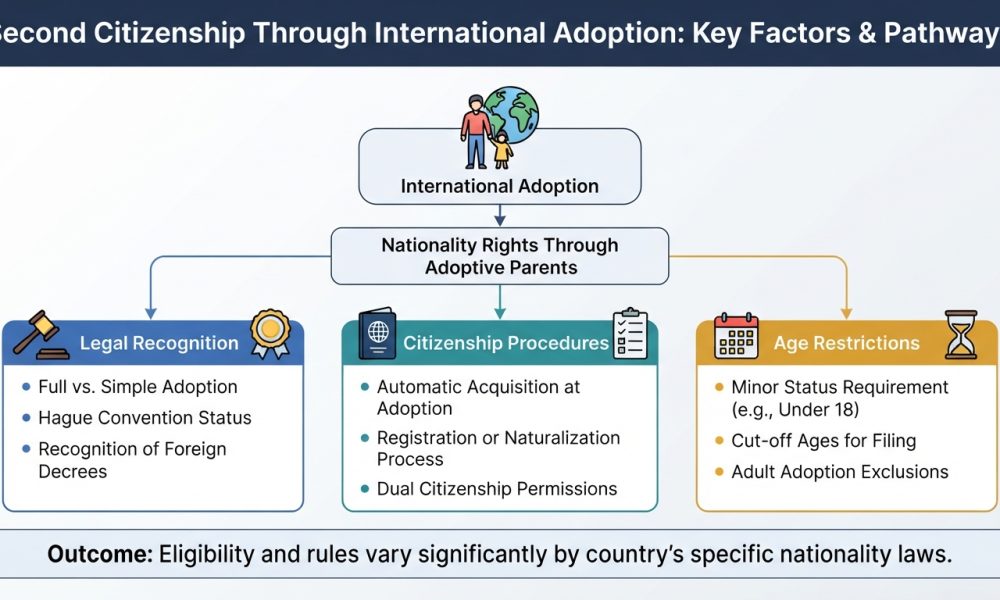
International adoption can create nationality rights through adoptive parents, but legal recognition, citizenship procedures and age restrictions differ significantly between countries.
WASHINGTON, November 16, 2026 — Children adopted across international borders may become eligible for another citizenship through their adoptive parents. Still, the outcome depends on the particular country’s nationality legislation, the legal adoption process and the child’s circumstances.
For families considering a second passport, the distinction between adoption, immigration permission and citizenship is essential, because a court order establishing parenthood does not always confer nationality or immediately authorize international travel under a new passport.
Recent government guidance in the United States, Britain and Canada illustrates sharply different approaches, making careful verification especially important for families adopting overseas and adults examining whether an earlier adoption ever established their citizenship rights.
Legal Parenthood and Nationality Are Separate Questions
An adoption order may establish a permanent parent-child relationship under family law. Still, nationality authorities separately determine whether that relationship meets the conditions for acquiring citizenship through adoption, registration, a direct grant, or subsequent naturalization.
The child may already hold citizenship through a birth parent or country of birth, and a later adoption does not automatically erase those existing connections. However, nationality retention and recognition depend on the laws of each country concerned.
Families should therefore establish the child’s current citizenship, legal parentage and immigration status before submitting a new nationality application, rather than treating a replacement birth certificate or new family surname as proof of a second citizenship.
The United States Provides Conditional Automatic Citizenship
Under the Child Citizenship Act, certain foreign-born children adopted by United States citizens acquire American citizenship automatically when statutory conditions are satisfied before their eighteenth birthday, including lawful permanent residence and residence in the citizen parent’s legal and physical custody.
The adoption must also meet the relevant immigration definition of an adopted child, including requirements for the adoption’s completion, age, and relationship, meaning neither an American parent nor a valid adoption decree alone settles every case.
The United States Department of State’s guidance for international adoptees explains the distinction between automatic acquisition under Immigration and Nationality Act Section 320 and a separate procedure available to certain qualifying children living abroad.
When families acquire citizenship automatically, they should still obtain reliable documentation, such as a certificate of citizenship or passport, because proving existing status can become difficult years later if original immigration records are incomplete.
Children Living Abroad May Need a Separate U.S. Procedure
For children who reside outside the United States with an American citizen parent, Section 322 can provide a naturalization route involving Form N-600K, provided the relevant conditions are completed before the child reaches eighteen years of age.
That pathway generally requires qualifying citizenship and custody relationships, the parent’s or eligible grandparent’s prescribed physical presence, and a properly completed procedure that may involve the child’s temporary presence in the United States for official processing.
Because the requirements differ from automatic acquisition inside the United States, adoptive parents should not assume that remaining abroad produces the same result as admission for permanent residence and living with the citizen parent domestically.
Older American Adoptees Reveal a Persistent Citizenship Gap
An Associated Press investigation into intercountry adoptees left without American citizenship documented how families sometimes completed legal adoptions without completing immigration and naturalization procedures, leaving adults exposed to serious consequences long after childhood.
The report also examined limitations in the 2000 Child Citizenship Act, which took effect on February 27, 2001, and did not retroactively confer citizenship on people who had already turned eighteen by that date.
Those cases illustrate why a familiar family relationship and decades of residence cannot substitute for a formal nationality determination, particularly when an adult discovers missing documentation while applying for employment, government benefits or a passport.
British Citizenship Depends on Adoption Recognition and Residence
British guidance updated in August 2026 explains that a child adopted under an appropriate court order in the United Kingdom can acquire British citizenship automatically when at least one adoptive parent was a British citizen at the relevant time.
Certain overseas adoptions certified under the Hague Convention can also confer British citizenship automatically when the statutory requirements are met, including applicable habitual-residence conditions involving the adoptive parent or parents at the time of adoption.
For overseas adoptions outside those automatic provisions, a child may require discretionary registration instead, and the British government examines recognition of the adoption, parental citizenship and whether relevant adoption procedures were lawfully followed.
That variation makes it unsafe to assume that a British passport held by an adoptive parent will always entitle a child adopted in another country to immediate British citizenship or travel documentation without further government review.
Canada Offers a Direct Grant Rather Than Universal Automatic Acquisition
Canada recognizes a direct-grant citizenship process for eligible people adopted abroad by Canadian citizens, but the grant is a separate government procedure and should not be confused with citizenship automatically acquired upon adoption.
An adopted child may also enter Canada as a permanent resident and later seek citizenship through an applicable naturalization route, making the family’s chosen procedure relevant to documentation and future nationality consequences.
Canadian guidance identifies adoption recognition, the adoptive parent’s citizenship at the relevant time, and applicable restrictions on transmitting citizenship as important questions, particularly for families who themselves have lived across several generations outside Canada.
Canada’s December 2025 Reform Added an Important Distinction
Changes effective December 15, 2025, addressed citizenship transmission to children born or adopted abroad, including circumstances involving Canadian parents who were themselves born or adopted outside Canada and have a sufficient connection to the country.
Under the updated rules, some such parents must demonstrate at least 1,095 days of physical presence in Canada before the child’s birth or adoption when seeking to transmit citizenship in a later generation, subject to specific exceptions.
The reform makes historical adoption dates, the parent’s citizenship history, and residence evidence consequential, so families should review the law that applies to their circumstances rather than rely on pre-reform descriptions of the first-generation limit.
The Hague Convention Does Not Create a Universal Passport
The Hague Convention on Protection of Children and Cooperation in Respect of Intercountry Adoption establishes safeguards and cooperation between participating countries. Still, participation in the treaty does not itself grant citizenship in every receiving state.
A convention-compliant adoption can have special recognition consequences under national law. Still, immigration entry, parental status, and nationality acquisition remain distinct matters that may require separate certificates, decisions, or applications after the adoption.
Parents should verify whether their case qualifies under the convention, which government issued the relevant certificate, and how the receiving country recognizes the adoption, rather than assuming an agency letter settles those legal questions.
Age Limits Can Determine Whether a Route Remains Available
The child’s age at adoption and the age at which citizenship conditions are met can independently affect eligibility, especially in systems where automatic acquisition or child registration must occur before an eighteenth birthday.
American adoption immigration definitions may also impose earlier adoption-age conditions with limited exceptions, so parents should review the entire statutory sequence rather than focusing only on when their child becomes eligible for a passport.
For adult adoptees, the availability of another route depends on the law and historical facts, and legal advice should distinguish proof of citizenship already acquired from a request for citizenship that was never secured.
A New Birth Certificate May Not Prove Citizenship
Many adoption processes create amended civil records identifying adoptive parents. Still, such documents primarily establish family relationships or civil identity and do not necessarily establish the citizenship or nationality status recognized by another government following the adoption.
The receiving country may still require the original adoption decree, evidence of the adoptive parent’s citizenship, immigration entry records, and any Hague certification, while ensuring names and dates match across all records.
Where an adoption involved a later legal name change, applicants should preserve authentic documents linking earlier and current identities, rather than attempting to conceal differences that can be explained through legitimate court and civil records.
Adoption Recognition May Differ From Immigration Recognition
A receiving country may recognize a foreign adoption for some family-law purposes without recognizing it as sufficient to automatically confer citizenship, leaving parents to pursue a separate immigration process, domestic adoption order, or nationality registration.
The precise sequence depends on whether the adoption was completed abroad or finalized after arrival, whether a convention procedure applied, and whether the child entered under an immigration category specifically designed for adopted children.
Parents should confirm that the foreign adoption was lawful in the child’s country of origin and recognized where the family will reside, because a defective or incomplete recognition process can complicate citizenship documentation even after the child joins the household.
A lawyer experienced in both intercountry adoption and nationality law can clarify those differences without promising approval, and the family should keep original decisions and certified records rather than rely solely on agency summaries.
Source-Country Citizenship Requires Its Own Assessment
Whether an adopted child retains citizenship from the country of birth or through biological parents depends on that country’s nationality law, including any provisions regarding loss, renunciation, dual nationality, or the legal effects of adoption.
An adoption might create an additional citizenship pathway without canceling an earlier citizenship. Still, families cannot assume every country recognizes dual nationality or automatically permits the child to retain and use both passports indefinitely.
The correct evaluation therefore examines both the receiving country’s acquisition rules and the original country’s retention rules, with particular care when an adopted person later reaches adulthood or seeks to pass citizenship to children.
Child Passports and Travel Consent Remain Separate
Even after citizenship is verified and a child obtains a passport, international travel may require additional parental consent or custody documentation, particularly when one adoptive parent travels alone, or the child travels with another guardian.
Amicus International Consulting’s article on Mexico’s child-passport safeguards and parental information describes how identifying responsible adults can support travel checks without replacing the separate legal rules governing consent, parental authority or departure arrangements.
Families should check the requirements of departure, transit and arrival jurisdictions, because a child’s valid passport establishes a travel identity but does not necessarily resolve every question concerning authorization to undertake a particular international journey.
Historical Adoption Records Can Be Difficult to Reconstruct
Older international adoptions sometimes occurred under procedures that differ from current safeguards, leaving adults with incomplete agency records and missing immigration documentation when they seek to establish citizenship years later.
Requests for archived adoption decrees, immigration admission records, certificates of citizenship, and source-country records should go through legitimate authorities, and any conflicting information should be investigated rather than silently altered to fit an application.
Document discrepancies may arise from translation mistakes or historical administrative practice. Still, some cases involve serious concerns about falsified origin information, making independent historical review and Protection of adoptees’ personal and legal rights especially important.
Adoption Safeguards Protect Children Against Abuse
Intercountry adoption rules are designed to protect children and families, including safeguards on consent, recognition, and preventing improper financial inducements, so nationality planning must remain secondary to a legitimate adoption process.
An arrangement created chiefly to secure a passport, bypass immigration requirements, or misrepresent a child’s parentage can raise serious legal concerns, even when paperwork appears formally complete or an intermediary promises rapid processing.
Responsible professionals should verify lawful adoption procedures and government authority at every stage, ensuring that any subsequent citizenship request follows an authentic legal relationship rather than an invented or commercially manufactured family history.
Second-Citizenship Planning Should Be Age Appropriate
A second nationality can eventually provide meaningful residence, educational and mobility options. Still, for children, the immediate priority is accurate legal status, secure family relationships and reliable identity documents rather than speculative future passport rankings.
Amicus International Consulting outlines broader second-passport advisory and international mobility planning. However, adoption-based nationality applications must be evaluated under each country’s legislation, and no private service provider or intermediary can guarantee them.
Parents should request a written explanation of which law applies, whether the child already acquired citizenship, what application is still necessary, and which specific legal deadlines could affect eligibility before making substantial financial commitments to an agency or consultant.
Adult Adoptees Should Not Assume Their Status Was Completed
An adult raised by citizen parents may reasonably believe citizenship followed automatically from adoption. Yet the legal answer can turn on historical entry categories, adoption dates, and whether statutory conditions were ever fulfilled during childhood.
If the record is uncertain, a careful status review should begin with official immigration and citizenship files, followed by qualified legal guidance before taking steps that could jeopardize lawful residence or complicate an unresolved case.
The goal is to distinguish an existing citizenship that needs documentation from an unavailable automatic claim or a potentially available naturalization procedure, rather than offering reassurance based only on family photographs or an amended birth certificate.
Citizenship May Affect the Next Generation
For an adopted person who becomes a citizen, future ability to transmit that nationality to children may depend on whether citizenship was acquired automatically, by direct grant, registration or naturalization, and on the country’s rules governing descent abroad.
Canadian law illustrates the significance of those distinctions, because the rules for transmitting citizenship to a later foreign-born or foreign-adopted generation can involve parental physical presence in Canada and the legal basis for the parent’s citizenship.
British guidance likewise distinguishes citizenship acquired through certain qualifying adoptions from other nationality routes, while recognizing that the parent’s citizenship category may affect whether citizenship can be passed to a future child abroad.
Families should therefore avoid treating the first passport as the end of all nationality questions. They should preserve evidence of how citizenship was obtained for later use in their children’s education, residence planning, and future family applications.
The Practical Path Begins With Verified Legal Facts
Families assessing an adoption-related second citizenship should identify the adoption date and type, the child’s age, each parent’s nationality, applicable residence conditions, and any immigration entry history before selecting a citizenship process.
They should also confirm whether the receiving country recognizes the adoption for nationality purposes, what evidence it accepts, and whether the child’s original citizenship remains valid, since no single international rule answers these questions.
A successful outcome can give an adopted person an additional nationality and the rights that lawfully accompany it. Still, those benefits depend on recognized adoption, accurate documentation, and completion of the requirements imposed by the relevant government.
The enduring lesson from different national systems is that adoption can open a citizenship pathway without automatically completing it, making early legal verification and careful preservation of records essential safeguards for children and adult adoptees alike.




