
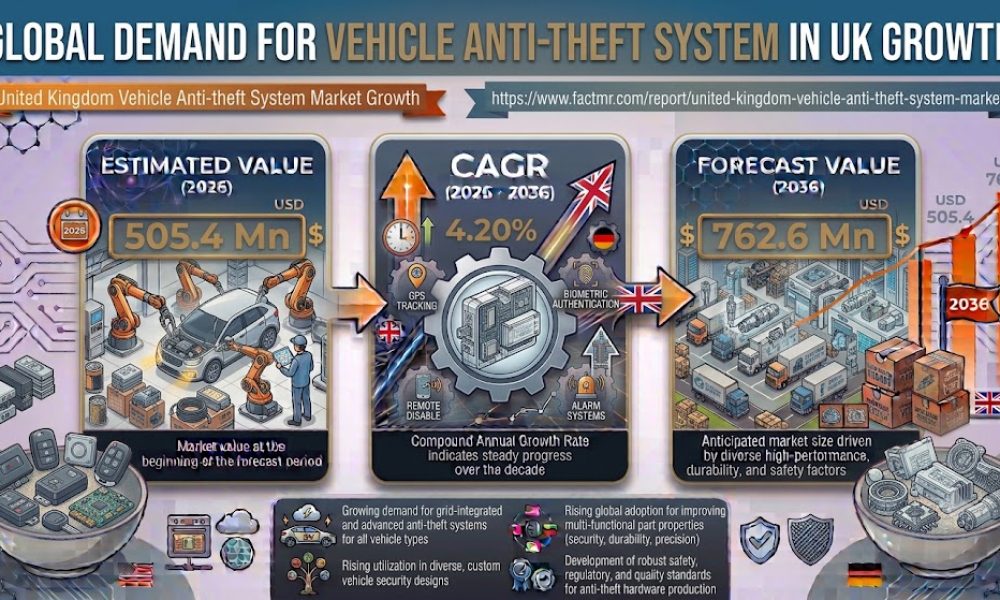
The Demand for Vehicle Anti-theft System in UK is projected to grow from USD 505.4 million in 2026 to USD 762.6 million by 2036, registering a 4.2% CAGR during the forecast period. The market was valued at USD 485.0 million in 2025, creating an absolute dollar opportunity of approximately USD 257.2 million through 2036.
The UK vehicle anti-theft system market covers electronic immobilizers, alarm systems, and GPS-based tracking devices used in passenger and commercial vehicles. Demand is supported by vehicle theft risks, insurance-related security requirements, connected-car adoption, and the need to protect vehicles against increasingly sophisticated theft methods.
Get Detailed Market Forecasts, Competitive Benchmarking, and Pricing Trends: https://www.factmr.com/connectus/sample?flag=S&rep_id=12319
Key Market Segments
- Immobilizers lead the technology segment with a 52.8% share in 2026. Their mandatory role in new vehicle security and their ability to prevent unauthorized engine starting support their leading position.
- Passenger vehicles account for 74.5% of demand, making them the dominant application segment. The large passenger-car population and higher theft exposure of premium and urban vehicles support demand.
- OEM-fitted systems represent 68.4% of the sales channel, reflecting the growing integration of security functions into vehicle electronic architectures during production.
Vehicle Theft Risk Keeps Security Demand High
Vehicle theft remains a major consideration for UK vehicle owners, automakers, insurers, and security providers. The growing sophistication of theft techniques is encouraging manufacturers to strengthen both physical and electronic protection.
One major concern is the rise of keyless vehicle theft through relay attacks. These attacks have created demand for signal-blocking solutions, motion-sensing immobilizers, and other technologies designed specifically to protect keyless vehicles.
The market is also influenced by Thatcham Research security ratings, which affect insurance group classifications. Better-rated security systems can support lower insurance premiums, giving vehicle manufacturers and owners a direct financial reason to invest in certified protection.
Immobilizers Remain the Foundation of Vehicle Security
Immobilizers hold the largest technology share because they directly prevent the engine from starting without an authorized digital key or token.
Modern systems are moving beyond fixed-code designs toward rolling-code and cryptographic solutions that address code-grabbing and relay attacks. Their integration with vehicle communication systems and engine-control electronics also makes them more difficult to bypass.
The aftermarket is creating an additional opportunity. Owners of older vehicles can install secondary immobilizers to strengthen factory security, particularly in areas with higher theft rates.
The report also points to smartphone-based digital keys and covert immobilizer technologies as areas of continuing development.
Connected Telematics Expand the Market
Vehicle security is increasingly connected with telematics. Tracking devices can provide real-time location information, geofencing alerts, remote immobilization functions, and stolen-vehicle recovery support.
This is creating a broader market for security products combined with recurring connected services. OEMs and specialist providers can generate additional value by integrating anti-theft functions with remote diagnostics, emergency assistance, and mobile applications.
GPS tracking is identified as the fastest-growing aftermarket technology category. Insurance incentives are helping strengthen demand, particularly for high-value vehicles and models with greater theft exposure.
OEM Integration Dominates Sales
OEM-fitted systems account for 68.4% of market revenue. Security is increasingly treated as part of the vehicle’s electronic architecture rather than a separate accessory.
Continental and Bosch are highlighted as major OEM-integrated suppliers. Their systems can combine immobilization, access control, connected services, and stolen-vehicle tracking within a broader electronic architecture.
Aftermarket suppliers continue to serve the existing vehicle population. Their focus includes tracking devices, additional immobilizers, alarms, and other solutions that can be installed after the vehicle has been sold.
The two channels serve different needs. OEM systems support new-vehicle security by design, while aftermarket products address upgrades and additional protection for vehicles already on the road.
Insurance and Certification Shape Purchasing
The UK market has a strong connection between security performance and insurance costs. Thatcham Research assessments influence insurance classifications, which can affect the cost of ownership for vehicle buyers.
This makes certification an important competitive factor. Security providers need to design products that meet relevant assessment requirements while also demonstrating protection against modern theft techniques.
The insurance relationship also encourages aftermarket adoption. Owners of higher-risk vehicles may consider approved tracking or immobilization systems when the potential reduction in insurance costs helps justify the purchase.
Regional Performance Across the UK
- England: Demand is forecast to grow at a 4.5% CAGR, the fastest rate among the four UK regions. High vehicle density, major theft hotspots, premium vehicle ownership, and a mature security ecosystem support strong demand.
- Scotland: Growth is projected at 4.1% CAGR. Police-industry cooperation, demand for tracking systems, commercial vehicle activity, and the need for resilient solutions in remote areas support the market.
- Wales: The market is expected to advance at 3.8% CAGR. Transport corridors, port activity, vehicle-security initiatives, and a relatively older vehicle population support demand.
- Northern Ireland: Growth is forecast at 3.5% CAGR, the lowest among the four regions. Cross-border theft patterns, all-island insurance considerations, and commercial vehicle security needs shape demand.
Market Drivers and Constraints
The leading growth factors include rising vehicle theft, increasing keyless-entry vulnerabilities, insurance-linked security requirements, and wider use of connected telematics.
Another important trend is the move toward cybersecurity. As vehicles become more software-driven, security providers must address both physical theft and digital intrusion.
The market faces challenges from high system costs, rapidly changing theft techniques, continuous software and hardware upgrades, and consumer underinvestment in supplementary protection.
For aftermarket suppliers, accredited installer networks are also important because professional installation, technical support, warranty service, and product availability influence purchasing decisions.
Competitive Landscape
The UK vehicle anti-theft system industry includes global automotive electronics suppliers, specialist security companies, and aftermarket installation networks.
Key companies profiled by Fact.MR include Continental AG, Robert Bosch GmbH, Lear Corporation, Valeo, Tokai Rika Co., Ltd., Mitsubishi Electric Corporation, VOXX International Corporation, Marquardt GmbH, U-Shin Ltd., Scorpion Automotive Ltd., Tracker Network, Meta System S.p.A., and Autowatch UK Ltd.
Continental AG and Robert Bosch GmbH are positioned strongly in the OEM-integrated segment, where security systems are incorporated into vehicle electronics during development.
Valeo and Tokai Rika compete across replacement components and independent repair channels, while Scorpion Automotive and Tracker Network have stronger specialist positions in aftermarket vehicle security and tracking.
Competition is increasingly based on technology integration, Thatcham certification, cybersecurity capability, tracking performance, installer networks, and connected service models.
Analyst Perspective
Fact.MR’s analysis positions the UK vehicle anti-theft system market around a strong interaction between vehicle security ratings, insurance economics, theft trends, and connected vehicle technology.
The market is not driven only by voluntary consumer spending. Security requirements incorporated into vehicle design provide a baseline demand for immobilizers and other electronic systems, while rising theft risks create additional demand for aftermarket protection.
The report also points to a continuing technology shift. As keyless-entry systems become more common, suppliers are developing specific countermeasures against relay attacks and other electronic theft methods.
Tracking systems offer another growth path because they combine theft prevention with vehicle recovery. This makes them relevant to consumers, insurers, fleet operators, and law-enforcement agencies.
Report Coverage
The Fact.MR study analyzes the Demand for Vehicle Anti-theft System in UK across technology, application, sales channel, and region.
Technology categories include immobilizers, alarm systems, and tracking devices.
Application categories cover passenger vehicles and commercial vehicles.
Sales channels include OEM-fitted and aftermarket installations.
Regional analysis covers England, Scotland, Wales, and Northern Ireland.
The report covers electronic vehicle anti-theft systems designed to prevent unauthorized access, deter theft, and support stolen-vehicle recovery. It excludes mechanical steering locks, gear locks, wheel clamps, vehicle insurance products, parking-facility CCTV, and general home security systems.
Fact.MR uses a hybrid top-down and bottom-up methodology, supported by primary discussions with procurement and operations professionals, regulatory records, standards documents, corporate reports, and public industry filings.
Explore More Related Studies Published by Fact.MR Research:
Hybrid Marine Capstans Market
Industrial DataOps Frameworks Market
About Fact.MR
Fact.MR is a global market research and consulting firm, trusted by Fortune 500 companies and emerging businesses for reliable insights and strategic intelligence. With a presence across the U.S., UK, India, and Dubai, we deliver data-driven research and tailored consulting solutions across 30+ industries and 1,000+ markets. Backed by deep expertise and advanced analytics, Fact.MR helps organizations uncover opportunities, reduce risks, and make informed decisions for sustainable growth.



