
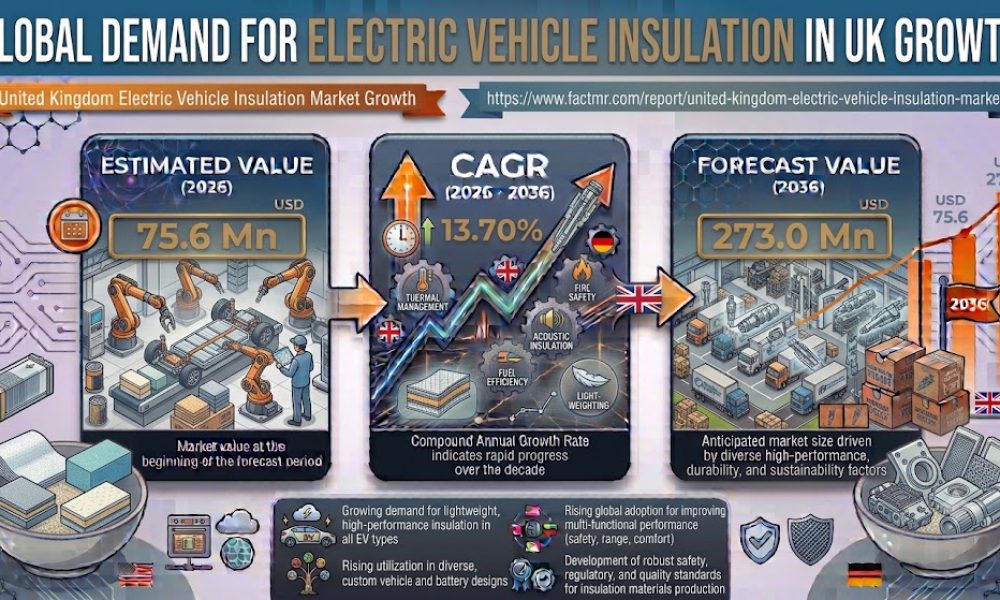
The Demand for Electric Vehicle Insulation in UK is projected to grow from USD 75.6 million in 2026 to USD 273.0 million by 2036, registering a 13.7% CAGR during the forecast period. The market was valued at USD 66.5 million in 2025, creating an absolute dollar opportunity of approximately USD 197.4 million between 2026 and 2036.
Electric vehicle insulation includes thermal, electrical, and acoustic insulation materials installed in battery packs, power electronics, and electric motor assemblies. These materials help manage heat, prevent electrical discharge, and reduce cabin noise in hybrid and electric vehicles.
Get Detailed Market Forecasts, Competitive Benchmarking, and Pricing Trends: https://www.factmr.com/connectus/sample?flag=S&rep_id=12431
Key Market Segments
- Foamed plastics lead the material segment with a 61.3% share in 2026. Their combination of low weight and thermal and acoustic insulation properties makes them suitable for automotive production.
- Electrical insulation accounts for 49.7% of demand. High-voltage battery systems require insulation at critical electrical interfaces to support safe vehicle operation.
Rising EV Production Supports Insulation Demand
The UK’s 2035 zero-emission vehicle mandate is supporting the expansion of electric vehicle production and assembly. As the number of EV platforms increases, demand for insulation materials rises across battery packs, power electronics, and motor assemblies.
Electric vehicles require more insulation content per vehicle than conventional internal combustion engine vehicles. High-voltage systems need electrical isolation, batteries require thermal management, and electric drivetrains create different acoustic conditions inside the cabin.
The move from 400V toward 800V battery architectures is adding another specification requirement. Higher voltage systems require stronger dielectric performance from electrical insulation materials.
Electrical Insulation Remains a Core Requirement
Electrical insulation represents 49.7% of demand in 2026. Its importance is directly linked to high-voltage battery connections, electrical interfaces, power electronics, and other components where insulation resistance is essential.
As EV battery voltages increase, manufacturers are evaluating materials that combine high dielectric performance with low weight and long-term durability.
Thermal insulation is also important because battery cells and power electronics generate heat during charging and operation. Acoustic insulation provides a separate application area as EVs produce less engine noise than conventional vehicles, making road, tire, motor, and drivetrain sounds more noticeable to passengers.
Foamed Plastics Hold the Leading Material Position
Foamed plastics account for 61.3% of the market in 2026, making them the leading material category.
Their established use in automotive manufacturing supports adoption. Foamed plastic materials can provide thermal and acoustic insulation while keeping additional vehicle weight relatively low.
Ceramics and thermal interface materials are also relevant in demanding battery applications. These materials can be considered where temperature management or higher thermal performance becomes the primary engineering requirement.
Higher Voltage Platforms Create New Opportunities
The shift toward 800V and higher-voltage EV architectures creates a specification upgrade cycle for insulation suppliers.
Material suppliers need to develop insulation products that meet higher dielectric requirements while remaining compatible with automotive manufacturing processes. This creates opportunities for suppliers with established qualification capabilities and automotive-grade material portfolios.
Multi-functional insulation is another opportunity. Materials that provide electrical, thermal, and acoustic functions in a single solution can help vehicle manufacturers reduce component complexity and simplify assembly.
The report also identifies the need for UK-based production or warehousing as an important strategic consideration because domestic vehicle assembly operations rely on reliable component availability and short delivery cycles.
Regional Performance Across the UK
- England: Demand is forecast to grow at a 17.8% CAGR, the fastest rate among the four UK regions. Extensive automotive infrastructure and manufacturing activity support the region’s leading position.
- Wales: Growth is projected at 17.2% CAGR. Automotive modernization and manufacturing activity are supporting demand for EV insulation technologies.
- Northern Ireland: The market is expected to advance at 16.9% CAGR. Expanding automotive facilities and regional manufacturing development are contributing to adoption.
- Scotland: Growth is forecast at 13.7% CAGR, the lowest among the four regions. Established automotive infrastructure and specialist operations continue to provide a base for market development.
Market Drivers and Constraints
The UK’s zero-emission vehicle mandate remains a major demand driver. Growing EV production increases the amount of insulation required across batteries, motors, and power electronics.
The transition toward higher battery voltages is creating additional demand for high-performance electrical insulation. Acoustic requirements are also gaining importance because EV cabins expose passengers to different noise sources than conventional vehicles.
The market faces challenges from alternative insulation technologies, specialist thermal validation requirements, material costs, and regulatory considerations. Suppliers must demonstrate that their products can maintain performance under automotive thermal, electrical, and operating conditions before large-scale adoption.
Competitive Landscape
The UK electric vehicle insulation market includes material manufacturers, thermal-management specialists, and automotive-component suppliers.
Key companies profiled by Fact.MR include Saint-Gobain S.A., Parker Hannifin Corporation, Elkem Silicones, Knauf Industries, BASF SE, Zotefoams Plc, 3M Company, Elmelin Ltd., Pyrophobic Systems Ltd., and Morgan Advanced Materials.
Saint-Gobain S.A. leads the competitive landscape with an estimated 16.2% market share. The company has capabilities across insulation materials and automotive applications.
Parker Hannifin Corporation provides engineered materials and thermal-management solutions. Elkem Silicones supplies silicone-based materials, while Knauf Industries and Zotefoams have expertise in polymer and foam technologies.
BASF SE, 3M Company, Elmelin Ltd., Pyrophobic Systems Ltd., and Morgan Advanced Materials add capabilities across specialty insulation, electrical protection, thermal management, and advanced materials.
Competition is centered on insulation performance, weight, durability, application compatibility, technical validation, and supply reliability.
Analyst Perspective
Fact.MR’s analysis describes the UK EV insulation market as a fast-growing automotive materials category because electric vehicles require substantially more insulation content than conventional vehicles.
A battery-electric vehicle requires electrical insulation at high-voltage interfaces, thermal insulation around battery systems, and acoustic insulation to manage cabin noise. This creates several insulation requirements within a single vehicle platform.
The analysis identifies foamed plastics as the leading material because they offer a balance of insulation performance, weight, and cost. Ceramics and thermal interface materials are gaining attention for higher-performance battery applications where thermal control is a primary requirement.
For suppliers, the report points to three priorities: developing materials suitable for 800V and higher architectures, providing multi-functional insulation solutions, and supporting automotive manufacturers with reliable local supply and technical validation.
Report Coverage
The Fact.MR study analyzes the Demand for Electric Vehicle Insulation in UK across material, product, end use, and region.
Material categories include foamed plastics, ceramics, thermal interface materials, and others.
Product categories include electrical insulation, thermal insulation, and acoustic insulation.
End-use categories cover hybrid electric vehicles, battery electric vehicles, plug-in hybrid EVs, and fuel cell EVs.
Regional analysis covers England, Scotland, Wales, and Northern Ireland.
The report covers insulation materials and components installed in electric and hybrid vehicles to manage heat dissipation, prevent electrical discharge, and reduce cabin noise transmission from electric drivetrains and battery systems.
It excludes conventional ICE vehicle insulation, building and construction insulation, industrial process insulation, and raw insulation polymer resins sold as commodity inputs.
Fact.MR uses a hybrid top-down and bottom-up methodology, supported by primary discussions with procurement and operations professionals, regulatory records, standards documents, corporate reports, and public industry filings.
Explore More Related Studies Published by Fact.MR Research:
About Fact.MR
Fact.MR is a global market research and consulting firm, trusted by Fortune 500 companies and emerging businesses for reliable insights and strategic intelligence. With a presence across the U.S., UK, India, and Dubai, we deliver data-driven research and tailored consulting solutions across 30+ industries and 1,000+ markets. Backed by deep expertise and advanced analytics, Fact.MR helps organizations uncover opportunities, reduce risks, and make informed decisions for sustainable growth.



