
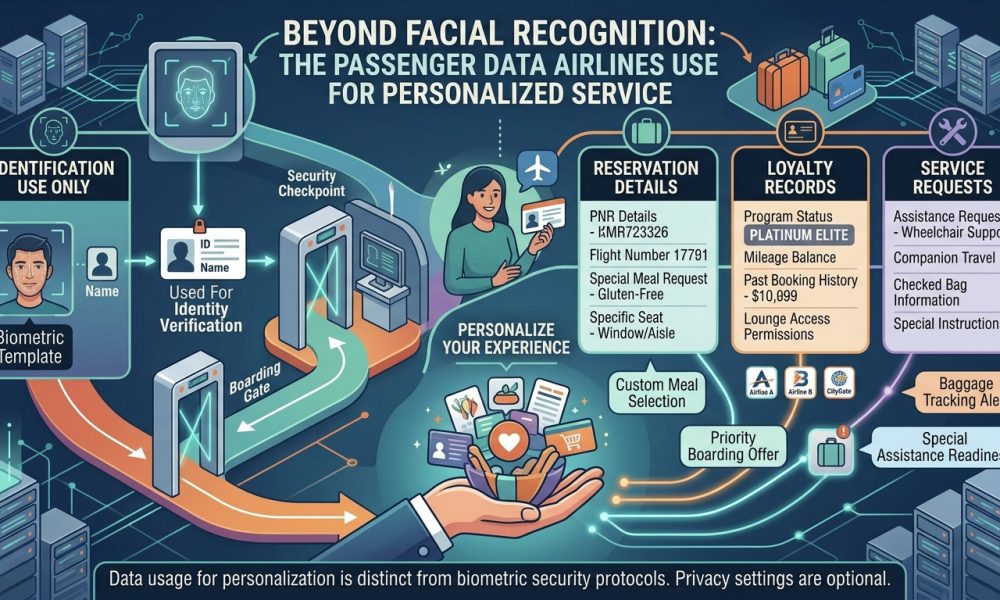
Reservation details, loyalty records, and service requests provide a separate source of information for customer care.
WASHINGTON, DC, October 7, 2026 — Facial recognition has become one of the most visible technologies in modern air travel. Yet, airlines can recognize passenger needs and personalize service through extensive reservation, loyalty, preference, and customer-service information that exists independently of the biometric systems at airport checkpoints.
Long before a traveler approaches a facial-recognition Camera, an airline may already know the passenger’s itinerary, seat assignment, loyalty status, previous transactions, requested assistance, meal preferences, baggage arrangements, and other details supplied while purchasing, managing, or preparing for the journey.
These conventional passenger records can help airline employees deliver personalized service without identifying someone through facial geometry, demonstrating why biometric recognition should be distinguished carefully from the much broader customer information systems that commercial carriers have used for decades.
Airlines Already Know Considerable Information From the Reservation
Every airline reservation creates an operational record containing the information needed to transport the passenger, starting with fundamental details such as the traveler’s name, itinerary, flight numbers, travel dates, contact information, ticket characteristics, and other booking-related information.
Depending on the journey and applicable government requirements, that reservation can also contain passport information, nationality, date of birth, known traveler numbers, redress information, and other identifying details needed to satisfy security, immigration, or transportation requirements before the passenger can travel.
These records allow an airline to recognize that a particular customer is expected on a particular flight without requiring facial recognition, because reservation systems already connect the traveler’s identity with specific services, purchases and operational requirements associated with the journey.
When airline employees address a passenger by name, recognize an upcoming connection, or know a customer requested a particular service, that information often comes from the reservation environment rather than from biometric surveillance inside the airport.
Loyalty Programs Add a Longer Customer History
Frequent-flyer programs create another major source of personalization because they can link individual trips to a continuing customer account containing travel history, loyalty status, mileage activity, benefit selections, and other information accumulated across many transactions.
When a passenger provides a loyalty number during booking, the airline can associate the reservation with that existing profile, giving customer-facing systems access to information that can affect priority services, upgrades, lounge access, and other benefits available under the program.
Delta’s current Global Privacy Policy explains that information connected with SkyMiles participation can include membership status, program activity, flight information, benefit choices, transactions, and other account information that may be used to provide services and tailor aspects of the customer experience.
This form of recognition differs from facial recognition because the airline identifies a known customer through account and reservation information rather than converting a live facial Image into data for comparison against a stored or government-held reference photograph.
Personalization Can Begin With Something as Simple as a Seat Preference
Airlines can use comparatively ordinary information to personalize journeys, including whether a traveler prefers an aisle, window, or other seat position, particularly when that preference is saved in a loyalty profile or deliberately provided while managing a reservation.
This information can support automated seat recommendations, reservation changes, or notifications when a preferred location becomes available, allowing the airline to provide individualized assistance based entirely on stated customer preferences rather than biometric characteristics.
American Airlines demonstrated this type of personalization in September 2026 when it introduced an Application feature allowing eligible AAdvantage members to specify desired seat characteristics, after which the system can automatically move the passenger when an eligible matching seat becomes available before departure.
That development illustrates an important distinction in the broader debate about airline data: personalization does not necessarily require highly sensitive biometric processing when reservation and loyalty systems already contain information that can make a journey feel substantially more individualized.
Special Service Requests Provide Operationally Important Information
Passenger records can also include special service requests that tell airlines what assistance is needed during travel, including wheelchair support, mobility considerations, traveling with certain medical equipment, assistance for passengers with visual or hearing impairments, and other services requiring advance coordination.
These records serve an operational purpose because airports and airlines need time to arrange personnel, equipment, and procedures that allow passengers requiring additional assistance to move safely between check-in, security, gates, aircraft, and connecting flights.
Employees reviewing a flight or passenger manifest can therefore identify that a particular traveler requires assistance without performing any facial-recognition search, because the service request has already been associated with the reservation before the passenger arrives.
Some of this information can be sensitive, particularly when it relates to health or disability, which is why travelers should understand that ordinary airline customer-service systems can sometimes contain personal information requiring careful Protection even when no biometric technology is involved.
Meal and Dietary Requests Can Become Part of the Passenger Record
On routes where airlines provide advance meal selection or accommodate special dietary requests, a passenger’s reservation can contain information indicating that a particular meal must be loaded and delivered to the correct seat during the flight.
Such information can include vegetarian, religious, allergy-related, medical, or other dietary requests, depending upon the services available and what the passenger voluntarily provides when making or updating the booking.
These details help cabin crews deliver the correct service without needing to identify travelers biometrically, because the airline already knows which passenger occupies a particular seat and which requested product or accommodation has been associated with that person’s reservation.
The example illustrates why discussions about airline privacy should extend beyond facial recognition, since personal information voluntarily supplied for customer care can sometimes reveal more about an individual’s needs or preferences than a temporary Image captured for automated identity verification.
Customer Service Records Can Provide Important Context
When passengers contact an airline about a schedule change, missed connection, refund, baggage issue or other problem, the resulting customer-service interaction can create another source of information that employees may consult when assisting the traveler later.
That history can help an agent understand that a passenger has already experienced a disruption, received a particular accommodation, or contacted another department, reducing the need for the customer to explain the entire situation during subsequent interactions repeatedly.
From the passenger’s perspective, this continuity can feel highly personalized because the employee appears to understand the traveler’s circumstances immediately, even though the recognition may come entirely from notes and transaction records displayed within the airline’s service platform.
A sophisticated customer-care system therefore does not need to identify a passenger through a Camera to create an individualized experience, because reservation and interaction histories can supply substantial contextual information whenever the traveler authenticates an account or presents a booking.
Disruption Management Depends Heavily on Existing Passenger Data
Flight cancellations, delays, and missed connections show clearly why airlines maintain detailed passenger information, because carriers must determine who is affected, where those travelers are going, and what rebooking options exist when normal operations deteriorate.
Reservation systems can identify connecting flights, final destinations, traveling companions, ticket conditions, loyalty status, and other factors that may influence the options presented to individual passengers during an operational disruption.
American Airlines’ current privacy policy specifically describes using booking contact information to communicate with travelers during delays, cancellations, and other service disruptions. Also, it explains broader uses of reservation, loyalty, and travel information to deliver and personalize airline services.
The ability to send a relevant notification or automatically propose a new itinerary can therefore represent personalization driven by operational records rather than biometric identity, even though both technologies may appear within the same increasingly digital airport environment.
Loyalty Status Can Influence the Service Employees See
Airline systems commonly display loyalty status and associated benefits when employees manage reservations, meaning a customer-service representative can immediately know whether a traveler qualifies for priority handling, preferred seating, upgrades, or other program benefits.
The information can also affect how automated systems present choices, since available benefits may vary by membership level, ticket type, route, and other conditions tied to the individual reservation.
This does not necessarily mean the airline is making a subjective Judgment about the passenger, because many benefits flow directly from published loyalty-program rules that systems apply whenever an eligible customer attaches the appropriate membership account to a booking.
Nevertheless, loyalty data creates a recognizable passenger profile that can persist across years of travel, making it an important component of airline personalization even though it is fundamentally separate from biometric Identification.
Mobile Applications Create Another Layer of Passenger Information
Modern airline applications give passengers extensive control over check-in, boarding passes, baggage tracking, seat changes, upgrades, and disruption management, while simultaneously generating information about how customers interact with those digital services.
Depending on the airline, privacy settings, and permissions granted by the user, applications can process information about device characteristics, account activity, location-enabled services, browsing behavior, reservations, and other digital interactions needed to provide or improve functionality.
Airlines can use that information to tailor what passengers see in their applications, presenting upcoming journeys, check-in reminders, airport information, baggage status, and offers that match the traveler’s reservation and program profile.
This type of personalization can sometimes appear remarkably intelligent because the Application knows where the passenger is in the travel process. Still, the underlying information may come directly from itinerary data and Application activity rather than continuous biometric Identification.
Airport Employees Can Receive a Consolidated Passenger View
Behind the scenes, airlines increasingly want to give employees consolidated customer information so an agent at a gate, lounge, or service desk can understand relevant aspects of the passenger’s journey without navigating numerous disconnected systems.
A useful customer profile might show the present itinerary, previous disruptions, connecting flights, loyalty status, baggage information and outstanding service requests, giving the employee enough context to provide more relevant assistance during a short airport interaction.
The experience can create the impression that the employee personally remembers the traveler, especially when a staff member immediately recognizes a connection problem or accommodation request, even if that recognition comes entirely from information displayed on an internal screen.
Airlines value this continuity because passengers often interact with multiple employees across large airports, and consistent, relevant information can make separate encounters feel more like one coordinated customer-service relationship.
Facial Recognition Performs a Much Narrower Function
Biometric systems generally answer a much more focused question: whether a newly captured facial Image sufficiently matches an expected reference photograph, supporting identity verification at designated checkpoints where confirming a person’s identity serves an operational or governmental purpose.
That capability differs considerably from a loyalty or reservation platform that knows a passenger prefers an aisle seat, requested wheelchair assistance, or has a connecting flight scheduled shortly after arrival.
Facial recognition can help establish that the person standing at a particular location is the expected traveler. At the same time,e conventional airline databases provide the contextual information needed to understand what services, preferences, and itinerary conditions apply to that traveler.
The distinction matters because public discussions sometimes attribute sophisticated airline personalization to biometrics, when most of the information used to deliver customer service comes from systems that existed long before airports began deploying facial comparison extensively.
A Passenger Name Record Can Connect Many Elements of a Journey
The Passenger Name Record, commonly described as a PNR, serves as an important operational foundation because it allows travel-related information connected to a booking to move among reservation systems, carriers, and other organizations involved in delivering a particular itinerary.
Depending upon how a journey was purchased and structured, the record can include booking references, flight segments, contact information, ticketing information, and service-related messages needed by the organizations responsible for transporting the passenger.
PNRs can become particularly complex when itineraries involve multiple airlines, travel agencies or connecting journeys, which means the data required to coordinate travel can extend well beyond the limited information visible on a boarding pass.
This environment existed decades before modern facial recognition became widespread, reminding us that aviation has always depended heavily on information systems that can link individual passengers to detailed operational records.
Partners Can Also Become Part of the Information Environment
Airline loyalty programs often extend beyond flights through relationships with hotels, rental-car providers, credit-card companies, and other commercial partners, creating opportunities for customers to earn or redeem rewards across a wider travel ecosystem.
When passengers deliberately connect loyalty accounts with participating partners, information about qualifying transactions can flow into the airline program according to the applicable terms and privacy practices governing those relationships.
This does not mean every commercial partner receives unlimited access to an airline’s passenger records, because information sharing can be limited to specific transactions and program purposes. At the same time, participating organizations maintain their own privacy responsibilities.
Travelers seeking to understand personalization should nevertheless recognize that loyalty ecosystems can involve information originating outside the airline itself, particularly when customers actively use their membership number across hotels, credit cards, shopping services, or other participating businesses.
Not Every Personalized Interaction Is Based on Historical Profiling
Some airline personalization is straightforward because the carrier responds to information a passenger supplies specifically for the current trip, such as a seat request, special meal, or notification preference.
A customer receiving an aisle seat after requesting one should not automatically assume the airline conducted extensive behavioral analysis, since the service may result directly from an explicit preference entered during booking or saved within the passenger’s account.
Similarly, receiving information about a connecting gate or baggage carousel reflects the airline’s knowledge of the current itinerary rather than necessarily representing a sophisticated prediction about the passenger’s behavior.
Distinguishing these direct service uses from broader analytical personalization can help travelers evaluate privacy more accurately, since not every apparently individualized experience depends upon extensive customer profiling.
Data Can Also Be Used to Anticipate Preferences
More advanced systems can combine previous transactions, travel patterns and customer communications to estimate which services a passenger may value, potentially allowing airlines to provide recommendations or offers that reflect earlier behavior.
Delta’s privacy disclosures, for example, explain that the airline can tailor products and services by considering previous travel, transactions,s and communications, illustrating how personalization can move beyond information explicitly supplied for one particular journey.
These analytical processes remain separate from facial recognition because the system does not need a live biometric Image to evaluate historical reservation behavior. However, the resulting passenger profile can still raise important questions about transparency and customer expectations.
Travelers should therefore distinguish biometric privacy from broader data privacy, since an airline could theoretically eliminate every facial-recognition Camera tomorrow while still possessing extensive information that supports sophisticated personalization.
Some Information Is Required Rather Than Optional
Another important distinction concerns why passenger information enters airline systems, because some details are supplied voluntarily for convenience while others must be collected to satisfy government, safety, or transportation requirements.
A passenger may voluntarily provide a loyalty number or seat preference. In contrast, information required for Secure Flight, international passenger processing, or other regulatory obligations may be necessary before the airline can transport the traveler.
These differences affect how passengers should interpret privacy controls, because declining personalized marketing is not equivalent to refusing information a carrier must obtain to satisfy legal requirements associated with the journey.
Understanding the purpose behind each category of information therefore provides a more useful privacy framework than treating every item an airline stores as though it were collected for the same reason.
Passport Information Can Exist Without Facial Recognition
International reservations often require passport-related information so airlines can transmit required passenger data, assess documentation conditions, and meet government reporting obligations tied to travel between countries.
Passport information in an airline reservation does not necessarily indicate that facial recognition has occurred, because the document details can support standard check-in and border processes without any live biometric comparison.
Likewise, passengers can encounter biometric boarding systems that rely upon government-held passport photographs without the airline necessarily receiving or retaining the same biometric information used during the underlying facial comparison.
Modern passports contain layered physical and electronic security mechanisms, and Amicus International Consulting examined these systems in its detailed guide to passport security and identity verification, which explains how secure document records support increasingly digital travel environments.
Data Minimization Remains an Important Privacy Principle
Airlines need substantial information to transport passengers safely and reliably, but legitimate operational purposes do not eliminate the importance of limiting information collection, controlling access, and establishing appropriate retention practices.
Passengers reasonably expect carriers to protect reservation records, loyalty accounts, payment information and service requests against unauthorized access, particularly because combining multiple categories of information can create a detailed picture of an individual’s travel behavior.
Security considerations therefore extend far beyond facial-recognition templates, because traditional airline databases can contain financially valuable and personally sensitive information whose compromise could expose travelers to fraud, account takeover or other harms.
Strong Authentication, employee access controls, encryption, monitoring and clear privacy governance remain important regardless of whether an airline uses facial recognition, since conventional passenger records represent valuable information in their own right.
Personalized Service and Biometric Identity Should Remain Distinct Concepts
Airlines increasingly describe future travel as personalized, seamless, and digital. Still, those terms can obscure important technical distinctions when passengers assume that every individualized service depends upon the airline recognizing their face.
A traveler can receive a preferred seat, appropriate meal, disruption notification, connecting-flight assistance, and loyalty benefits entirely through reservation and account information without participating in a biometric identity program.
Facial recognition becomes relevant when organizations need to determine whether the person physically present at a particular checkpoint matches the expected traveler, a narrower identity-verification function than the broader task of providing personalized customer service.
Keeping these concepts separate lets passengers evaluate both systems more intelligently, because someone may feel comfortable letting an airline remember a seat preference while reaching a different conclusion about participating in optional biometric processing.
The Future Passenger Experience Will Combine Multiple Information Sources
Modern aviation is moving toward an environment where reservation data, loyalty information, mobile applications, airport systems and biometric identity services can operate alongside one another, creating a passenger journey that feels increasingly coordinated from booking through arrival.
That coordination can improve convenience when airlines use relevant information responsibly, particularly by reducing repetitive questions, anticipating service needs, providing timely disruption assistance, and allowing employees to understand the traveler’s immediate circumstances more quickly.
However, the increasingly integrated experience makes transparency more important because passengers should be able to understand whether a particular service resulted from information they deliberately supplied, historical activity associated with their loyalty account or biometric technology operating at a designated identity checkpoint.
Recognizing those distinctions prevents facial recognition from becoming an inaccurate shorthand for every form of airline personalization, while also encouraging more precise discussions about what information airlines possess and why they use particular categories of data.
Airlines Can Know the Customer Without Recognizing the Face
For travelers navigating an increasingly digital aviation system, the most important distinction is that an airline does not need to recognize someone’s face to know a considerable amount about the journey that person has purchased and the services they expect to receive.
The reservation can explain where the traveler is going, the loyalty profile can identify eligible benefits, service requests can describe assistance requirements, and Application activity can help deliver timely information throughout the passenger’s trip.
Facial recognition adds another capability by helping confirm that the individual at a specific airport location matches an expected identity. Still, that biometric function remains fundamentally different from the extensive customer-care information already supporting personalized airline operations.
As airlines continue developing more individualized travel experiences, understanding that distinction will help passengers ask more precise privacy questions, separating the narrow issue of biometric Identification from the much broader world of reservation, loyalty, and service information that has shaped airline customer care for many years.




