
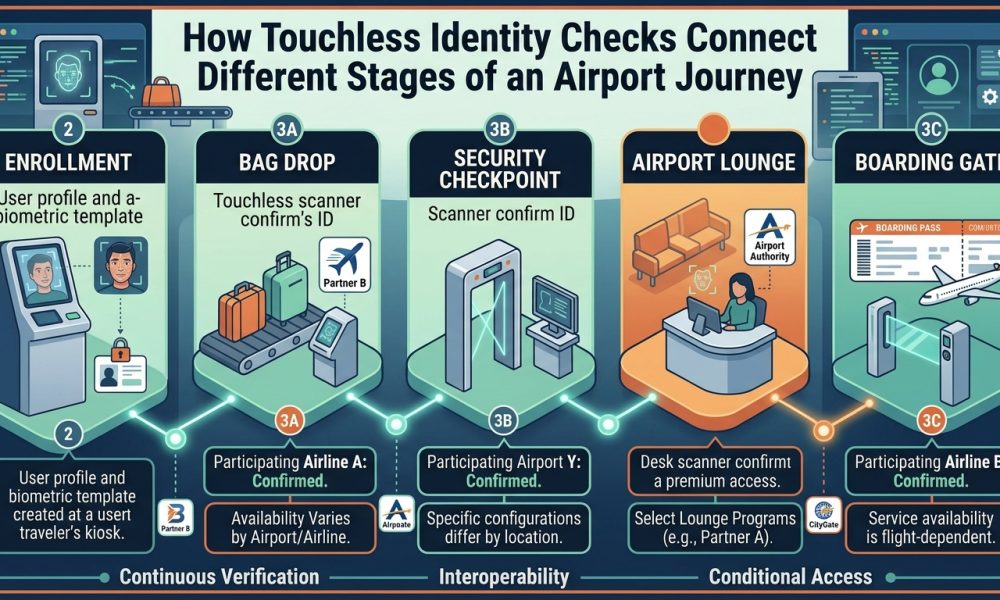
Participating programs can support identity verification at designated locations, with availability varying by airport and airline.
WASHINGTON, DC, October 7, 2026 — Touchless identity technology is gradually changing how eligible passengers move through major airports, allowing facial verification to support several previously separate identity checks while airlines, security agencies, and airport operators continue determining where the technology can provide meaningful operational advantages.
Although travelers may hear descriptions of a seamless, curb-to-gate biometric journey, current implementations remain far more fragmented because participating airlines support different airports, individual locations offer different touchpoints, and passengers may still need conventional Identification when biometric processing is unavailable or unsuccessful.
The result is an airport environment where the same enrolled traveler might use facial recognition to check baggage and pass through transportation security at one airport, encounter touchless identity only at security somewhere else, and rely entirely upon traditional Identification procedures at another location.
Airport Travel Contains Several Separate Identity Checks
Commercial air travel has historically required passengers to establish their identity repeatedly because airlines, transportation security authorities, and border agencies perform different functions and therefore need to confirm who travelers are at different points in the journey.
A passenger might provide identifying information during reservation and check-in, present Identification while checking baggage, establish identity again before entering a secure area, show documentation during international processing, and finally satisfy airline requirements before boarding the aircraft.
These procedures evolved separately because each checkpoint serves a particular operational or governmental purpose. Still, digital identity technology creates an opportunity to connect some of those stages through an identity record that can be verified repeatedly without requiring the traveler to present the same physical document every time.
The concept does not mean that every airport process becomes a single government transaction, because baggage handling, security screening and boarding can remain organizationally distinct even when facial verification provides a common method for confirming the traveler participating in each process.
Enrollment Creates a Digital Link Before Airport Arrival
Touchless processing generally begins before travelers enter the terminal because participating programs need enough identity information to determine eligibility and link an upcoming reservation to the person who may later appear before a biometric camera
Under the current TSA PreCheck Touchless ID program, participating travelers need qualifying identity information and TSA PreCheck eligibility. At the same time, enrollment through a supporting airline links the passenger’s future journey to the touchless verification option at locations where the service operates.
This preexisting digital relationship is essential because facial recognition works best when a system already knows who is expected, rather than trying to identify every individual entering a busy airport from an unrestricted population of millions of possible identities.
When an enrolled passenger subsequently approaches an authorized touchless location, participating systems can use itinerary and identity information to determine whether facial comparison is available, allowing the traveler to proceed through the designated verification process without automatically repeating every earlier enrollment step.
Bag Drop Can Become the First Physical Touchpoint
For passengers checking luggage, the bag-drop area can become the first visible example of how digital identity connects separate stages of an airport journey, because travelers traditionally need to establish their identity before an airline accepts baggage associated with a particular reservation.
At airports supporting touchless baggage processing, eligible passengers can approach designated facilities where facial recognition helps confirm that the person presenting the luggage matches the traveler on the reservation, potentially reducing the need for a conventional agent-facilitated Identification check.
The process does not eliminate the airline’s need to associate luggage with the correct passenger, confirm applicable baggage conditions, or complete required security procedures, because biometric identity verification addresses only one component within a broader baggage acceptance transaction.
Instead, the technology allows an authoritative identity result to replace or streamline the moment when an employee would otherwise need to inspect a physical credential, creating an experience that can feel substantially faster while preserving the underlying requirement to establish who is checking the baggage.
Security Can Use the Same Identity Concept Differently
After completing baggage acceptance, the passenger may encounter facial verification again at transportation security, but the operational purpose changes because the Transportation Security Administration needs to establish identity before allowing the traveler to proceed through the applicable screening process.
At a participating TSA PreCheck Touchless ID checkpoint, eligible travelers can enter a designated line where biometric identity verification lets them establish who they are without routinely presenting a conventional physical Identification document during that transaction.
This second use illustrates how touchless identity can connect stages of an airport journey without making them identical, because the bag-drop system serves an airline operational function. At the same time, the checkpoint verification supports a federal aviation security function.
The passenger experiences continuity because the same enrolled identity supports both processes. Still, different organizations can remain responsible for the surrounding transaction, demonstrating why a connected biometric journey should not be understood as one uninterrupted database operation controlled by a single entity.
Availability Can Change Between Airports
The most important practical limitation for travelers is that touchless identity remains location-dependent, meaning enrollment does not guarantee that every airport, terminal, checkpoint, or airline station will provide the same biometric experience.
Delta, which has expanded touchless processing substantially, has described Touchless ID availability across participating locations while also identifying differences between airports that support both baggage and security functions and those where only certain touchpoints are available.
A passenger who successfully used facial recognition for both bag drop and security on one journey could arrive at another participating airport and find the technology supports only security. At the same time, another location might not offer the right service for that passenger’s airline or itinerary.
That variability reflects the infrastructure required to implement touchless processing, because airports differ in terminal design, airline facilities, checkpoint configuration, passenger volume, technical equipment, and the operational relationships needed to introduce biometric verification safely.
Airline Participation Matters as Much as Airport Participation
An airport can support biometric identity technology without every carrier automatically offering the same passenger experience, because airlines need compatible systems, appropriate enrollment procedures, and operational coordination before their customers can participate through a particular touchless program.
This means travelers should not simply ask whether an airport has facial recognition, because a more useful question is whether their airline participates in the relevant program at that airport and whether the passenger meets the eligibility conditions for that journey.
An eligible traveler flying with one participating carrier could therefore receive a touchless identity indicator for a particular departure. At the same time, another passenger leaving from the same terminal on a different airline follows conventional Identification procedures.
The physical presence of biometric equipment reveals relatively little by itself, because program availability depends on the relationship among the airport, participating airline, responsible government agency, enrolled passenger, and the specific operational touchpoint being used.
A Connected Journey Does Not Mean One Continuous Facial Scan
Descriptions of seamless biometric travel sometimes create the impression that airport cameras continuously recognize passengers as they move through terminals. Still, touchless identity programs generally function around defined transaction points where identity verification has a specific operational purpose.
The passenger approaches a designated location, a live Image is captured for authorized comparison, the system determines whether the traveler matches the expected identity, and the surrounding airport process continues based on the result and applicable procedures.
Travelers are therefore not necessarily being tracked continuously from curb to aircraft merely because the same identity framework can support multiple checkpoints, since separate biometric transactions can occur only when the passenger reaches participating equipment associated with a defined process.
This transaction-based structure matters for airport privacy because using facial verification at designated locations differs substantially from unrestricted Identification of everyone moving through public terminal areas.
The Face Functions as a Temporary Presentation Mechanism
Traditional airport Identification requires passengers to repeatedly retrieve a passport or driver’s license so an employee or automated document reader can examine the credential and compare the photograph with the person standing at the checkpoint.
Touchless systems shift that model by allowing the passenger’s face to serve as the immediate identity signal, while existing government records and previously supplied information provide the trusted reference material needed to make the comparison.
This arrangement can significantly reduce document handling, but it does not mean the traveler’s physical passport or government Identification has become irrelevant, because authoritative identity records remain central to enrollment and can still be required when automated verification cannot be completed.
The technological change therefore concerns how identity is presented during particular airport interactions rather than eliminating the underlying documentation and government records that support confidence in the traveler’s asserted identity.
Facial Verification Does Not Complete Security Screening
A successful biometric comparison at a TSA checkpoint confirms an identity-related element of the passenger-processing sequence. Still, it does not replace the separate screening procedures applied to travelers and their belongings before entry into secure airport areas.
Passengers must still complete the appropriate physical security processes because facial recognition cannot determine whether luggage contains prohibited objects, whether an alarm requires resolution, or whether another screening procedure is needed before the traveler proceeds toward the departure gates.
Touchless identity can therefore speed up one administrative bottleneck without eliminating the broader aviation security structure, allowing officers and automated equipment to focus on subsequent screening functions after the participating system establishes identity.
This separation also explains why a passenger should not interpret successful facial verification as complete security clearance, because the identity result represents only one stage within the larger sequence required before access to the sterile airport environment is permitted.
International Travel Can Add Additional Identity Layers
Passengers departing internationally may encounter additional biometric processes after using touchless identity at baggage acceptance or transportation security, especially when border agencies or participating airlines use facial recognition for international boarding and exit verification.
Those later interactions may look almost identical because the passenger again faces a Camera. Still, their governmental purpose can differ substantially from the earlier domestic-style touchless process that streamlined identity verification at baggage or security locations.
International biometric boarding can support border exit responsibilities and airline departure processing. In contrast, TSA PreCheck Touchless ID primarily supports eligible passenger identity verification associated with aviation security and participating airport services.
Travelers should therefore avoid assuming that enrollment in one touchless program automatically determines the legal authority, privacy rules, or participation requirements governing other facial recognition systems they encounter later in the same journey.
Boarding Represents Another Potential Biometric Stage
Airlines have increasingly explored facial verification during aircraft boarding, particularly on international routes where biometric departure systems can compare travelers with government reference photographs and help confirm identity without requiring every passenger to present a passport at the boarding podium repeatedly.
From the passenger’s perspective, this can create a more connected sequence in which identity is verified at baggage acceptance, security, and eventually boarding through facial comparison, making the airport experience seem to revolve around one persistent digital credential.
Operationally, however, these stages can remain separate systems with different responsibilities, because an airline baggage transaction, TSA security verification, and government border departure process do not become legally identical simply because each can use facial biometrics.
Understanding that distinction becomes increasingly important as airports pursue more seamless journeys, because technical interoperability can connect identity processes without erasing the legal and institutional boundaries surrounding them.
Physical Documents Remain Essential Backup Credentials
Even the most extensively connected touchless journey still requires travelers to carry appropriate Identification, particularly because facial verification systems can become unavailable due to technical interruptions, eligibility issues, itinerary changes, or unsuccessful biometric comparisons.
Passengers may also encounter locations that do not participate in their program, making physical credentials necessary when moving between airports whose biometric capabilities differ substantially, even when served by the same airline.
For international journeys, passports remain indispensable because destination governments, airline employees, immigration authorities, or other officials can require physical document inspection regardless of how many earlier touchless transactions the traveler completed.
Touchless technology should therefore be understood as a way to reduce repetitive presentation rather than permission to leave required documents behind, since the traditional credential remains an essential fallback whenever the digital pathway cannot complete the transaction.
Passport Security Supports the Digital Journey
The growing ability to travel without repeatedly showing a passport can make the physical document seem less important. Still, secure passports remain foundational because digital identity systems depend on confidence in authoritative government records and the identities established when those documents were issued.
Modern passports incorporate physical and electronic protections that can include specialized materials, complex printing, machine-readable information and digitally signed chip data, providing multiple mechanisms through which authorities can authenticate documents and support reliable identity records.
Amicus International Consulting has examined these protections in its detailed guide to modern passport security and identity verification, explaining how document security continues to support increasingly automated travel environments where passengers may interact with digital systems more often than physical inspection desks.
The transition toward touchless identity therefore does not replace passports with facial recognition, but expands how trusted identity information from secure credentials can support passenger processing throughout the airport.
Failed Comparisons Need Conventional Alternatives
No biometric system can guarantee that every legitimate traveler will match successfully in every transaction, because photographs can differ due to aging, appearance changes, lighting, Camera positioning, Image quality, and other technical conditions that affect automated facial comparison.
Airport programs consequently need established fallback procedures that allow passengers to present conventional Identification when automated verification produces an uncertain result, preventing a technological failure from automatically becoming a determination that the traveler has committed wrongdoing.
This principle becomes particularly important when one identity system supports several airport stages, because a passenger who completed touchless baggage acceptance could still experience a failed comparison later at security, without that inconsistency necessarily indicating an identity problem.
Each transaction must therefore be evaluated according to its circumstances, with manual verification remaining an important safeguard for legitimate travelers whenever automated processing cannot establish sufficient confidence.
Connected Identity Can Reduce Repetitive Document Handling
The main passenger benefit of a multi-stage touchless journey is not that airport authorities stop checking identity, but that travelers can establish the same identity through a less repetitive process while moving between functions that still require verification.
For frequent travelers, reducing repeated searches for Identification can make airport navigation noticeably more efficient, particularly when passengers are simultaneously managing mobile devices, baggage, boarding information, family members, and the other practical demands associated with commercial travel.
Airlines and government agencies also gain operational advantages when automated identity verification reduces transaction times, particularly at high-volume locations where even modest improvements across thousands of passengers can affect queues and staffing requirements.
The broader objective is therefore to remove unnecessary friction from processes that still need to occur, rather than eliminating the security and identity controls surrounding commercial aviation.
Airport Architecture Will Shape Future Expansion
Expanding touchless identity across an entire passenger journey requires more than installing additional cameras, because airports must coordinate physical infrastructure, passenger flow, airline technology, government systems and privacy procedures before biometric processing can function reliably at scale.
Older terminals can present particularly difficult challenges because baggage counters, checkpoint entrances and passenger circulation patterns were designed long before digital identity became a realistic alternative to repeated manual document inspection.
Newer airport facilities can incorporate biometric processing more deliberately, potentially making identity verification systems part of the architecture rather than equipment added later to locations originally designed around physical documents and staffed inspection desks.
These differences help explain why biometric availability can expand unevenly, with some hubs developing multiple touchless touchpoints while others introduce only one stage or continue relying predominantly on conventional Identification.
More Than 60 Airports Illustrate Growing Scale
By 2026, Delta reported that TSA PreCheck Touchless ID was available at more than 60 airports, showing how quickly the program moved beyond its early pilot locations while still leaving important differences in the services available at individual facilities.
United has likewise expanded TSA PreCheck Touchless ID across several major hubs and reported millions of customer uses during 2025, demonstrating that biometric identity verification is increasingly becoming an operational passenger-processing tool rather than remaining confined to small experimental demonstrations.
The growing number of participating locations does not mean every traveler receives an identical experience, however, because eligibility, airline support, airport infrastructure, and individual touchpoint availability still determine which parts of a journey can become touchless.
That distinction will remain important as broader availability encourages travelers to expect biometric processing, because expansion across airports does not necessarily produce uniformity within them.
The Long-Term Goal Is a More Connected Journey
Federal transportation planning has described a broader ambition of developing increasingly seamless identity processing that can reduce repetitive document presentation across multiple points in the airport journey, including security and potentially baggage-related functions.
Achieving that objective requires participating systems to recognize an eligible traveler accurately while preserving clear boundaries among the different organizations responsible for baggage operations, security screening, border management,nt and aircraft boarding.
The passenger may eventually experience those systems as one continuous digital journey. However, effective implementation will still depend upon clearly defining what each biometric transaction accomplishes and ensuring travelers can understand when different authorities are performing different checks.
A seamless experience should therefore mean reduced passenger friction rather than the disappearance of institutional distinctions, because airlines and government agencies still perform separate responsibilities even when technology lets their identity processes interact more efficiently.
Travelers Should Check Their Specific Journey
As touchless identity expands, passengers should confirm availability for their specific airline and departure airport rather than assuming previous enrollment guarantees the same process on every future trip.
An airport may support touchless security but not biometric bag drop; another location may offer both functions for one airline, and a third may require conventional Identification even if the traveler remains enrolled in the broader program.
Travelers should also continue carrying required Identification because participating systems remain supplementary processing tools whose availability can change based on airport operations, technology conditions, and individual itinerary requirements.
Understanding these limitations allows passengers to benefit from faster identity processing without developing unrealistic expectations about what enrollment provides once they reach an unfamiliar airport.
One Identity Can Support Several Distinct Transactions
The broader transformation underway in airports involves moving from repeatedly presenting a document to repeatedly confirming a trusted digital identity, allowing qualifying travelers to complete separate transactions while reducing the physical exchange of passports and Identification cards.
Bag drop, transportation security, and boarding can each remain separate events with different organizations and purposes. Yet, facial verification can provide a common identity mechanism that makes those stages feel substantially more connected.
For passengers, the change shows up in shorter interactions with cameras and fewer times documents must be physically presented. At the same time, behind the scenes, airlines and government agencies continue performing the individual checks required for their respective responsibilities.
As deployment continues to expand, the most accurate description of touchless travel is not an airport without identity checks, but an airport where a trusted identity can increasingly accompany an eligible passenger through several designated stages without requiring the same physical credential to be presented again and again.
The article checked current availability and expansion details against TSA, Delta, and United materials, while keeping the distinction clear between connected passenger identity and the separate operational purposes of bag drop, security, and boarding.




