
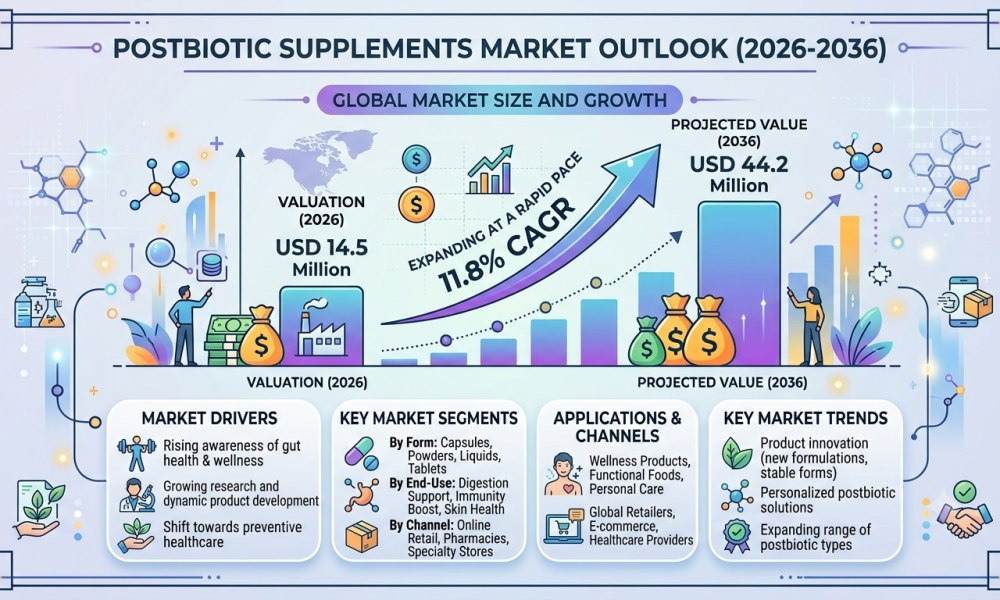
The global postbiotic supplements market is projected to grow from USD 14.5 million in 2026 to USD 44.2 million by 2036, registering an 11.8% CAGR during the forecast period. Demand is supported by growing interest in microbiome health, increasing preference for shelf-stable supplement formats, and the shift from live probiotic cultures toward heat-treated preparations. Consumers and brands are increasingly seeking postbiotic products that offer easier storage, stable formulations, and targeted support for digestive and immune health.
Capsules and tablets are expected to remain the leading product format, accounting for 55.6% of market revenue in 2026. Fixed-dose formats support consistent delivery of clinically studied preparations while allowing manufacturers to use established encapsulation capabilities. Online retailing is also gaining importance and is projected to account for 41.2% of sales channel revenue in 2026, giving brands greater space to explain postbiotic benefits, dosage, preparation details, and supporting research.
Get detailed market forecasts, competitive benchmarking, and pricing trends: https://www.futuremarketinsights.com/reports/sample/rep-gb-11655
Global Segment Leaders
- Form – Capsules and Tablets: 55.6% in 2026. The segment leads as fixed-dose formats support consistent delivery and allow brands to use established encapsulation infrastructure.
- Sales Channel – Online Retailing: 41.2% in 2026. Online channels provide brands with greater space to explain postbiotic formulations, dosage, scientific evidence, and product benefits while supporting repeat purchases and subscriptions.
- Product Positioning – Gut and Immune Health: Demand is supported by growing consumer interest in digestive and immune support, with brands increasingly developing need-specific postbiotic products.
Country-Level Performance
The United Kingdom is projected to grow at the fastest pace among the profiled countries, with a 13.8% CAGR through 2036. Growth is supported by expanding supplement demand and continued developments in the country’s regulatory framework for food supplements and health claims.
Germany is expected to record a 13.2% CAGR, supported by pharmacy-led demand, strong documentation requirements, and consumer emphasis on quality and scientific evidence. Health claims remain closely aligned with the European Union authorization framework, making research-backed products particularly important.
Japan is forecast to grow at an 11.9% CAGR, supported by interest in functional supplements and continued development of manufacturing standards. GMP-based manufacturing control for supplement-form Foods with Function Claims is applicable from September 2026.
The United States is projected to expand at a 9.5% CAGR. A large existing dietary supplement consumer base provides a strong customer pool for postbiotic products, while targeted applications such as digestive support among specific consumer groups are creating additional opportunities.
South Korea is expected to record an 8.5% CAGR, representing the slowest growth among the five profiled countries. Functional-ingredient recognition requirements continue to influence product development and health-claim opportunities.
Regional Context
The United Kingdom and Germany represent the fastest-growing profiled markets, with CAGRs of 13.8% and 13.2%, respectively. Growth across these European markets is supported by established supplement consumption, increasing interest in microbiome-focused products, and demand for products backed by stronger scientific documentation.
Japan follows closely at 11.9%, reflecting continued interest in functional nutrition and improvements in supplement manufacturing standards. The United States records a 9.5% CAGR, supported by its sizeable dietary supplement consumer base and expanding interest in targeted digestive and immune health solutions. South Korea records an 8.5% CAGR as regulatory recognition remains an important consideration for new functional ingredients.
The full report covers North America, Latin America, Western Europe, Eastern Europe, East Asia, South Asia and Pacific, and the Middle East and Africa, with country-level analysis across 27 countries and country groups.
Access full Report in PDF Format@ https://www.futuremarketinsights.com/reports/brochure/rep-gb-11655
Competitive Landscape
The competitive landscape includes DSM-Firmenich, Novonesis, Kerry Group plc, Lallemand Inc., Probi AB, and Kirin Holdings Company, Limited. Competition is shaped by strain-specific clinical evidence, product stability, formulation support, regulatory readiness, and the ability to develop postbiotic products for targeted health applications.
Recent developments include Probi’s introduction of Rham271h, a heat-inactivated Lacticaseibacillus rhamnosus 271 preparation, in May 2026, with the company highlighting enhanced pH, heat, and shelf stability. Lallemand Health Solutions agreed in May 2025 to distribute Kirin’s heat-inactivated IMMUSE strain Plasma for immune support. In April 2026, Lallemand featured IMMUSE in its Vitafoods Barcelona portfolio covering multiple health areas. DSM-Firmenich also reported the launch of an allergen-free version of Humiome Post LB designed for gummy applications in February 2026.
About Future Market Insights (FMI)
Future Market Insights, Inc. (ESOMAR certified, recipient of the Stevie Award, and a member of the Greater New York Chamber of Commerce) offers profound insights into the driving factors that are boosting demand in the market. FMI stands as the leading global provider of market intelligence, advisory services, consulting, and events for the Packaging, Food and Beverage, Consumer Technology, Healthcare, Industrial, and Chemicals markets. With a vast team of over 400 analysts worldwide, FMI provides global, regional, and local expertise on diverse domains and industry trends across more than 110 countries.



