
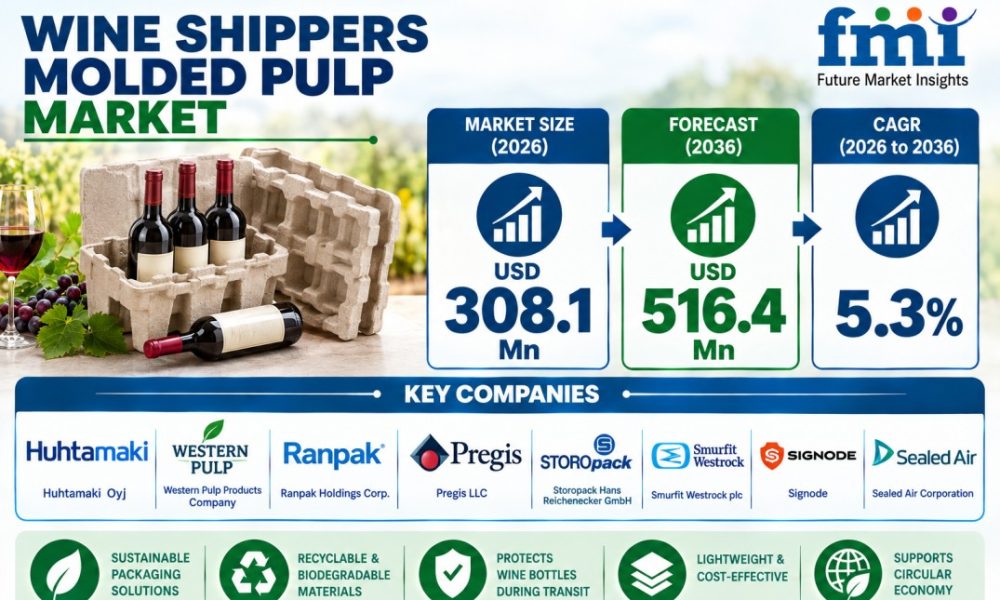
The global wine shippers molded pulp market is projected to reach USD 516.4 million by 2036, rising from USD 308.1 million in 2026 at a 5.3% CAGR, according to Future Market Insights.
The market is being shaped by the growing need to protect glass bottles across parcel and direct-to-consumer shipping networks. Unlike stable pallet movements between trade locations, parcel shipments expose wine bottles to repeated sorting, transfer and handling cycles. This makes bottle separation, carton fit and repeatable pack-out increasingly important in packaging specifications. Molded pulp and related fiber protective formats are gaining attention as wineries and fulfillment operators review material choices alongside recovery requirements, destination rules and operating costs.
👉 Get Detailed Market Forecasts, Competitive Benchmarking, and Pricing Trends: https://www.futuremarketinsights.com/reports/sample/rep-gb-34759
Standard Formats Lead Market Demand
Standard formats are projected to account for 41.0% of the market in 2026, making them the leading format category.
Their advantage comes from repeatable bottle counts and established outer-carton footprints. Standardized designs can reduce tooling changes and qualification work for wineries that ship familiar bottle configurations throughout seasonal direct-to-consumer programs.
For fulfillment teams, repeat geometry also provides a consistent pack-out method. This becomes increasingly valuable during seasonal peaks when changes in packaging format can add operational complexity.
By material, paper-based systems are estimated to hold 34.0% share in 2026. Fiber structures provide bottle separation while fitting established paper recovery routes in major markets.
However, material selection remains tied to mechanical performance. Compression and shock resistance must be validated against the intended bottle, outer carton and parcel route.
E-commerce and Parcel Shipping Creates a Recurring Requirement
The e-commerce and parcel segment is projected to hold 29.0% share in 2026.
Direct shipping creates a different protection requirement from palletized wine distribution. Bottles encounter repeated handling and transfer points, increasing the importance of consistent isolation and carton fit.
Automated fulfillment is also raising the value of inserts that can be loaded quickly and consistently. This creates an opportunity for molded-pulp designs that combine bottle protection with efficient pack-station operation.
Ranpak introduced three automated packaging systems in January 2025 aimed at improving productivity in fulfillment environments, while its collaboration with Walmart has also highlighted automated paper packaging systems for high-volume fulfillment.
Standard Duty Remains the Leading Performance Class
Standard-duty formats are expected to account for 40.0% share in 2026.
Routine wine parcels generally require validated mechanical protection rather than thermal conditioning. The primary objective is to prevent bottle-to-bottle contact and limit movement within the outer carton.
Heavy-duty and temperature-assured formats remain relevant for higher-risk routes, but their additional material and qualification requirements can limit routine adoption.
This makes route-specific testing important. A shipper that performs well under one distribution profile may require a different configuration for another combination of bottle, carton, carrier and destination.
Nandini Roy Choudhury, Principal Consultant at Future Market Insights, explains:
“Wine shippers should be qualified against the actual bottle mix and outer carton before unit price enters the final comparison. The stronger commercial offer pairs repeatable transit protection with replenishment capacity and pack-line fit across seasonal direct-to-consumer programs.”
👉 Access the Complete Report in PDF Format: https://www.futuremarketinsights.com/reports/brochure/rep-gb-34759
Regulatory Conditions Affect Packaging Specifications
Wine packaging decisions are increasingly influenced by differences in alcohol-channel rules and packaging requirements across markets.
The UAE wine shippers molded pulp market is projected to grow at 6.5% CAGR, followed by the USA at 5.9%, UK at 5.6%, France at 5.3%, and Germany at 5.0% through 2036.
In the United States, state-level direct-shipping rules can complicate the use of a single national packaging specification. In the UK, producer-responsibility fees create an additional cost consideration when comparing paper and plastic packaging.
France is preparing for the operational start of professional-packaging EPR in 2027, while Germany provides clearer recyclability criteria for packaging qualification.
These differences mean that packaging approval cannot be separated from the destination market.
Competitive Landscape
The market includes molded-fiber specialists as well as companies providing broader paper protection, fulfillment and end-of-line engineering.
Key companies profiled by Future Market Insights include Huhtamaki Oyj, Western Pulp Products Company, Ranpak Holdings Corp., Pregis LLC, Storopack Hans Reichenecker GmbH, Smurfit Westrock plc, Signode, and Sealed Air Corporation.
Recent developments show continued investment in paper-based protection and fulfillment automation. In June 2026, Storopack launched PAPERwrap as recyclable paper cushioning for fragile goods and glass surfaces. Pregis introduced EasyPack Strata in January 2026 for individual packing stations and centralized fulfillment lines.
These developments point to a broader market requirement: wine shippers must combine mechanical protection with practical pack-station performance.
As wineries expand direct-to-consumer fulfillment, the commercial opportunity for molded-pulp wine shippers will depend on repeatable bottle protection, replenishment capacity and compatibility with established packing operations.
To explore how FMI Custom Research can support your strategic priorities, connect with our team at – [email protected]
About Future Market Insights (FMI)
Future Market Insights, Inc. is an ESOMAR-certified, ISO 9001:2015 market research and consulting organization trusted by Fortune 500 companies. With a global presence across the U.S., UK, India, and Dubai, FMI delivers data-driven insights across 30+ industries and 1200 markets worldwide.



