
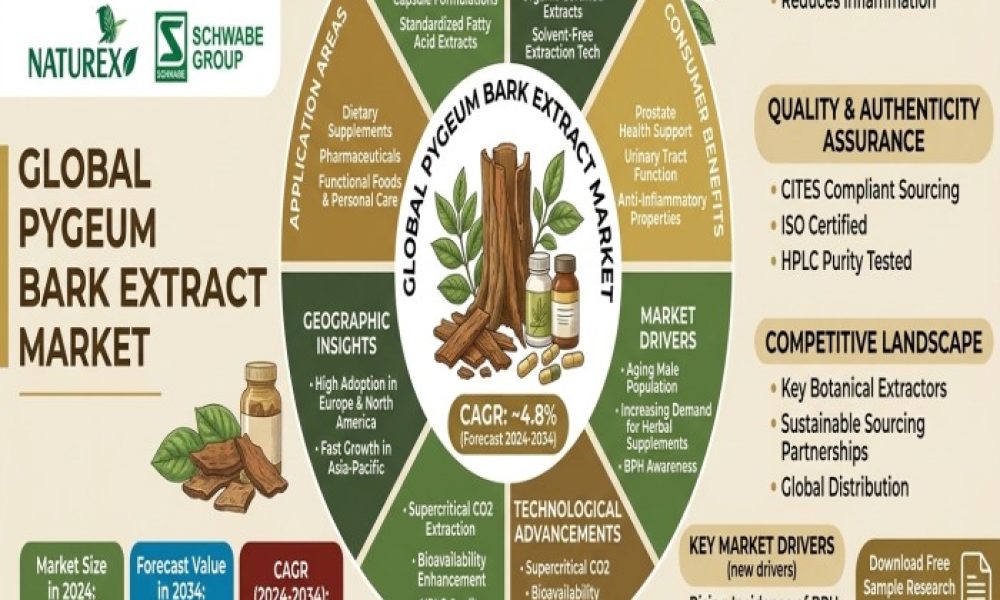
Rockville, Maryland — October 7, 2026 : The Pygeum Bark Extract Market is forecast to expand from USD 300.0 million in 2026 to USD 595.7 million by 2036, advancing at a 7.1% CAGR during the forecast period. Rising demand for standardized botanical ingredients, growing use of pygeum in men’s wellness supplements, and the manufacturing convenience of powder formats are supporting market expansion. The market generated USD 280.1 million in 2025, highlighting the increasing commercial relevance of Prunus africana bark-derived extracts in supplement formulations.
Get detailed market forecasts, competitive benchmarking, and pricing trends:
Standardized Pygeum Bark Extract is expected to remain the leading product category, accounting for 63.7% of the market in 2026. Its leadership reflects growing requirements for defined bark identity and consistent active-content profiles, which help supplement manufacturers maintain predictable formulation specifications. Dietary Supplements represent another major opportunity, projected to hold a 48.2% share in 2026 as pygeum is incorporated primarily into men’s wellness and urinary-comfort formulations. Nutraceutical manufacturers are expected to lead the end-use segment with a 72.4% share, reflecting the role of bulk pygeum ingredients in capsule and tablet production. Powder Formulations are also projected to account for 56.8% of demand because dry extracts can move efficiently through blending, encapsulation, and direct-compression processes.
Germany is projected to record the fastest country-level growth among the markets covered, with an 8.2% CAGR through 2036. Established supplement use and heightened consumer attention to health-risk communication are expected to support demand for standardized pygeum products. Germany’s position also reflects the importance of clear product information and supplier documentation when botanical ingredients are evaluated for supplement applications.
Brazil is expected to follow with a 7.5% CAGR. The country’s outlook is linked to increasingly regularized supplement supply and distributor screening, with Anvisa’s regulatory framework supporting greater scrutiny of compliant products and supplier documentation. This environment is expected to favor pygeum suppliers capable of providing reliable identity, sourcing, and import-related documentation.
The UK Pygeum Bark Extract Market is estimated to grow at a 6.0% CAGR through 2036. Food supplement guidance and continuing label surveillance are expected to keep formulation details, dosage information, and permitted claims central to purchasing and commercialization decisions. UK brands and specialty retailers are likely to place greater emphasis on supplier documentation as pygeum products move through online and specialty distribution channels.
Market expansion is being shaped by the qualification requirements surrounding botanical ingredients. Supplement brands increasingly need specifications covering bark identity and extract strength, while traceable sourcing records can influence supplier approval. Direct B2B supply is expected to retain the largest distribution position with a 44.5% share in 2026 because buyers often require technical files and sourcing information before establishing repeat purchasing relationships. Verified bark-origin programs and private-label capsule opportunities are also identified as areas with commercial potential.
At the same time, sourcing risks, disease-claim restrictions, testing costs, and the relatively narrow consumer awareness of pygeum compared with better-known botanicals can constrain expansion. Suppliers therefore face increasing pressure to demonstrate product identity, consistent extract specifications, contaminant controls, and compliant documentation. These factors are expected to make quality assurance and transparent sourcing important competitive differentiators across the forecast period.
The competitive landscape includes Better Being Co., NOW Health Group, Inc., Life Extension, Nutra Green Biotechnology Co. Ltd., and Xi’an Natural Field Bio-Technique Co. Ltd. These companies participate across finished supplement products and bulk botanical supply, with competition centered on specification depth, traceable sourcing, formulation suitability, and documentation capabilities.
Unlock 360° insights for strategic decision making and investment planning:
Fact.MR’s Pygeum Bark Extract Market report provides analysis across product, application, end use, technology, formulation, distribution channel, and regional markets. The study covers Germany, Brazil, the USA, the UK, and Japan, offering market sizing, segment shares, country-level CAGRs, competitive analysis, and strategic insights for stakeholders evaluating opportunities in pygeum-based supplement ingredients.
Explore More Related Studies Published by Fact.MR Research
Concentrated Liquid Smoke Market
About Fact.MR
Fact.MR is a market research and consulting firm providing syndicated research, customized research, investment research, and market intelligence across a broad range of industries. Its research coverage includes food and beverage, healthcare, pharmaceuticals, biotechnology, consumer products, chemicals and materials, technology, industrial goods, and packaging.
Fact.MR provides market intelligence designed to help organizations understand market dynamics, emerging opportunities, competitive developments, and changing industry requirements.
Media Contact
Fact.MR
Email: [email protected]
Phone: +1 (628) 251-1583
Website: www.factmr.com



