
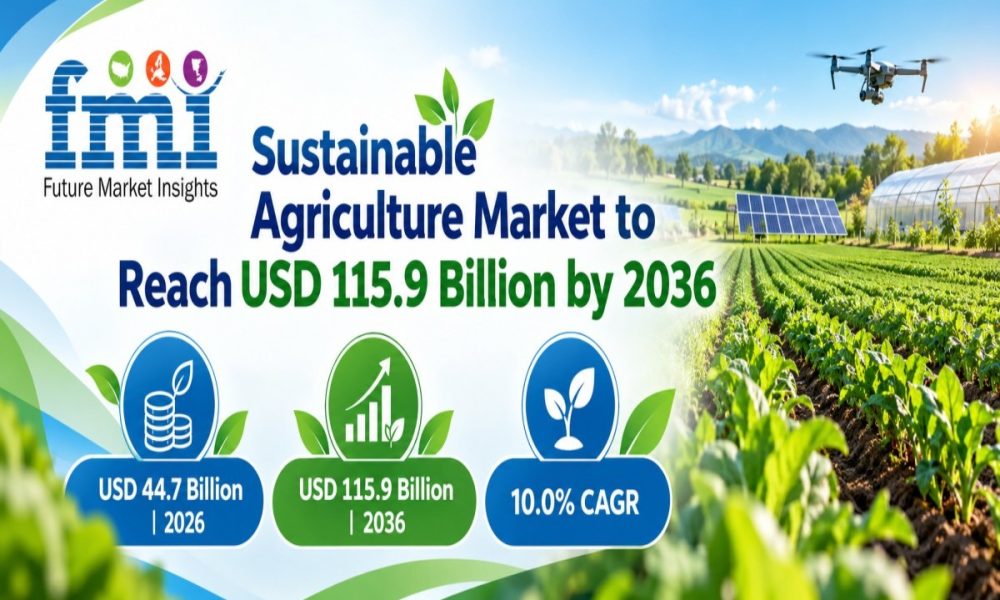
The global Sustainable Agriculture Market is projected to reach USD 115.9 billion by 2036, up from approximately USD 44.7 billion in 2026, expanding at a 10.0% CAGR during the forecast period, according to the latest analysis by Future Market Insights (FMI).
The market is being supported by growing demand for resource-efficient agricultural inputs and farm systems that help producers maintain yields while improving nutrient-use efficiency and reducing environmental impacts. Increasing adoption of precision input-management practices, smart-farming technologies and sustainable crop-production systems is creating additional opportunities for market participants.
Get Detailed Market Forecasts, Competitive Benchmarking, and Pricing Trends:
https://www.futuremarketinsights.com/reports/sample/rep-gb-34556
Enhanced-Efficiency Synthetic Inputs Continue to Lead Product Demand
Enhanced-efficiency synthetic inputs are estimated to account for 31.0% of product type demand in 2026, making them the leading product category.
These inputs alter nutrient release or persistence within established fertilizer programs, allowing producers to integrate efficiency-focused products into familiar nutrient-management routines. Compatibility with existing application schedules and field machinery supports adoption across commercial farms.
Conventional Farms Adopting Sustainable Inputs Lead Farming System Demand
Conventional farms adopting sustainable inputs are projected to represent 38.0% of farming system demand in 2026.
Conventional farms can introduce selected sustainable inputs across defined acreage without replacing their complete production systems. Precision tools and smart irrigation systems provide measured entry points for nutrient and water-management decisions.
Cereals and Grains Generate Recurring Sustainable Agriculture Demand
Cereals and grains are projected to account for 38.0% of crop type demand in 2026.
Cereal farms repeat fertilizer and crop-protection decisions across broad acreage and fixed seasonal windows. Soil-testing programs help agronomists adjust input rates according to field variability before extending products across complete crop rotations.
Liquid Formulations Hold a Leading Share
Liquid formulations are forecast to account for 47.0% of the form category in 2026.
Liquid products fit established mixing and spraying routines across commercial farms. Liquid biofertilizers and biostimulants can be incorporated into existing spray or irrigation programs with limited equipment changes.
Agronomic Support Creates Opportunities for Broader Adoption
Companies can combine registered agricultural inputs with field monitoring, analytics and technical guidance to reduce uncertainty during commercial trials.
Agriculture analytics platforms can identify application problems and support expansion across additional acreage. Technical advisory services help growers adjust timing, dosage and placement according to local conditions, allowing successful pilot results to translate into broader commercial adoption.
South Korea Shows the Fastest Growth Among Highlighted Markets
Among the highlighted country markets, South Korea is projected to record an 11.2% CAGR through 2036, followed by Australia at 10.3%, Germany at 10.1%, the United Kingdom at 10.0% and the United States at 9.8%.
Germany Combines Organic Agriculture with Advisory Networks
Germany’s sustainable agriculture market is anticipated to advance at a 10.1% CAGR over the assessment period.
Substantial organic acreage and established advisory networks support demand for agricultural inputs that combine environmental performance with dependable output. Companies must provide compliant labeling and repeatable field evidence across varied soils and crop rotations.
United States Offers Broad Conservation-Acreage Potential
The United States is estimated to post a 9.8% CAGR over the forecast period.
Growers are adding selected soil-management and input-efficiency practices across large commodity-crop regions. Broad agricultural acreage creates significant market potential, although federal registration and state distribution requirements can increase expansion costs.
Competitive Landscape
The Sustainable Agriculture Market includes integrated crop-science companies, crop-protection providers, biological-input suppliers and formulation specialists.
Key companies profiled by FMI include Bayer AG (Crop Science), Syngenta Group, Corteva Agriscience, UPL Limited, FMC Corporation, BASF SE, Sumitomo Chemical Co., Ltd. and ADAMA Ltd.
Competitive positioning is influenced by registered product coverage, biological and plant-health portfolios, digital agriculture integration, formulation capabilities, field support and geographic reach.
Key Industry Developments
The market continues to see regulatory approvals, biological manufacturing expansion and agricultural technology development.
In July 2026, Sumitomo Chemical obtained United States registration for Rapidicil and prepared state launches for no-till weed programs.
In May 2026, BASF commissioned its Ludwigshafen BioHub and began production of biological active ingredients for fungicide and seed-treatment programs.
In February 2025, Syngenta strengthened its agricultural biologicals capabilities through research assets and facility expansion in South Carolina.
Analyst Perspective
“Recurring orders depend on evidence that lower input losses preserve output with familiar equipment. Farms compare registration coverage and local support across complete rotations.” — Nandini Roy Choudhury, Principal Consultant, Future Market Insights
Exclusive Discounts on Full Report
https://www.futuremarketinsights.com/reports/sustainable-agriculture-market
Report Scope
The FMI study covers the Sustainable Agriculture Market by product type, farming system, crop type, form, mode of application and region.
Product types include enhanced-efficiency synthetic inputs, controlled-release fertilizers, stabilized nitrogen fertilizers, biological crop protection products, biopesticides, biofungicides, plant biostimulants, seaweed extracts, biofertilizers and microbial inoculants.
Farming systems include conventional farms adopting sustainable inputs, precision input management, efficient irrigation systems, regenerative-conservation agriculture farms, no-till farming, cover cropping, organic agriculture and integrated pest management-focused farms.
Crop types include cereals and grains, oilseeds and pulses, fruits and vegetables, and industrial and cash crops.
Forms include liquid formulations, dry-granular formulations, powder-wettable powder formulations and other formulations. Modes of application include soil-applied field application, foliar application, seed-applied planting-stage application and fertigation-irrigation-mediated application.
The research covers North America, Latin America, Europe, East Asia, South Asia and Pacific, and the Middle East and Africa, with South Korea, Australia, Germany, the United Kingdom, the United States and 20+ additional countries included in the full report.
Key Executive Benefits
- Decision-Ready Insights
- Reduced Strategic Risk
- Market Entry Confidence
- Competitive Advantage
- Faster Growth Decisions
- Primary Market Validation
To explore how FMI Custom Research can support your strategic priorities, connect with our team at [email protected].
About Future Market Insights (FMI)
Future Market Insights, Inc. is an ESOMAR-certified, ISO 9001:2015 market research and consulting organization trusted by Fortune 500 companies. With a global presence across the U.S., UK, India and Dubai, FMI delivers data-driven insights across 30+ industries and 1,200 markets worldwide.



