
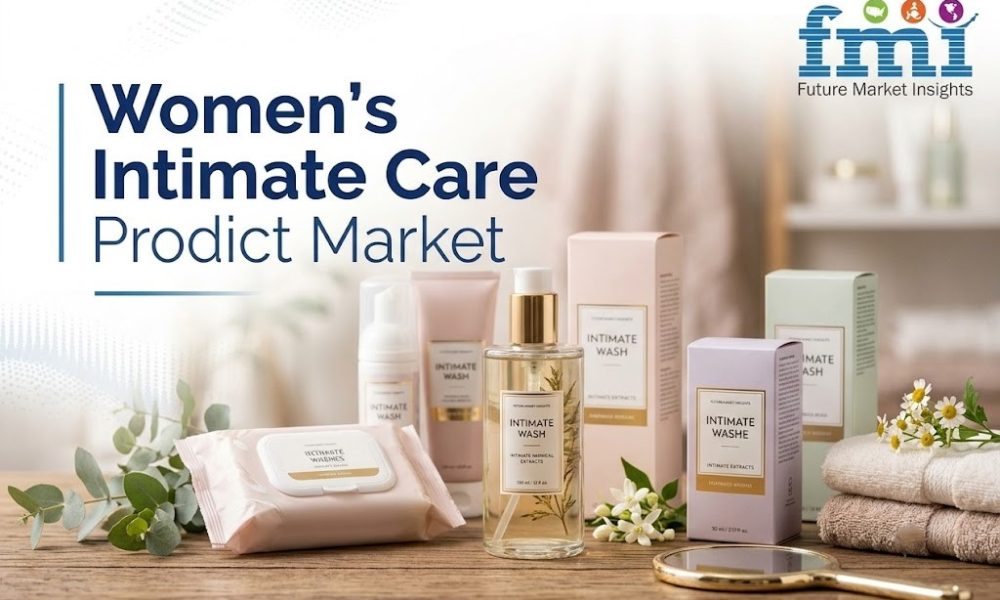
The global women’s intimate care product market is entering a period of steady expansion as consumers place greater emphasis on daily hygiene, sensitive-skin needs, formulation transparency, and convenient access to specialized personal care products. According to Future Market Insights (FMI), the market was valued at USD 31.4 billion in 2025 and is projected to reach USD 48.5 billion by 2036, expanding at a 3.9% CAGR between 2026 and 2036. The market is expected to create an incremental opportunity of USD 15.9 billion over the forecast period.
In 2026, the market is expected to be valued at USD 32.6 billion, according to FMI. Intimate wash is projected to remain the leading product type, accounting for 20.0% of the segment. Liquid formats are expected to hold a 34.0% share, while pH-balanced ingredients are projected to account for 29.0% of ingredient-type demand.
Get detailed market forecasts, competitive benchmarking, and pricing trends: https://www.futuremarketinsights.com/reports/sample/rep-gb-11016
Daily Hygiene and Sensitive-Skin Needs Support Market Expansion
The market is moving beyond occasional hygiene use toward routine personal care. Greater awareness of intimate hygiene is encouraging consumers to consider products specifically formulated for external intimate care rather than relying solely on general body-care products.
pH-balanced cleansing is an important demand driver as consumers seek products positioned around mildness and external-use comfort. Sensitive-skin concerns are also influencing product selection, with consumers showing interest in formulations that avoid harsh fragrance and strong cleansing claims.
Online retail is strengthening access to the category. Consumers can privately research products, compare ingredients, review product information, and evaluate claims before purchasing. Pharmacy and supermarket channels remain important for trusted product discovery and replenishment.
Natural, organic, herbal, and probiotic positioning is also creating opportunities for premium products. However, brands face the need to maintain clear claim boundaries and distinguish cosmetic and hygiene positioning from medical treatment claims.
Intimate Wash Leads Product Demand
Intimate wash is expected to account for 20.0% of the product-type segment in 2026, supported by its fit with established daily hygiene routines and broad availability through pharmacies and online channels. Wipes are positioned around convenience and on-the-go use, while moisturizers address dryness and comfort-related needs.
Cleansing is expected to remain the leading application, with a 36.5% share in 2026. The 26 to 40 age group is projected to generate 45.0% of market revenue, while sensitive skin is expected to account for 42.0% of the skin-type segment.
Online retail is forecast to lead sales channels with an estimated 32.0% share, reflecting the importance of privacy, product education, ingredient comparison, and direct digital discovery.
India and China Show Strong Growth Potential
Country-level performance indicates notable opportunities across emerging and established markets. India is projected to register a 6.2% CAGR through 2036, making it the fastest-growing major country in the FMI analysis. Growth is supported by urban hygiene awareness, expanding online retail access, pharmacy distribution, and increasing adoption of women-focused personal care.
China is projected to grow at 5.6% CAGR, supported by digital beauty retail, premium hygiene positioning, ingredient awareness, and consumer interest in specialized personal care.
South Korea is forecast to expand at 4.8% CAGR, while Brazil is projected to register 4.6% growth. The United States is expected to grow at 3.8% CAGR, followed by France at 3.1% and Germany at 2.9%.
Safety, Formulation and Claim Clarity Remain Key Considerations
Despite favorable demand conditions, the market faces challenges related to consumer sensitivity, product safety perceptions, and the interpretation of intimate care claims. Consumers may distinguish carefully between cosmetic hygiene products and products positioned around medical or therapeutic benefits.
This creates an opportunity for companies to focus on straightforward usage instructions, ingredient transparency, mild formulations, and clearly defined external-use positioning. Pharmacy distribution and online education can also help brands establish credibility and improve product understanding.
“Demand is shifting toward pH-balanced and sensitive-skin intimate care products. Brands with clear safety claims, pharmacy trust, and strong online visibility are likely to gain repeat demand,” said Rahul Pandita, Associate Vice President at Future Market Insights.
Competitive Landscape
The women’s intimate care product market remains fragmented, with established consumer health companies and specialist brands competing across formulation, product breadth, retail access, and digital engagement.
Key companies identified by FMI include Combe Incorporated, Prestige Consumer Healthcare, Sanofi Consumer Healthcare, Bayer AG, Kao Corporation, Sebamed, Lactacyd, The Honey Pot Company, Nua, Sirona Hygiene, and Rael.
Established companies benefit from pharmacy presence, established distribution networks, and formulation trust. Specialist and digital-first brands are competing through plant-derived positioning, direct consumer communication, online education, and focused product portfolios.
Recent developments also illustrate the changing competitive environment. In May 2025, Rael expanded its retail presence through Walmart, Ulta Beauty, and Walgreens. In February 2025, Sirona’s founders reacquired the feminine hygiene brand from Good Glamm Group, restoring independent operations.
Access the Complete Report in PDF Format: https://www.futuremarketinsights.com/reports/brochure/rep-gb-11016
Report Scope
FMI’s study covers women’s intimate care products intended for external hygiene, freshness, moisturizing, odor control, hair removal, and comfort. Product categories include intimate wash, wipes, sprays, moisturizers, powders, hair removal products, oils, and deodorants.
The report analyzes product type, form, ingredient type, application, consumer age group, skin type, and region across North America, Latin America, Europe, East Asia, South Asia and Pacific, and the Middle East & Africa. The study covers India, China, South Korea, Brazil, the United States, France, Germany, and more than 30 additional countries. The forecast period is 2026 to 2036.
Business Impact
FMI helps organizations transform market complexity into strategic clarity, enabling leadership teams to identify growth opportunities faster, optimize resource allocation, strengthen competitive positioning, and make high-stakes business decisions with confidence.
To explore how FMI Custom Research can support your strategic priorities, please connect with our team at – [email protected]
About Future Market Insights (FMI)
Future Market Insights, Inc. (FMI) is an ESOMAR-certified, ISO 9001:2015 market research and consulting organization, trusted by Fortune 500 clients and global enterprises. With operations in the U.S., UK, India, and Dubai, FMI provides data-backed insights and strategic intelligence across 30+ industries and 1200 markets worldwide.



