
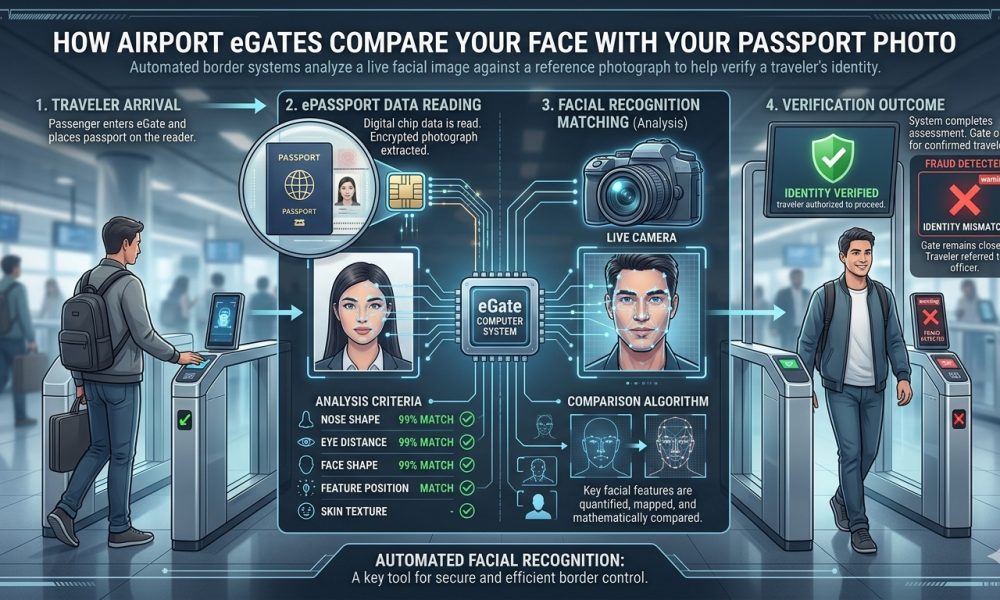
Automated border systems analyze a live facial Image against a reference photograph to help verify a traveler’s identity.
WASHINGTON, DC, October 5, 2026, When an international traveler steps into an automated airport eGate, the system can capture a live facial iImageand compare that Image against a trusted photograph associated with the traveler’s passport, helping border authorities determine whether the person presenting the document appears to be its legitimate holder.
Although the process often takes only several seconds from the traveler’s perspective, the underlying verification can involve passport reading, electronic data retrieval, facial-image processing, biometric comparison, eligibility checks, and government-system queries before the physical barrier opens or the traveler is referred for additional inspection.
The Passport Provides the Reference Identity
For electronic passports, the facial photograph stored in the passport’s contactless chip can provide a high-quality reference Image incorporated during government personalization, allowing compatible inspection systems to compare that trusted portrait with the traveler standing before the eGate Camera.
The international biometric architecture described by ICAO Doc 9303 specifically recognizes facial comparison between a traveler’s currently captured biometric Image and biometric information obtained from the travel document or another trusted source as an important method for confirming identity relationships during automated inspection.
The Gate First Establishes Which Passport Is Being Presented
Before facial comparison becomes meaningful, the automated system must establish which travel document belongs to the person entering the gate, typically by reading the passport and obtaining the identifying information needed to link the traveler to the corresponding document record.
Depending upon the border system and passport involved, the inspection equipment can obtain information from the Machine Readable Zone, electronic chip, government systems, or combinations of those sources before using an appropriate reference portrait for the biometric comparison performed inside the automated lane.
The Traveler Then Faces a Camera
After the document has been accepted for processing, the traveler is generally instructed to face an integrated Camera so the eGate can capture a sufficiently clear live facial Image for comparison against the photograph associated with the passport or government travel record.
Australia’s SmartGate instructions, for example, direct travelers to face the Camera and remove masks, hats, sunglasses, headphones, and other bulky items that could interfere with facial recognition, while allowing religious head coverings when the relevant facial area remains visible.
Software Converts Images Into Comparable Facial Information
Modern facial-recognition software does not simply place two photographs side by side and decide whether they look generally similar, because automated systems analyze measurable facial information and create mathematical representations that can be compared computationally despite ordinary differences between photographs.
Algorithms can evaluate relationships among facial regions while accommodating reasonable differences in expression, Camera position, illumination, hairstyle, aging, and other variables. However, Image quality and environmental conditions remain important because biometric comparison becomes harder when significant facial information is obscured or poorly captured.
The Comparison Is Usually One-to-One
A conventional eGate passport check generally performs what biometric specialists call a one-to-one comparison, meaning the system evaluates whether the live face presented at that moment sufficiently matches the reference portrait associated with the passport being processed.
This differs fundamentally from one-to-many facial Identification, where a newly captured face is compared against a larger gallery or watchlist to determine whether any stored identity matches the person being observed, because the ordinary document-holder comparison starts with a claimed identity supplied by the passport.
The System Produces a Similarity Assessment
Rather than requiring every facial characteristic to match perfectly, biometric software calculates a similarity measurement indicating how closely the live Image corresponds to the reference photograph, after which the border system evaluates that measurement against operational thresholds established for the particular deployment.
A traveler whose live Image produces sufficiently strong similarity can satisfy the facial-comparison component. At the same time, a weaker or uncertain result can stop the automated process, request another capture, or send the traveler to an officer instead of allowing the gate to make the final automated clearance.
A Threshold Determines Whether Automation Can Continue
The threshold used by an automated border system reflects an operational decision that balances security, traveler convenience, biometric performance, and the consequences of incorrectly accepting or rejecting a facial comparison, meaning facial-recognition systems do not simply operate according to an abstract universal percentage applied identically everywhere.
Border authorities can configure their systems to meet national requirements and operational environments, so travelers should not assume that a similarity result displayed by a commercial smartphone Application corresponds directly to the acceptance logic used inside a government-controlled airport eGate.
The Chip Photograph Can Be Especially Valuable
When the reference portrait comes from an authenticated electronic passport chip, the inspection system can be more confident that the facial Image matches the electronically protected information established during passport issuance, especially when the chip’s signed data has also passed the appropriate cryptographic checks.
This arrangement creates an important relationship between document Authentication and biometric verification, because cryptography can help establish confidence in the electronic reference information. At the same time, facial comparison addresses the separate question of whether the traveler at the gate matches the person depicted in that information.
The Printed Photograph Can Remain Relevant
Electronic systems have not made the physical passport photograph irrelevant, because trained border personnel can visually compare the traveler with the data-page portrait during referral or manual inspection. At the same time, document examination can identify physical inconsistencies that facial-recognition software was never designed to evaluate independently.
ICAO guidance also recognizes progressively broader biometric comparisons involving the traveler’s current Image, the biometric Image contained within the electronic travel document, information held within an authorized database, and visual inspection of the photograph appearing on the physical data page.
Facial Recognition Does Not Authenticate the Entire Passport
A successful facial comparison primarily shows that the person at the gate resembles the trusted reference photograph strongly enough to meet the system’s configured biometric requirements, rather than independently proving that every physical and electronic characteristic of the passport is genuine.
Document Authentication therefore remains a separate part of the inspection architecture, potentially involving chip Authentication, signed-data verification, certificate trust, physical-document checks, database status, and other procedures that answer questions fundamentally different from whether two facial images appear to represent the same individual.
Document Authentication and Facial Matching Work Together
The strongest automated inspection systems combine document information with biometric verification so the border process does not merely ask whether a passport appears technically legitimate or whether a traveler resembles a photograph, but instead evaluates several related elements in one controlled inspection.
Australia’s Border Force describes SmartGate as an automated passport-control system that uses facial recognition with the traveler’s passport to confirm identity, showing how modern border automation integrates biometric comparison with document processing rather than treating facial recognition as a stand-alone substitute for passport inspection.
Aging Does Not Automatically Prevent a Match
Passport photographs can remain valid for many years, so facial-recognition systems must routinely compare current travelers against reference portraits captured much earlier, when hairstyle, facial hair, weight, skin appearance, eyewear, and other visible characteristics may have changed noticeably.
Modern biometric comparison focuses on facial information that can remain relatively stable despite ordinary appearance changes, although substantial aging, major facial changes, low-quality images, unusual positioning, or other factors can reduce comparison confidence and require human review.
Camera Position and Lighting Still Matter
Automated gates are carefully designed to capture usable facial images because even advanced biometric algorithms depend on sufficient Image quality, making Camera positioning, lighting, facial visibility, and the traveler’s orientation important to achieving a reliable comparison.
Instructions asking travelers to look directly at the Camera and remove sunglasses or face coverings therefore serve a technical purpose by reducing avoidable differences between the live capture and reference Image that could otherwise weaken the biometric comparison or trigger unnecessary manual referral.
A Failed Facial Comparison Does Not Prove Impersonation
When an eGate does not accept a traveler’s facial comparison, that outcome does not automatically mean the individual is attempting to use someone else’s passport, because ordinary operational factors can prevent an automated system from reaching sufficient confidence even when the traveler is legitimate.
Poor Image capture, significant changes in appearance, document-reading difficulties, technical faults, eligibility issues, or other border-security requirements can all result in referral, which is why official systems maintain human inspection procedures rather than treating every automated rejection as evidence of fraud.
Human Officers Remain Part of the System
The United Kingdom explains through its current ePassport gate guidance that its automated gates use facial-recognition technology to check a traveler’s identity against the passport photograph. In contrast, travelers who cannot complete automated processing can be referred for further examination.
This human fallback is essential because automated border control is designed to process suitable routine cases efficiently while preserving trained officers’ ability to resolve uncertain biometric results, investigate documentation questions, and evaluate circumstances requiring broader immigration or security assessment.
The Gate Can Check More Than Facial Similarity
A traveler may experience an eGate as a Camera and moving barrier. Still, the surrounding border environment can include additional checks on travel-document validity, immigration status, nationality, eligibility, security information, and other records available to the responsible government.
Current United Kingdom guidance notes that travelers can be referred when additional inquiries are needed to verify a travel document, confirm nationality or identity, assess entry eligibility, resolve digital immigration permission issues, or address an operational problem with the gate itself.
One-to-One Verification Should Not Be Confused With Watchlist Identification
The passport-holder comparison conducted at an eGate should also be distinguished from separate facial-recognition systems that compare individuals against watchlists, because the two applications involve different biometric questions even when both technologies analyze human faces.
In passport verification, the system generally asks whether the traveler matches a specific identity already presented through the travel document. In contrast, a watchlist system asks whether an observed person matches one of numerous individuals in a predefined gallery.
Privacy Rules Differ Between Jurisdictions
Automated facial comparison necessarily involves personal and biometric information, so governments establish their own legal frameworks governing collection, retention, disclosure, security, and permitted uses under national immigration, border-management, and privacy laws.
The Australian Border Force states that automated entry processing involves collecting a full facial Image and travel-document information, and that its handling of personal information operates within Australian privacy and migration legislation, illustrating how biometric processing remains tied to national legal requirements rather than only technical specifications.
Smartphone Passport Apps Perform a Narrower Version of the Concept
Some mobile identity applications can perform facial comparison by retrieving the digital portrait from an electronic passport and comparing it with a selfie or live Camera capture, producing a process that can resemble one component of automated border verification.
However, a consumer or commercial Application generally lacks the full governmental environment surrounding an airport eGate, so its facial match cannot independently replicate the border authority’s document-status systems, immigration records, operational rules, security checks, and legal decision-making powers.
Airport eGates Are Layered Identity Systems.
As Amicus International Consulting has explained throughout its coverage of modern passport verification, electronic travel security becomes strongest when physical-document features, authenticated chip information, biometric comparison, cryptographic verification, and authoritative government records operate as complementary layers rather than interchangeable substitutes.
An eGate facial comparison is therefore one powerful component within that broader architecture, answering the key question of whether the individual standing before the Camera matches the trusted facial reference linked to the passport being presented.
The Face Match Helps Connect the Person to the Document
For travelers, the process can seem remarkably simple: they place or scan a passport, look into a Camera, and wait briefly for the gate to open, while the technology underneath turns those actions into a structured comparison between a claimed identity and a live biometric observation.
When the comparison succeeds alongside the other required border checks, the automated system gains evidence that the passport and the traveler belong together. At the same time, uncertain or unsuccessful cases remain available for human examination rather than forcing facial-recognition software to make decisions beyond the confidence supported by the available evidence.




