
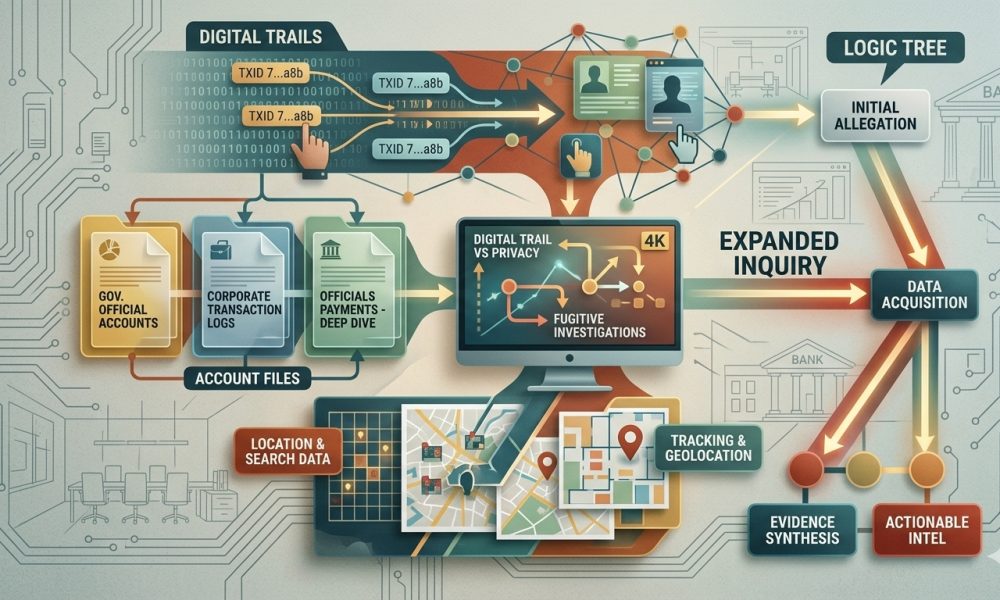
Claims of complete online invisibility overlook the broader evidence investigators can gather from a wanted person’s financial activity, devices, witnesses, and services.
Washington, DC, October 4, 2026 — Claims that a wanted person can become completely invisible online often overlook how modern investigations combine financial records, device evidence, travel information, witness testimony, and service-provider data to reconstruct activity even when individual communications or accounts are protected.
Strong privacy tools can reduce the visibility of particular data streams. Still, they do not automatically erase the many records created when people move money, use devices, cross borders, communicate with others, or interact with regulated institutions.
Digital Privacy Is Not the Same as Total Invisibility
A person may reduce exposure by limiting social media activity, using encrypted communications, or avoiding unnecessary online accounts. Still, those measures do not mean every relevant activity becomes inaccessible to investigators.
Modern investigations often rely on overlapping evidence sources rather than a single platform, allowing authorities to compare financial activity, communications, travel records, and device information before concluding a person’s movements or relationships.
This distinction matters because privacy tools can protect specific communications or records while leaving unrelated evidence available through banks, service providers, witnesses, and government systems.
Investigators often assemble the resulting picture gradually from many small pieces rather than discovering it through one decisive digital source.
Financial Activity Can Create Durable Records
Banks, payment processors, and other regulated financial institutions can maintain records showing account activity, transfers, and identity information under applicable law and retention requirements.
Those records can remain relevant even when a wanted person uses strong privacy settings elsewhere because financial systems operate independently from social media and messaging platforms.
Investigators may compare transactions with travel, communications, or witness accounts to determine whether multiple sources point to the same person or activity.
The Financial Action Task Force has long emphasized the importance of financial transparency and record-keeping in investigations involving money laundering, corruption, and other serious financial offenses.
Digital Assets Do Not Eliminate Financial Evidence
Cryptocurrency can change the structure of financial evidence, but it does not necessarily eliminate records of how assets were acquired, transferred, or converted.
Investigators may examine exchange records, banking activity, devices, and communications alongside whatever blockchain information remains available on the relevant network.
Privacy-focused digital assets can reduce public transaction visibility, yet the surrounding financial ecosystem may still generate records that help connect individuals with particular transactions.
This broader approach explains why digital asset investigations often depend upon several technical and conventional evidence sources rather than blockchain analysis alone.
Devices Can Reveal More Than Online Accounts
A smartphone, laptop or tablet can contain applications, locally stored communications, photographs, account information and other records that may become relevant when investigators obtain lawful authority to examine the device.
Digital forensics can sometimes reveal evidence not visible through a public internet search, and that may never have been uploaded to an external service.
The significance of device evidence depends upon attribution, meaning investigators still need to establish who controlled the device and how the recovered information relates to the broader case.
Possession of privacy software or encrypted applications alone should not be treated as evidence of criminal conduct because those tools have many legitimate uses.
Service Providers Can Hold Separate Records
A person may delete public profiles while service providers continue to retain account, billing, or access information under their own policies and legal obligations.
Different providers preserve different categories of information, making it inaccurate to assume that deleting an account automatically eliminates every associated record from every system.
Investigators seeking nonpublic information generally require appropriate legal process, and the availability of particular records depends upon jurisdiction, platform architecture, and retention practices.
This creates a distinction between what disappears from public view and what may still exist within controlled institutional systems.
Witnesses Can Reconstruct Activity That Technology Does Not Show
Human witnesses remain important in digitally sophisticated investigations because colleagues, family members, business associates, and service providers can sometimes explain relationships that electronic records alone leave ambiguous.
A witness can identify who used an account, explain the purpose of a payment, or place an individual at a particular meeting or location.
Those statements become more reliable when supported by independent records such as financial transactions, travel documents,s or communications.
This combination of human and technical evidence can undermine simplistic assumptions that avoiding public online activity makes a person impossible to identify or trace.
Travel Creates Its Own Information Trail
International movement often involves airlines, immigration systems, and identity-document checks that operate independently from ordinary consumer internet platforms.
Travelers may generate reservation records, border entries, visa information, and other administrative data under the laws and systems of the countries involved.
Deleting social media accounts does not erase those separate government and commercial records.
Investigators working across jurisdictions can sometimes use lawful international cooperation to obtain relevant travel information when the evidence meets applicable legal requirements.
Border Systems Operate Outside Social Media
Border agencies can examine passports, immigration databases and watchlist information without relying upon a person’s public online presence.
A traveler who has little or no social media footprint can therefore remain highly visible within immigration and transportation systems when using ordinary international travel infrastructure.
The INTERPOL network facilitates international police cooperation and information exchange in appropriate cases, although national authorities remain responsible for their own criminal procedures and enforcement decisions.
This separation demonstrates why online privacy and border visibility are fundamentally different concepts.
Encrypted Messaging Protects Content, Not Every Related Fact
End-to-end encryption can prevent unauthorized parties from reading message content during transmission, but it does not necessarily erase every piece of evidence associated with the communication.
Messages can remain on devices, recipients can preserve copies, and surrounding financial or travel records may independently confirm events discussed in private conversations.
Service architectures also differ, meaning some platforms may retain limited account or connection information even when they cannot read encrypted message content.
Investigators therefore treat encryption as one technical factor rather than assuming that encrypted communication makes the surrounding activity invisible.
Account Deletion Has Limited Reach
Deleting an account can remove public content or end future access, but it does not necessarily erase records previously shared with recipients, businesses, or government systems.
Screenshots, forwarded messages and financial records may remain outside the deleted account entirely.
Some providers may also retain limited records for security, legal, or operational reasons under their published policies and applicable law.
In practice, account deletion should not be interpreted as erasing every historical trace of activity.
Metadata Can Sometimes Provide Context
Even when message content remains unavailable, other records can sometimes establish timing, account relationships, or patterns of activity that become relevant alongside independent evidence.
Metadata alone usually does not explain what people discussed or prove criminal conduct, which means investigators must interpret it cautiously.
Its value increases when timestamps or account activity correspond with documented payments, meetings, or travel events.
This type of corroboration makes several weak clues more informative when they consistently support the same factual timeline.
Commercial Services Create Their Own Records
Hotels, rental companies, telecommunications providers, and online marketplaces can create records independently of a person’s social media presence.
The existence, availability, and retention of those records vary by jurisdiction and provider, and investigators generally need lawful authority before obtaining nonpublic information.
Those systems illustrate how ordinary commercial activity can produce evidence even when someone takes substantial steps to limit public online exposure.
A person can therefore be difficult to find through open internet searches while remaining visible in institutional records created by everyday transactions.
Real Estate and Corporate Records Can Matter
Property ownership, corporate registrations, and related legal filings can generate records that exist separately from consumer internet services.
Investigators examining financial crime or fugitive activity may review those records to understand ownership structures, business relationships, or potential asset locations.
The legal accessibility of particular records differs considerably among jurisdictions, and the mere appearance of a person’s name does not establish wrongdoing.
Their significance comes from how they fit with other evidence concerning finances, communications and movements.
Professional Relationships Can Leave Documentary Trails
Lawyers, accountants, consultants and other professionals can generate engagement records, invoices and communications in the ordinary course of legitimate work.
Professional confidentiality and privilege rules can restrict access to some information, particularly in legal relationships, meaning investigators must respect applicable protections.
Where records are lawfully obtainable and not privileged, they can help establish timelines or financial relationships relevant to an investigation.
This again shows why fugitive investigations can involve many institutional records that extend far beyond a person’s visible online presence.
Cash Can Reduce Digital Records Without Eliminating Evidence
Cash transactions create fewer automatic electronic records than conventional bank transfers, but they do not necessarily eliminate investigative evidence.
Withdrawals, surveillance, witnesses, and later purchases can provide circumstantial information about when cash was obtained and how it may have been used.
The absence of a bank-to-bank transfer therefore changes the evidence available without making the transaction inherently untraceable.
Investigators still need corroboration because cash activity alone can have entirely lawful explanations.
Associates Can Become Investigative Links
A wanted person can maintain strong personal privacy while still interacting with friends, relatives, business partners, or service providers whose own activities create records.
Investigators may examine those relationships when they have lawful reason to believe associates possess relevant evidence or information.
This does not make association itself suspicious, because people can know or assist someone in legitimate ways without participating in criminal conduct.
The evidentiary question remains whether independent facts connect the relationship to the conduct under investigation.
Communications Can Be Recovered From Other Participants
Even if one person deletes messages from a device, copies may remain with recipients or on other authorized systems depending upon the communication method used.
Investigators may obtain those records lawfully from cooperating witnesses or devices seized under appropriate legal authority.
The resulting evidence can reconstruct conversations that no longer appear on the wanted person’s own hardware.
This redundancy makes it difficult to control the historical record once information has been shared with another person.
Photographs Can Reveal Context Beyond Social Media
Images stored on devices or provided by witnesses can contain contextual information about locations, meetings, and relationships, even when those photographs were never posted publicly.
Investigators can examine such material when legally obtained and relevant to the case.
The evidentiary value depends upon Authenticity and context because an Image can be misunderstood when its date, source, or circumstances remain uncertain.
Visual evidence therefore works best when corroborated by travel, financial or witness information rather than interpreted in isolation.
Internet Privacy Does Not Erase Government Records
A person can reduce their public online footprint, but government agencies continue to maintain records connected with identity, immigration, licensing, taxation, or other lawful administrative functions.
Individuals do not ordinarily control those systems the same way they can delete or deactivate a social media account.
Access remains governed by law and agency procedures, meaning investigators cannot simply browse every governmental record without appropriate authority.
The important point is that personal control over public internet visibility does not equal control over independent government databases.
Identity Documents Link Physical and Administrative Records
Passports and other government-issued Identification connect a traveler with administrative records that exist outside ordinary online platforms.
Border authorities can authenticate physical and electronic document features while consulting separate systems concerning document status and immigration information.
This creates an evidentiary environment that remains largely unaffected by whether the traveler maintains public social media profiles.
Travelers seeking a broader explanation of modern identity-document verification can review the Amicus International Consulting guide to passport security and modern counterfeit detection.
Privacy Tools Can Still Be Valuable
The fact that complete invisibility is unrealistic does not mean digital privacy tools lack legitimate value.
Strong passwords, encrypted communications and careful data-sharing practices can reduce exposure to criminals, commercial tracking and unauthorized access.
Those benefits remain important for ordinary users who want greater control over personal information.
The problem arises when privacy technology is described as creating guaranteed immunity from lawful investigation, because that claim ignores the many unrelated records generated through normal financial and administrative activity.
Privacy and Evasion Are Different Concepts
Protecting personal information from unnecessary exposure is fundamentally different from attempting to conceal evidence or obstruct a lawful investigation.
The same encryption tool can serve legitimate professional confidentiality in one context and become relevant evidence in another if communications show participation in an alleged offense.
Investigators should therefore focus on conduct rather than treating privacy preferences as inherently suspicious.
This distinction protects lawful privacy while preserving the ability to investigate serious crimes through evidence-based methods.
Fugitive Investigations Depend on Corroboration
A strong investigation rarely depends entirely upon one phone record, payment, or witness because individual evidence sources can be incomplete or misleading.
Authorities often build timelines by comparing independent information from financial institutions, devices, travel records and interviews.
When several unrelated sources consistently place the same person within the same sequence of events, the combined evidence can become substantially stronger.
This method remains useful even if the person maintained a significant public internet presence.
Open-Source Searches Are Only One Investigative Tool
Public internet searches can help locate social media posts, corporate information, or other openly available material, but they represent only one layer of a broader investigation.
A person who avoids public posting can make open-source research less productive, but it does not prevent authorities from pursuing lawful evidence through other channels.
Financial records, witness interviews and government databases operate under different legal and technical conditions from public web searches.
The absence of online search results should therefore not be confused with the absence of an evidentiary trail.
International Cooperation Can Expand the Evidence Available
Fugitive cases frequently cross national boundaries, creating situations where relevant financial, travel or service-provider records are located in another jurisdiction.
Authorities can use Extradition treaties, mutual legal assistance procedures, and other formal cooperation mechanisms to seek evidence when applicable legal requirements are satisfied.
These procedures can be slow and complex, but they extend investigations beyond the records immediately available within one country.
Digital privacy measures therefore do not erase evidence lawfully maintained by institutions abroad.
Privacy Services Have Different Data Practices
Virtual private networks, email providers and messaging services differ significantly in what information they collect, retain and disclose under applicable law.
Using one privacy-oriented service should not create assumptions about another because technical architecture and retention practices vary widely.
Investigators must understand the specific provider and, where relevant, obtain information through lawful procedures.
Broad claims that all privacy services make users completely invisible therefore ignore substantial technical and legal differences between platforms.
Device Security Can Protect Users Without Creating Immunity
Full-disk encryption, secure messaging and strong Authentication can protect devices from unauthorized access and theft, providing important security benefits for legitimate users.
Those protections can complicate digital forensic examination in some investigations, but they do not erase financial records, witnesses, or external service data.
Authorities may also obtain evidence from sources that never depended upon the protected device.
This demonstrates why digital security should be understood as protecting particular systems rather than making every activity surrounding the user disappear.
AFugitive’ss Network Can Produce Evidence Independently
Business partners and associates can create communications, financial records, and travel information that investigators obtain independently from the person they are trying to locate.
A wanted individual therefore does not control every record relevant to the investigation simply by securing their own devices.
The more people involved in a network, the more potential evidence sources there are, although each source still requires proper legal and factual evaluation.
Network investigations often succeed through these independent points of corroboration rather than through one vulnerable account.
Complete Digital Invisibility Is an Unrealistic Standard
The phrase digital invisibility suggests that an individual can eliminate every discoverable connection between identity, finances, travel, and communications, which becomes increasingly unrealistic once that person continues interacting with modern institutions.
Every commercial transaction or official interaction can potentially create a record somewhere, although access to that information remains subject to technical availability and legal authority.
A person can substantially reduce unnecessary public exposure without gaining complete control over every independent record other organizations create.
This distinction provides a more accurate understanding of what privacy technology can realistically accomplish.
Evidence Still Requires Lawful Interpretation
The existence of digital records does not mean investigators can use them without limitation or treat ambiguous information as proof of criminality.
Evidence must be obtained lawfully, authenticated appropriately, and interpreted within the case’s factual context.
Defendants can challenge attribution, search procedures and the meaning prosecutors assign to particular records.
Modern investigative capability therefore operates within legal safeguards rather than eliminating the importance of due process.
Privacy Claims Should Be Evaluated Precisely
A service claiming to minimize logs, encrypt messages, or reduce tracking may provide a genuine privacy benefit within the technical area it addresses.
Problems arise when narrow protections are marketed or interpreted as guaranteeing that a user cannot be located or investigated through unrelated evidence.
Accurate privacy analysis asks which information is protected, who can still possess independent records,s and what legal mechanisms may apply.
That approach produces a more realistic assessment than broad claims promising complete anonymity across every financial, travel and administrative system.
Modern Investigations Are Built From Networks of Evidence
Fugitive investigations increasingly combine digital forensics with traditional methods, including interviews, financial analysis, travel records and documentary evidence.
Privacy technology can reduce the visibility of individual communications or online activities, but the broader investigation can continue through sources outside those protected channels.
When several independent records converge, authorities may reconstruct activity even without direct access to every message or account.
For legitimate users, the same reality carries an important lesson: strong privacy tools remain valuable for protecting personal information, but they do not eliminate the independent records created through ordinary participation in modern financial, commercial, and governmental systems.




