
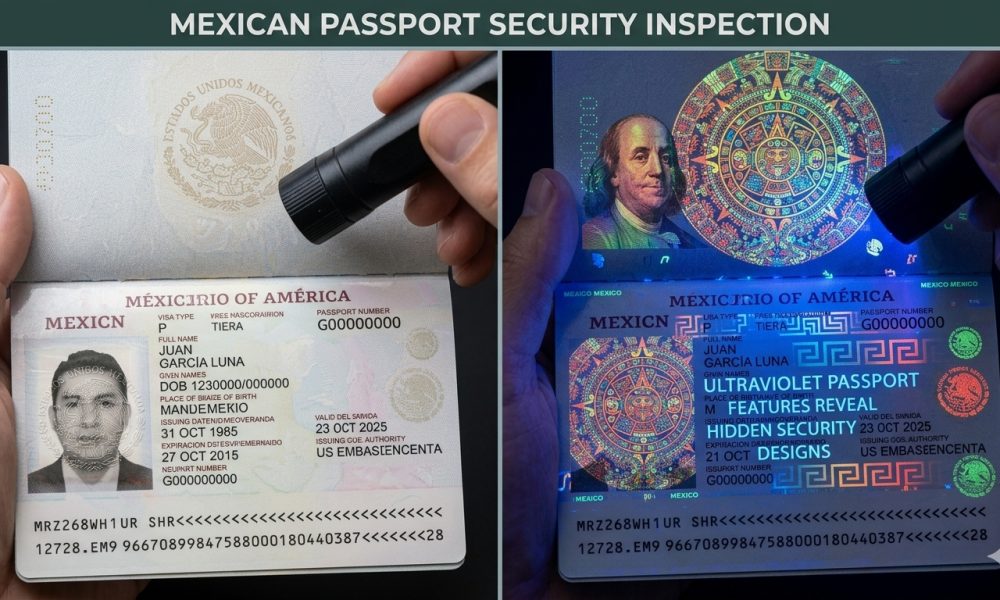
Fluorescent artwork and security fibers provide additional inspection evidence when examiners compare documents with the correct issuing-country specifications.
Washington, DC, October 3, 2026 — Ultraviolet security features allow passport inspectors to see details that remain invisible or hard to detect under ordinary white light, adding evidence that can help distinguish authentic document construction from reproduction, substitution, or unauthorized alteration.
These hidden characteristics can include fluorescent fibers, symbols, Background patterns, page numbers, and other designs that respond predictably under ultraviolet illumination. However,h their value depends upon comparing the questioned passport against the correct specifications for that issuing country and document generation.
Ultraviolet Examination Reveals a Different Visual Layer
Many passport security features are designed to become visible only under ultraviolet light, allowing authorities to create a second visual environment that complements the information a traveler normally sees on the document.
Under appropriate illumination, portions of the passport may display fluorescent artwork, national symbols, geometric patterns, fibers, or other elements that remain nearly invisible under normal conditions but appear clearly during professional document examination.
This hidden layer gives inspectors another independent source of information because counterfeiters who reproduce only the visible appearance of a passport may fail to duplicate the ultraviolet characteristics embedded in the original materials and printing.
The International Civil Aviation Organization’s travel document program maintains the broader international framework for secure machine-readable travel documents, supporting internationally interoperable standards for passports and other travel documents.
Fluorescent Artwork Can Extend Across Entire Pages
Ultraviolet-responsive printing can create complex artwork that covers large portions of visa pages, identity pages, and other passport sections while remaining unobtrusive under normal daylight examination.
A page that appears relatively simple under white light may reveal detailed patterns, symbols or illustrations under ultraviolet illumination, giving inspectors multiple points of comparison against known genuine examples.
These designs may also continue across facing pages or interact with other visible security elements, creating relationships that become difficult to reproduce accurately if someone substitutes or reconstructs part of the booklet.
When a replacement page displays missing, incomplete,e or incorrectly positioned fluorescent artwork, the discrepancy can become an important reason for further investigation.
Security Fibers Add Randomized Evidence
Passport paper can contain fluorescent fibers incorporated during manufacturing, creating small security elements distributed throughout the material rather than printed onto its surface.
Under ultraviolet illumination, these fibers may glow in predetermined colors while remaining difficult to see under normal lighting, allowing inspectors to evaluate whether the underlying paper behaves like genuine security stock.
Because the fibers are embedded within the material, an imitation produced on ordinary commercial paper may fail to reproduce their depth, distribution, or ultraviolet response convincingly.
Their randomized placement also complicates reproduction because counterfeiters must imitate a physical manufacturing characteristic rather than merely copy a repeating printed design.
Ordinary Paper Can Behave Differently Under Ultraviolet Light
Commercial paper often contains optical brightening agents that can cause the entire sheet to fluoresce strongly under ultraviolet illumination, producing a noticeably different appearance from specialized security paper designed for controlled optical behavior.
Passport manufacturers can select materials that react in carefully specified ways, allowing certain fibers or patterns to fluoresce while the surrounding substrate remains comparatively subdued.
A substituted page produced from ordinary office paper may therefore appear unusually bright or respond inconsistently when compared with neighboring genuine pages from the same booklet.
This difference does not independently establish fraud, but it can provide useful evidence when combined with printing inconsistencies, binding irregularities or discrepancies in other security features.
Different Ultraviolet Wavelengths Can Produce Different Results
Ultraviolet examination is not always a single standardized visual test because different wavelengths can cause inks, fibers, and materials to respond differently depending upon the document design.
Examiners commonly use long-wave ultraviolet light during document examination, while specialized laboratory equipment may support additional wavelengths when more detailed analysis is needed.
The appearance of a genuine feature therefore depends upon using appropriate equipment and understanding how that particular passport generation is expected to respond under the selected illumination conditions.
An examiner cannot reliably conclude that a feature is missing merely because it fails to appear under an unsuitable light source or because the equipment does not reproduce the wavelength the document designer intended.
Issuing-Country Specifications Matter
Ultraviolet designs differ substantially between countries and passport generations, which means inspectors must understand what features should appear before deciding whether a questioned document behaves incorrectly.
One country may use fluorescent national symbols throughout its visa pages. At the same time, another may incorporate geometric patterns, page-specific illustrations, or fibers that appear only in certain sections of the booklet.
Even passports issued by the same government can differ after redesigns, creating situations where a genuine older document displays ultraviolet characteristics that do not match a newer passport series.
Travelers seeking a broader explanation of these layered defenses can review the Amicus International Consulting guide to passport security and modern counterfeit detection, which examines how physical and electronic features contribute to document Authentication.
Ultraviolet Features Can Protect the Identity Page
Governments can position ultraviolet artwork near photographs, names, document numbers, and other personalized information, creating hidden structures that help reveal whether important identity fields have been disturbed.
If someone removes, replaces, or modifies part of the data page, nearby fluorescent printing may become damaged, interrupted, or misaligned, producing evidence that becomes more obvious under ultraviolet light.
This technique becomes particularly valuable when a visible alteration has been performed carefully enough to appear convincing under ordinary lighting.
The ultraviolet response can therefore expose inconsistencies that would otherwise remain concealed during a brief inspection focused only upon the photograph and printed biographical information.
Fluorescent Printing Can Cross Photographs and Personalization
Some designs place ultraviolet-responsive elements directly over or around personalized information, creating overlapping relationships that make unauthorized substitution increasingly difficult.
A fluorescent pattern crossing a portrait or biographical field should retain expected continuity and alignment, while an altered area may show missing sections or intensity differences.
Counterfeiters attempting to recreate the visible appearance of a photograph may overlook hidden ultraviolet artwork that should continue through the same region.
Inspectors can therefore compare both the ordinary and ultraviolet appearance of the personalized area before deciding whether the page remains structurally consistent.
Visa Pages Provide Additional Examination Opportunities
Ultraviolet features are frequently distributed throughout passport visa pages rather than being concentrated exclusively on the primary identity page.
This design lets inspectors check whether the entire booklet shows the expected fluorescent characteristics, making page substitution or reconstruction harder.
A replacement visa page may resemble neighboring pages under normal lighting but reveal completely different fluorescence under ultraviolet illumination.
When multiple pages show consistent hidden artwork and one page reacts differently, the discrepancy can become an important indicator requiring closer inspection.
Ultraviolet Fibers and Printed Designs Perform Different Functions
Embedded security fibers and printed fluorescent artwork may look similar when illuminated, but they come from different manufacturing processes and therefore provide distinct evidence.
Fibers are generally incorporated into the paper itself, while fluorescent inks or coatings can be applied during specialized printing stages after the substrate is manufactured.
An authentic passport may use both techniques simultaneously, forcing a counterfeit reproduction to imitate several independent material and printing characteristics correctly.
This layered approach strengthens security because defeating one ultraviolet feature does not automatically reproduce the others.
Hidden Page Numbers Can Support Structural Inspection
Some passport designs include ultraviolet-reactive page numbers or other sequencing information that allows inspectors to confirm whether pages appear in the expected order.
A missing, duplicated, or incorrectly positioned number can attract attention, especially when the surrounding visible page numbering appears normal.
Hidden numbering also creates another obstacle for page substitution because a replacement sheet must reproduce both visible and ultraviolet sequencing features.
Inspectors can compare those characteristics with binding, stitching, and page alignment to determine whether the booklet has likely remained intact.
Ultraviolet Examination Can Reveal Damage and Repairs
Physical manipulation can disturb fluorescent printing and security fibers in ways that become easier to recognize under ultraviolet illumination than under ordinary white light.
Scraping, chemical treatment, adhesive Application, or page reconstruction may alter how affected areas respond to ultraviolet light, producing differences in brightness or fluorescence.
These anomalies can be especially significant when they occur around photographs, passport numbers or other fields commonly targeted during document alteration.
However, examiners must distinguish deliberate manipulation from ordinary wear because legitimate passports can also develop stains, abrasion, or environmental damage over years of travel.
Authentic Features Can Deteriorate Over Time
Ultraviolet security elements are not immune to aging, repeated handling, moisture, heat or other environmental influences that may change their appearance over the lifetime of a passport.
A damaged fluorescent feature therefore does not automatically prove that the document is counterfeit or altered.
Professional examination considers whether the observed deterioration appears consistent with the passport’s age, overall condition and documented use.
An ultraviolet anomaly becomes more significant when it appears alongside unrelated inconsistencies involving printing, chip data, security paper, or document construction.
Reference Material Is Essential for Reliable Comparison
Document specialists rely upon authoritative reference material when examining ultraviolet features because visual expectations can vary significantly between issuing authorities and document series.
The European Union’s Public Register of Authentic Identity and Travel Documents Online provides reference information about many passports and identity documents, helping legitimate users understand which security features may be present in particular document types.
Reference information prevents inspectors from assuming that every passport should display the same fluorescence, patterns, or fibers under ultraviolet examination.
Correct Identification of the issuing country, passport generation, and document type should therefore precede any meaningful conclusion about whether an ultraviolet feature appears abnormal.
Ultraviolet Features Do Not Establish Authenticity by Themselves
A passport containing convincing fluorescent artwork is not automatically genuine because sophisticated counterfeiters may reproduce visible or ultraviolet-reactive elements using specialized inks and commercially available materials.
Professional inspection therefore considers whether the ultraviolet feature displays the correct design, location, intensity, alignment and relationship with surrounding security elements.
A fraudulent document may reproduce one hidden feature successfully while failing other tests involving microprinting, laser engraving, security paper, chip Authentication, or booklet construction.
Similarly, a genuine passport with damaged ultraviolet printing may still satisfy numerous other physical and electronic checks.
Electronic Authentication Provides an Independent Check
Modern biometric passports add electronic security through contactless chips that store standardized personal data and digitally signed information from the issuing authority.
Electronic verification serves a different function than ultraviolet inspection because cryptographic Authentication evaluates digital information, while ultraviolet examination assesses hidden physical characteristics within the booklet.
When both systems produce consistent results, authorities have stronger evidence that the passport conforms to expected issuance and manufacturing characteristics.
When physical and electronic evidence conflict, the document may require additional inspection before an examiner can reach a reliable conclusion.
Ultraviolet Security Works Best as Part of a Layered System
The value of ultraviolet passport features comes from their ability to reveal information that complements visible printing, optical devices, laser personalization, and electronic Authentication rather than replacing those technologies.
A suspicious passport may include one convincing fluorescent design while showing incorrect paper, inconsistent personalization, or electronic data that fails expected validation procedures.
Authorities therefore gain the strongest assessment when ultraviolet features support a broader collection of mutually consistent physical and digital evidence.
For legitimate travelers, fluorescent artwork and security fibers usually go unnoticed, yet these hidden features give trained inspectors additional information when a passport requires closer examination.
Ultraviolet passport security ultimately demonstrates how modern travel documents protect identity through multiple overlapping technologies, ensuring that important Authentication evidence can remain concealed from casual observation while remaining available to properly equipped and informed examiners.




