
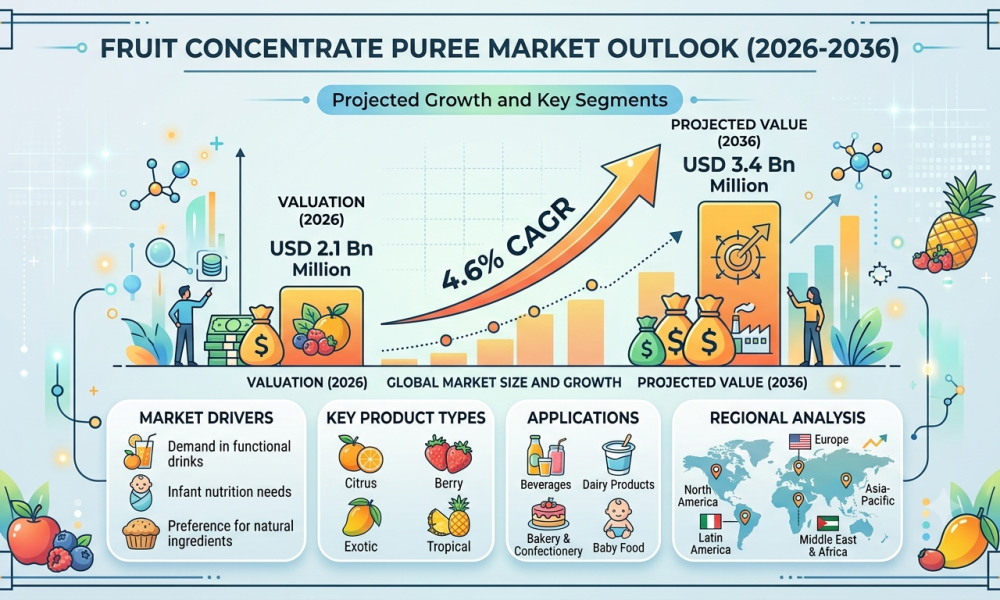
The global fruit concentrate puree market is projected to grow from USD 2.1 billion in 2026 to USD 3.4 billion by 2036, registering a 4.6% CAGR during the forecast period. Demand is supported by growing use of concentrated fruit ingredients across beverages, dairy, bakery, snacks, functional foods, and infant nutrition. Food manufacturers are increasingly using concentrates to deliver fruit flavor, color, and body while reducing the amount of water that needs to be transported and stored.
Demand is also being shaped by sugar-reduction pressures and the growing preference for clean-label and naturally positioned products. No added sugar concentrates are gaining traction as manufacturers seek greater control over sugar levels and product labeling. Exotic fruit concentrates, particularly mango, passion fruit, and pineapple, are also finding applications across beverage, dairy, and snack formulations. Crop variability, seasonal supply, and fruit-price fluctuations remain important considerations for buyers and suppliers.
Get detailed market forecasts, competitive benchmarking, and pricing trends: https://www.futuremarketinsights.com/reports/sample/rep-gb-102
Global Segment Leaders
- Fruit Family – Exotic Fruit: 28.5% in 2026. The segment leads the fruit family category, supported by demand for mango, passion fruit, pineapple, and other tropical profiles across beverages, dairy products, and snacks.
- Type – No Added Sugar: 65.3% in 2026. The segment leads as food manufacturers seek greater control over sugar levels amid growing reformulation and sugar-reduction requirements.
Country-Level Performance
The United States is projected to grow at the fastest pace among the profiled countries, with a 5.8% CAGR through 2036. Growth is supported by a broad food and beverage formulation base and increasing efforts by food manufacturers to respond to added-sugar reduction guidance.
South Korea is expected to record a 5.2% CAGR, supported by the country’s reliance on imported intermediate food-processing ingredients. USDA Foreign Agricultural Service reported strong growth in Korean fruit and vegetable juice imports, with concentrates identified as an area of opportunity.
Germany is projected to expand at a 4.6% CAGR, matching the global market growth rate. Demand is supported by the country’s large processed food and beverage sector and growing interest in healthier, convenient, and sustainable food products.
The United Kingdom is forecast to grow at a 3.9% CAGR, with soft drinks policy and changing sugar-related requirements influencing formulation demand. The UK’s Soft Drinks Industry Levy is also scheduled for a lower sugar threshold from January 2028.
Japan is expected to grow at a 3.5% CAGR through 2036, representing the slowest growth among the profiled countries. Demand remains supported by applications in soft drinks, juices, health foods, frozen foods, and dairy products.
Regional Context
The United States and South Korea represent the faster-growing markets among the countries profiled, with CAGRs of 5.8% and 5.2%, respectively. The United States benefits from a broad formulation base and growing sugar-reduction activity, while South Korea’s reliance on imported processing ingredients creates opportunities for fruit concentrate puree suppliers.
Germany, the United Kingdom, and Japan represent more mature markets, with CAGRs ranging from 4.6% to 3.5%. Germany’s processed food and beverage industry supports steady demand, while UK growth is influenced by soft drinks labeling and sugar-levy changes. Japan continues to see demand across beverages, health foods, and dairy despite its slower projected growth rate.
The full report covers North America, Latin America, Western Europe, Eastern Europe, East Asia, South Asia and Pacific, and the Middle East and Africa, with more than 30 countries included within the report scope.
Access full Report in PDF Format@ https://www.futuremarketinsights.com/reports/brochure/rep-gb-102
Competitive Landscape
The competitive landscape includes Döhler Group, AGRANA Beteiligungs-AG, Tree Top, Kanegrade Limited, Symrise AG, iTi Tropicals, and Andros Group. Competition is shaped by access to fruit sources, processing integration, Brix control, formulation expertise, application support, and geographic reach.
Recent developments include Symrise AG completing major upgrades at its Pasaje, Ecuador facility in June 2025, strengthening its tropical ingredients production capabilities. In September 2025, SVZ integrated tropical fruit specialist Netra Agro into its core portfolio, expanding its fruit and vegetable ingredient offering. In October 2025, AGRANA Beteiligungs-AG completed the purchase of RWA’s 49.99% stake in AUSTRIA JUICE, strengthening its position in fruit processing and ingredients.
The market continues to present opportunities for suppliers with diversified sourcing networks and application support. Weather-related crop variability across European and tropical fruit origins is making multi-origin sourcing, consistent Brix specifications, and supply continuity increasingly important for food and beverage manufacturers.
About Future Market Insights (FMI)
Future Market Insights, Inc. (ESOMAR certified, recipient of the Stevie Award, and a member of the Greater New York Chamber of Commerce) offers profound insights into the driving factors that are boosting demand in the market. FMI stands as the leading global provider of market intelligence, advisory services, consulting, and events for the Packaging, Food and Beverage, Consumer Technology, Healthcare, Industrial, and Chemicals markets. With a vast team of over 400 analysts worldwide, FMI provides global, regional, and local expertise on diverse domains and industry trends across more than 110 countries.



