
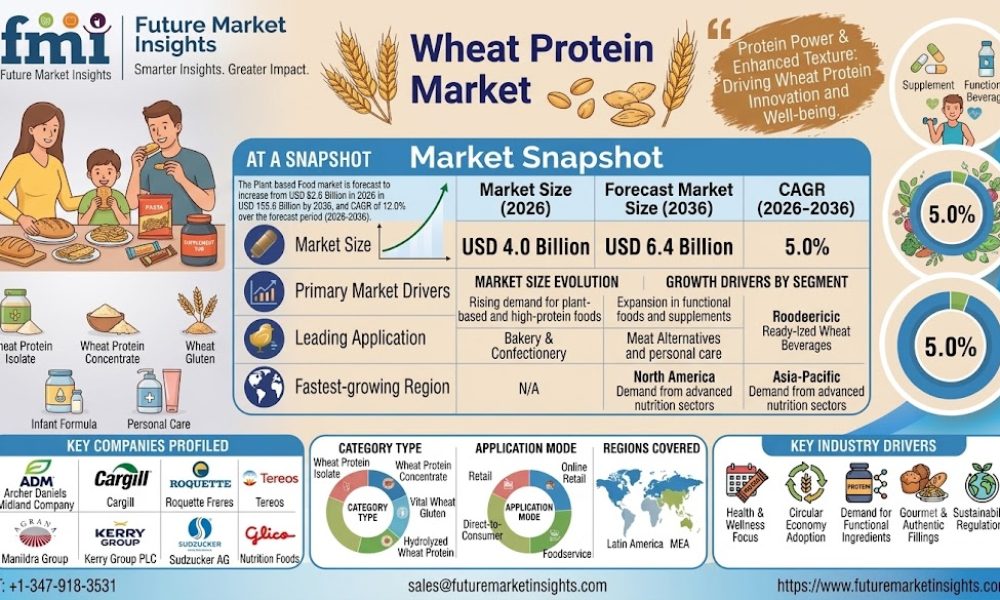
NEWARK, Del., September 25, 2026 According to Future Market Insights (FMI), the Wheat Protein Market is projected to grow from USD 4.0 billion in 2026 to USD 6.4 billion by 2036, expanding at a 5.0% CAGR. The market was valued at an estimated USD 3.8 billion in 2025. Demand is supported by the dual role of wheat protein in nutrition and food processing, where it can contribute protein content while also improving dough strength, hydration, texture, and product structure.
Wheat protein serves different technical purposes across applications. Bakers use it to influence dough strength and handling, while manufacturers of meat alternatives use wheat protein to develop structure and texture. Nutrition products require concentrated protein while meeting serving and amino-acid targets. As a result, suppliers must demonstrate how individual grades perform at the required dose in the finished product rather than competing solely on price per kilogram.
Raw-material availability and grain quality also influence input economics across producing countries. Germany harvested 22.6 million tonnes of winter wheat in 2025, while official quality testing recorded average crude protein at 12.2%. Japan’s March 2026 wheat outlook placed food-wheat demand at 5.60 million tonnes, including 4.61 million tonnes expected from foreign wheat. Canada also maintains a substantial wheat milling base. These figures indicate potential raw-material supply routes but do not directly measure wheat protein sales.
Get detailed market forecasts, competitive benchmarking, and pricing trends: https://www.futuremarketinsights.com/reports/sample/rep-gb-6395
Key Takeaways
- The Wheat Protein Market is estimated at USD 4.0 Billion in 2026 and is forecast to reach USD 6.4 Billion by 2036, expanding at a 5.0% CAGR. The 2025 market base was approximately USD 3.8 Billion.
- Wheat Gluten accounts for 32.0% of Product Type revenue in 2026, supported by its viscoelastic network and applications in bakery, flour standardization, meat alternatives, and selected feed uses.
- Dry represents 79.0% of Form revenue in 2026, benefiting from bulk storage, standardized dosing, dry blending, and long-distance distribution advantages.
- Nutrition Supplements lead the Application segment in 2026, supported by the use of isolates and hydrolysates in concentrated protein products and specialized nutrition formulations.
- Wheat protein supports both protein enrichment and functional performance, allowing manufacturers to address structural, hydration, texture, and nutritional requirements.
- Wheat allergen labeling and gluten avoidance restrict the eligible consumer base, while protein quality and solubility can make switching suppliers more difficult when flavor or dose requirements are stringent.
- Key companies profiled in the market include Archer Daniels Midland Company (ADM), Cargill, Roquette Freres, Tereos, MGP Ingredients, Agrana Beteiligungs-AG, Manildra Group, Kerry Group PLC, Sudzucker AG, and Glico Nutrition Foods.
Analyst Perspective
“The same wheat protein specification will behave differently in bread dough, a beverage and a meat alternative. Buyers should test the intended function and dose before judging offers on price per kilogram.”
— Nandini Roy Choudhury, Principal Consultant, Future Market Insights
Market Growth Outlook
The Wheat Protein Market is positioned at the intersection of functional food ingredients, protein enrichment, bakery processing, meat alternatives, and specialized nutrition.
The market is forecast to increase from USD 4.0 billion in 2026 to USD 6.4 billion by 2036, reflecting a 5.0% CAGR. Growth is supported by manufacturers seeking ingredients that can deliver both nutritional value and functional performance in finished products.
Wheat protein has applications across multiple product categories. In bakery, it can influence dough strength and handling. In meat alternatives, it contributes to structure. Nutrition manufacturers use concentrated forms such as isolates and hydrolysates to increase protein content in specialized formulations.
This diversity of applications creates different purchasing requirements. A bakery manufacturer may prioritize dough performance, while a nutrition company may focus more heavily on protein concentration, dispersibility, serving requirements, and amino-acid targets.
Key Market Drivers
- Rising demand for protein-enriched food products
- Growing use of wheat protein in bakery applications
- Increasing adoption of meat alternatives
- Demand for functional food ingredients
- Expansion of sports and specialized nutrition products
- Growing use of concentrated protein ingredients
- Need for improved dough strength and handling
- Increasing demand for standardized ingredient performance
- Expansion of dry ingredient blending
- Growing interest in plant-based protein formulations
Segment Insights
Which Product Type Leads the Wheat Protein Market?
Wheat Gluten accounts for 32.0% of Product Type revenue in 2026.
Wheat gluten provides a viscoelastic protein network that supports dough structure and processing performance. Its functionality also makes it relevant to meat alternatives and selected feed applications.
The broad range of functional uses supports its position across bakery and other food-processing applications.
Which Form Leads the Market?
Dry represents 79.0% of Form revenue in 2026.
Dry wheat protein formats support bulk storage, standardized dosing, dry blending, and long-distance distribution. These characteristics are particularly relevant for industrial food manufacturers handling ingredients at scale.
Which Application Leads the Market?
Nutrition Supplements lead the Application segment in 2026.
Wheat protein isolates and hydrolysates can provide concentrated protein for powders and specialized nutrition products. Formulators must nevertheless balance protein concentration with dispersibility, serving requirements, flavor, and nutritional targets.
Regional Outlook
Regional market dynamics are influenced by wheat production, grain quality, milling capacity, import requirements, and downstream food manufacturing.
Germany represents an important wheat supply environment. The country harvested 22.6 million tonnes of winter wheat in 2025, with official quality testing reporting average crude protein of 12.2%. Wheat quality can influence the suitability and economics of downstream protein processing.
Japan has a significant dependence on imported wheat for food use. Its March 2026 wheat outlook placed food-wheat demand at 5.60 million tonnes, with 4.61 million tonnes expected from foreign wheat. This creates a different raw-material sourcing environment from major wheat-producing markets.
Canada also maintains a substantial wheat milling base, supporting potential raw-material routes for wheat protein production and processing.
These agricultural and milling indicators help explain differences in supply economics, but they should not be interpreted as direct measurements of wheat protein sales.
Market Dynamics
Market Opportunities
The market presents opportunities for manufacturers through protein-enriched foods, specialized nutrition products, bakery ingredients, meat alternatives, and functional formulations.
Suppliers can differentiate through protein concentration, solubility, dispersibility, functional performance, and application-specific grades. Demonstrating performance at the required dosage can also help suppliers build repeat business with industrial buyers.
Dry formats provide additional opportunities because they support bulk handling, standardized dosing, dry blending, and transportation over longer distances.
Market Challenges
Wheat allergen labeling and gluten avoidance represent important constraints for manufacturers targeting broad consumer markets. Products containing wheat protein may not be suitable for consumers avoiding gluten or wheat-based ingredients.
Protein quality, solubility, dispersibility, flavor, and required dosage can also affect formulation economics. Switching suppliers may therefore involve application testing rather than a simple comparison of ingredient prices.
Emerging Market Trends
Major trends shaping the Wheat Protein Market include:
- Rising demand for protein-enriched products
- Increasing use of plant-based protein ingredients
- Expansion of wheat protein in meat alternatives
- Growing application in specialized nutrition
- Greater emphasis on protein concentration
- Increasing demand for application-specific protein grades
- Expansion of dry protein ingredient formats
- Growing focus on ingredient functionality
- Increased importance of solubility and dispersibility
- Greater emphasis on allergen and labeling controls
Competitive Landscape
Competition in the Wheat Protein Market is influenced by protein concentration, functional performance, processing capabilities, application expertise, raw-material sourcing, and distribution reach.
The companies profiled in the market include Archer Daniels Midland Company (ADM), Cargill, Roquette Freres, Tereos, MGP Ingredients, Agrana Beteiligungs-AG, Manildra Group, Kerry Group PLC, Sudzucker AG, and Glico Nutrition Foods.
Market participants are focused on serving different application requirements across bakery, nutrition, meat alternatives, and other food-processing categories. Product functionality and performance at the required dosage remain important factors in supplier selection.
Frequently Asked Questions
What is the projected size of the Wheat Protein Market by 2036?
The global Wheat Protein Market is forecast to reach USD 6.4 Billion by 2036, increasing from USD 4.0 Billion in 2026.
What is the expected CAGR of the Wheat Protein Market?
The market is projected to expand at a 5.0% CAGR between 2026 and 2036.
What was the market size in 2025?
The Wheat Protein Market was valued at an estimated USD 3.8 Billion in 2025.
Which product type leads the market?
Wheat Gluten accounts for 32.0% of Product Type revenue in 2026.
Which form holds the largest share?
Dry represents 79.0% of Form revenue in 2026.
Which application leads the market?
Nutrition Supplements lead the Application segment in 2026, supported by the use of concentrated wheat protein ingredients in specialized nutrition products.
What are the key uses of wheat protein?
Wheat protein is used in bakery products, meat alternatives, nutrition supplements, and selected feed applications, where it can contribute protein content and functional characteristics such as structure, dough strength, hydration, and texture.
What are the major challenges facing the market?
Key challenges include wheat allergen labeling, gluten avoidance, protein quality, solubility, dispersibility, flavor, and application-specific dosage requirements.
Who are the key players in the Wheat Protein Market?
Key profiled companies include Archer Daniels Midland Company (ADM), Cargill, Roquette Freres, Tereos, MGP Ingredients, Agrana Beteiligungs-AG, Manildra Group, Kerry Group PLC, Sudzucker AG, and Glico Nutrition Foods.
About Future Market Insights (FMI)
Future Market Insights, Inc. (ESOMAR certified and a recipient of the Stevie® Award) provides actionable market intelligence and consulting services across food & beverage, pharmaceuticals, chemicals, advanced materials, industrial manufacturing, sustainability, and consumer goods industries.
FMI delivers comprehensive market research, competitive intelligence, and strategic insights that help organizations identify emerging opportunities, evaluate market dynamics, and make informed business decisions across global markets.
For Press & Corporate Inquiries
Rahul Singh
AVP – Marketing and Growth Strategy
Future Market Insights, Inc.
+91 8600020075
For Sales: [email protected]
For Media: [email protected]
For Web: Future Market Insights
For Web: Fact.MR



