
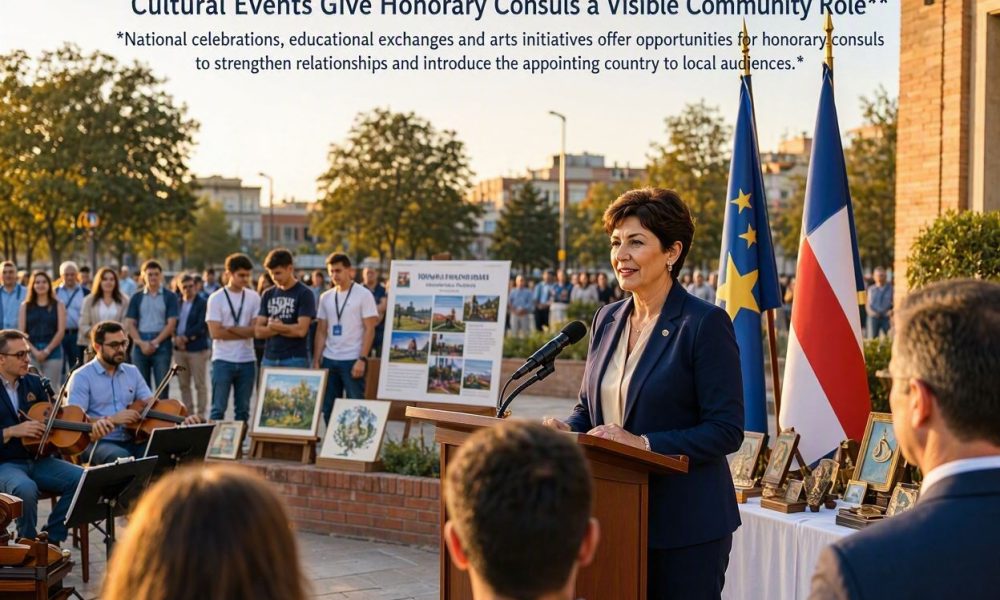
National celebrations, educational exchanges, and arts initiatives offer honorary consuls opportunities to strengthen relationships and introduce their appointing country to local audiences.
WASHINGTON, D.C., September 19, 2026 — Cultural events can give honorary consuls one of their most visible roles in the communities where they serve, because national celebrations, educational exchanges, exhibitions, performances and public programs create practical opportunities to introduce the appointing country while building relationships that extend beyond formal government meetings.
Cultural Relations Are Part of the Consular Framework
The legal foundation for this public-facing work is broader than ceremony, since Article 5 of the Vienna Convention on Consular Relations identifies the development of commercial, economic, cultural and scientific relations, together with the promotion of friendly relations, as recognized consular functions between sending and receiving states.
The U.S. Department of State guidance on honorary consular officers further explains that honorary consular officers recognized in the United States are expected to exercise meaningful consular functions regularly while remaining supervised by, and accountable to, the foreign government they officially represent.
That framework helps explain why an honorary consul may appear at an independence-day reception, university program, film screening, heritage festival or business-cultural forum without acting as a career diplomat, because cultural engagement can form part of an authorized consular portfolio when it remains connected to the appointing government.
Those requirements matter because the title of honorary consul does not create an unrestricted personal platform, and cultural events should be understood as extensions of an official appointment rather than private opportunities to imply broader diplomatic authority than the receiving state has actually recognized.
Smaller Diplomatic Networks Can Gain Local Visibility
For smaller countries with limited diplomatic networks, cultural programming can provide a comparatively efficient way to maintain a local presence in cities where establishing a fully staffed career consulate would be expensive, unnecessary or inconsistent with the host country’s rules governing foreign representation.
A national-day reception may bring together local officials, educators, business leaders, diaspora organizations, artists and community representatives, creating a setting in which an honorary consul can introduce the country’s history, tourism, investment priorities and cultural traditions while expanding the network available to the appointing government.
Unlike highly formal diplomatic meetings conducted primarily among government officials, these gatherings can place a foreign country directly before local communities, allowing residents to experience its traditions, language, food, music and artistic expression through personal participation rather than through distant institutional communications.
Educational Exchanges Can Create Lasting Relationships
Educational exchanges can create an even longer-lasting effect because partnerships among universities, colleges, language programs and cultural institutions may continue after a single event, giving students and researchers recurring opportunities to build direct connections with institutions and people in the appointing country.
An honorary consul who helps connect a university with a visiting lecturer, research institution, or scholarship program therefore contributes to relationship building in a way that can be locally visible, relatively low cost, and consistent with the broader objective of strengthening cultural and scientific ties.
Students who initially encounter another country through a university lecture, exchange program, or language initiative may later become tourists, researchers, investors, or international business professionals, giving educational diplomacy an influence that can continue for years beyond the original honorary-consular event.
Arts and Culture Can Reach Audiences Beyond Government
Arts initiatives can serve a similar purpose, especially when galleries, museums, film societies, and performing-arts organizations want to present work from countries that may have limited representation in the local cultural calendar or little public recognition among residents of the host city.
A carefully organized exhibition or film program can introduce local audiences to contemporary writers, musicians, filmmakers and visual artists while also moving the public Image of a country beyond political headlines, tourism advertising or simplified cultural stereotypes that often dominate international perceptions.
The value of these events depends heavily on credibility, because audiences generally respond more positively when programming is presented as genuine cultural exchange rather than as an exaggerated display of status, influence or protocol surrounding the individual who holds the honorary appointment.
Cultural Diplomacy Is Increasingly Local
Modern diplomacy increasingly emphasizes engagement beyond capital cities, and Reuters reporting on the expansion of consular representation in Greenland described scientific and cultural initiatives as methods used by diplomatic representatives to build stronger relationships with communities and institutions outside traditional political channels.
Although that example involves career consular representation rather than an honorary appointment, the underlying approach illustrates why cultural programming can be strategically useful for smaller diplomatic footprints, especially when the objective is to build familiarity, institutional contacts, and goodwill over time.
For an honorary consul working far from the appointingcountry’ss embassy, cultural engagement can therefore become an important bridge between formal diplomacy and ordinary community life, particularly when residents might otherwise have little direct contact with representatives of that foreign government.
Diaspora Communities Often Become Natural Partners
Diaspora communities often become natural partners in this work because they can help organize national celebrations, language programs, food festivals, commemorations, and visiting delegations. At the same time, the honorary consul can provide an official connection to the sending state and help coordinate appropriate participation by its embassy or ministries.
These communities may already possess extensive knowledge of the sending country’s traditions, language, and institutions, allowing honorary consuls to work with established organizations rather than creating every cultural initiative independently or relying exclusively on resources supplied by a distant embassy.
At the same time, an effective honorary consul should avoid letting community events become narrowly exclusive gatherings, because one of the strongest benefits of cultural diplomacy comes from introducing the appointing country to people who do not already belong to its diaspora, business network, or established circle of supporters.
Schools, Libraries and Universities Expand the Audience
Public schools, universities, libraries, museums and municipal cultural organizations can therefore be especially valuable partners, since their audiences often include younger people and residents who may have little previous exposure to the sending country but are open to education, travel, language study and international collaboration.
Programs involving visiting authors, historical exhibitions, student competitions, language instruction or national heritage celebrations can make international relations tangible for residents who may never attend a diplomatic reception, meet an ambassador or interact directly with a foreign ministry.
That community-level visibility can be particularly useful for countries whose international profiles are dominated by a narrow range of political or economic stories, because cultural programming lets local audiences encounter a broader representation of the country’s history, society, and contemporary identity.
Cultural Programs Can Also Support Trade Relationships
Business relationships can also grow from cultural engagement, even when commercial promotion is not the primary purpose, because receptions and public programs create informal settings where entrepreneurs, trade officials and local professionals can meet people whose first connection to the country began through culture rather than investment.
This overlap between culture, trade and community relations helps explain why governments sometimes select honorary consuls who already have deep local networks, since a respected resident with established institutional relationships may be able to connect the sending state with organizations that would otherwise receive little direct diplomatic attention.
A cultural event can consequently create introductions that later lead to tourism promotion, educational cooperation, commercial discussions or investment opportunities, even though the original gathering may have been organized around music, national heritage, cuisine, literature or another noncommercial subject.
Honorary Consuls Remain Different From Ambassadors
However, local visibility does not transform an honorary consul into an ambassador, and governments, appointees, and event organizers should communicate titles carefully. Hence, guests understand the official capacity involved without assuming that every statement, business discussion, or social appearance carries the authority of a full diplomatic mission.
That distinction matters in an era when diplomatic titles and official-looking documents can be misunderstood, because lawful diplomatic status depends on appointment, recognition, and the applicable international framework rather than on personal presentation, social prestige, or the simple possession of an official or diplomatic passport.
Amicus International Consulting has previously examined these distinctions in its analysis of diplomatic passports and immunity, emphasizing the broader principle that official diplomatic treatment depends upon recognized status and applicable legal protections rather than appearances or assumptions surrounding a particular document.
Visibility Brings Reputational Responsibility
A separate Amicus examination of the state of diplomatic passports in 2026 also discusses the reputational problems that can develop when diplomatic status becomes confused with personal advantage, making disciplined public communication especially important for honorary officials whose effectiveness depends heavily upon credibility.
Cultural events should therefore reinforce the appointing country’s interests and relationships rather than become vehicles for personal promotion, because the legitimacy of an honorary appointment ultimately comes from government authorization, receiving-state recognition, and the genuine performance of the functions assigned to that position.
The strongest cultural programs therefore tend to be those that make the appointing country, rather than the consul personally, the center of attention, while producing measurable connections such as new educational partnerships, recurring community programs, artistic exchanges, tourism relationships or sustained institutional cooperation.
National Celebrations Can Become Diplomatic Platforms
National-day celebrations remain among the most recognizable examples because they combine ceremony, history and community participation while allowing honorary consuls to explain the significance of a country’s independence, constitution, monarchy, national foundation or another important historical milestone to unfamiliar audiences.
When local elected officials, cultural leaders, educators, business representatives, and members of the diaspora attend together, the event can create a network that extends well beyond the celebration itself and provide the honorary consulate with relationships that may support future educational, commercial, or community initiatives.
These events can also help an embassy understand regional communities it rarely encounters directly, since an honorary consul positioned hundreds or thousands of kilometers from the national capital can provide local observations about institutions, economic interests, and potential partners within the assigned consular district.
Cultural Diplomacy Can Give a Small Office a Large Reach
For receiving communities, these programs can broaden international awareness without requiring residents to travel abroad; for sending governments, they offer a practical way to maintain a human presence, communicate national culture, and identify potential partners in regions where a traditional diplomatic footprint may remain limited.
When managed carefully, cultural diplomacy can become one of the most constructive and publicly understandable functions of an honorary consulate, because it translates an otherwise technical appointment into visible community activity while remaining connected to the recognized purpose of strengthening relations between countries.
The NewsTrail Takeaway
The result is a role that can be modest in formal power yet significant in local reach, with national celebrations, educational exchanges and arts initiatives giving honorary consuls repeated opportunities to build durable relationships that continue long after the reception ends or the exhibition closes.
For governments with limited diplomatic networks, that community presence can make an honorary consulate far more than a nameplate or ceremonial appointment, provided the consul remains properly authorized, accurately represents the limits of the office, and consistently directs public attention toward the country and relationships the appointment was created to serve.




