
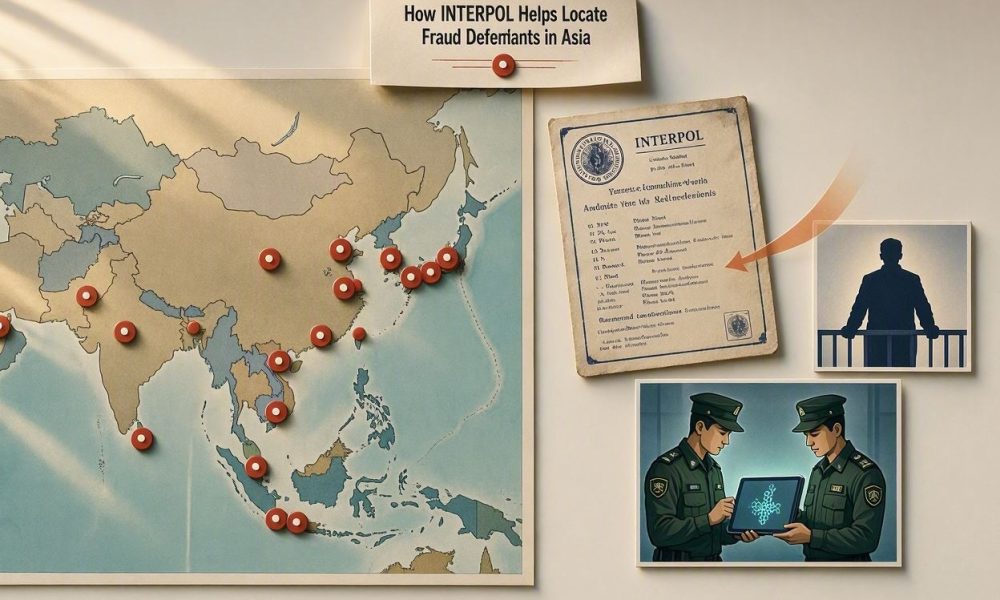
An INTERPOL Red Notice or wanted-person diffusion can alert foreign authorities to a defendant sought by American prosecutors, helping police establish identity and location. In contrast, national authorities assess possible detention, and the United States pursues formal Extradition.
WASHINGTON, DC, September 9, 2026 — For American fraud investigators following a defendant into Asia, INTERPOL can provide an essential connection between an outstanding criminal case and foreign police who otherwise might not recognize the significance of a person they encounter.
The organization helps participating authorities exchange identifying information, communicate investigative requests, and develop international leads, but locating a defendant, establishing a lawful basis for detention, and securing Extradition remain distinct tasks involving different institutions and separate legal decisions.
That distinction matters in financial crime cases because allegations may span several countries, involve companies with similar names and concern transactions that require substantial explanation before foreign officials can understand why a particular individual is being sought.
An International Alert With National Consequences
A Red Notice requests assistance in locating and provisionally arresting a person pending Extradition, surrender, or comparable legal action. Still, its circulation does not create a universal arrest warrant or compel every receiving country to detain the individual.
The Justice Department’s explanation of INTERPOL notices states that each member country determines their effect under national law, making the receiving jurisdiction’s legal framework central to understanding what an international alert can accomplish when police encounter a wanted defendant.
For readers following a fraud investigation, the practical implication is that an announcement about a notice establishes a request for international cooperation. In contrast, any later announcement about an arrest should identify which national authority acted and under what process.
The distinction also protects the presumption of innocence, because a person wanted for prosecution remains an accused defendant, and neither the prominence of an international alert nor the seriousness of alleged financial losses establishes guilt before a competent court.
How Police Cooperation Crosses Borders
INTERPOL’s National Central Bureaus connect national law enforcement agencies with their counterparts abroad, allowing officials to exchange requests through an established institutional network rather than relying exclusively on isolated contacts between investigators working in different countries and legal systems.
For an American fraud case, that connection can help foreign officers understand who is wanted, which authority seeks assistance, and where follow-up questions should go, creating a clearer basis for cooperation when an unfamiliar name appears during an investigation.
A useful way to understand this role is to imagine a foreign officer receiving a fragment of a much larger case, with international communication providing the context needed to distinguish a meaningful lead from an unrelated similarity.
That context becomes especially important when an investigation concerns several defendants, overlapping businesses, or alleged intermediaries, because the description of one participant’s conduct should not automatically apply to everyone connected with the same company, account, or commercial project.
Red Notices and Diffusions Serve Related Purposes
INTERPOL describes a diffusion as a cooperation request circulated directly by a membercountry’ss National Central Bureau to some or all other member countries, with wanted-person diffusions providing a mechanism for seeking action concerning accused or convicted individuals.
Both notices and diffusions must comply with INTERPOL’s rules. However, their circulation and review processes differ, so describing a diffusion as an unrestricted informal message would overlook the legal standards governing information exchanged through the organization’s police cooperation system.
For public understanding, the most useful question concerns what the particular communication requests, since an alert seeking information about identity or location should not automatically be described as a request to arrest somebody for eventual Extradition proceedings abroad.
A precise account therefore identifies the communication when authorities disclose it, acknowledges uncertainty when they do not, and avoids presenting every reference to INTERPOL as proof that a published Red Notice exists for the individual under discussion.
Locating Someone Requires Reliable Identification
International police databases can support comparisons of identifying records, including photographs and fingerprints where available. However, investigators still need to understand a match in context before authorities treat the person encountered as the defendant sought in another country.
Names alone can create ambiguity across languages, spelling conventions and document systems, making accurate identity information particularly valuable when investigators must explain why apparently different records refer to one person or why similar records concern entirely different people.
Consider a hypothetical case involving two businesspeople with similar names, where an imprecise public allegation could harm the wrong individual. At the same time, a carefully documented comparison would give investigators a stronger basis for deciding whether further inquiries are justified.
The broader lesson is evidence quality: international reach adds value only when the information shared is accurate, current, and specific enough to support responsible decisions by officials who may know little about the original investigation.
A Bali Arrest Illustrates the Distinction
In October 2024, Associated Press reporting on an Indonesian fraud arrest described the detention in Bali of a Chinese suspect sought over an alleged investment scheme exceeding fourteen billion dollars, after immigration screening identified him while he attempted to depart for Singapore.
The report said Indonesian authorities were still considering deportation or Extradition and examining questions about the suspect’s citizenship and travel document, illustrating how locating a wanted person can precede separate decisions about the legal mechanism for returning that individual.
For American cases in Asia, the analytical relevance lies in those separate stages, because a successful identification answers where someone is while leaving authorities to address custody, documentation, and the requested destination through the applicable procedures.
The example should therefore be read as an illustration of cooperation rather than a forecast for another prosecution, since a case requested by one government cannot establish how a different country will handle an American defendant facing different allegations.
Asia Requires Country-Specific Legal Analysis
Asia contains many legal systems and Extradition relationships, making a regional label useful for geography but insufficient for predicting whether a particular fraud defendant can be arrested, detained, or surrendered after American authorities request assistance from a foreign government.
A careful assessment must consider the country involved, the defendant’s circumstances, and the allegations actually presented, because a broad statement about regional enforcement cannot substitute for examining the legal basis governing an individual case at the relevant time.
For businesses and families following proceedings, this means that another defendant’s experience offers limited guidance unless the underlying circumstances are comparable, including the requesting government, the applicable rules and the procedural stage reached when the reported development took place.
The distinction matters in headlines promising a rapid return, because an arrest announcement may mark substantial investigative progress without resolving the legal questions that determine whether an international transfer can ultimately proceed in the case being reported.
The Extradition File Must Support the Request
The Justice Department’s Justice Manual assigns its Office of International Affairs a central role in reviewing American Extradition requests. At the same time, prosecutors prepare supporting materials and the State Department handles the diplomatic transmission required for formal requests under the applicable process.
Those materials generally address the charges, warrant, relevant laws, evidence, and identity, with certification, authentication, and translation requirements shaped by the governing treaty and destination country, so publishing an international alert does not replace preparing the Extradition submission.
From an editorial perspective, this explains why the most visible event may be the arrest while the less visible work involves documents, since officials receiving a request need a coherent account they can assess within their own legal framework.
A large alleged loss can attract attention, but the amount alone does not explain the defendant’s role, the nature of the alleged deception, or the connection between particular transactions and the offenses for which surrender is being requested.
Provisional Arrest Creates Urgency
The Justice Manual explains that urgent cases may involve provisional arrest before the full Extradition submission arrives, after which applicable deadlines govern delivery of the required documents. Failure to follow through can result in release from that detention.
The practical significance is that police success and documentary readiness should be understood together, since finding a person can create immediate procedural demands that require prosecutors, translators and government officials to work from consistent information about the same underlying case.
For observers, a subsequent release requires careful explanation of the actual ruling, because release from one form of custody does not by itself reveal whether the criminal charges were dismissed or whether the prosecution continues in the requesting country.
Likewise, continued detention should not be reported as a prediction of conviction, since the legal reasons for holding somebody during Extradition proceedings concern that process and cannot substitute for the criminal court’s eventual determination of the underlying allegations.
Fraud Allegations Need a Clear Factual Narrative
An international fraud story becomes easier to understand when it explains the alleged conduct in ordinary language, identifying what representations were made, who allegedly relied on them, and how prosecutors say the resulting transfers or losses connect to the defendant.
That explanatory approach also helps readers distinguish allegations about intentional deception from descriptions of commercial failure, because an unsuccessful investment, unpaid debt or collapsed business does not establish every element of a criminal fraud offense simply through its financial outcome.
Where dual criminality applies, the relevant inquiry concerns whether the alleged conduct meets the required criminal standard in both jurisdictions, subject to the governing rules, rather than whether the countries happen to use identical names for their offenses.
For that reason, a responsible article should avoid treating an American charge label as self-explanatory internationally, instead describing the alleged behavior accurately while leaving disputed factual conclusions and the application of foreign law to the appropriate legal decision-makers.
The Public Website Shows Only Part of the Picture
INTERPOL explains that most notices are restricted to police use, with public extracts appearing only when publication is requested for an appropriate purpose, so searching the organization’s public website cannot establish the full range of information available to authorized authorities.
For journalists, employers and concerned relatives, the absence of a public result is therefore a limited observation about that search, rather than reliable proof that no international cooperation request, domestic warrant or separate proceeding exists concerning the person being researched.
The reverse problem also deserves attention, because an old article or copied notice image may survive online after circumstances change, making the date, origin and current relevance of a record essential to any fair account of somebody’s legal position.
Responsible reporting should describe what has actually been verified and distinguish it from what remains unknown, particularly when a search result might otherwise encourage readers to confuse a historic allegation, a current alert and a final judicial outcome.
Safeguards Protect the Integrity of International Alerts
INTERPOL reviews notices and wanted-person diffusions for compliance with its constitution and data rules, including requirements addressing judicial information and identity. At the same time, its framework also restricts activities of a political, military, religious or racial character within the organization’s mandate.
The Commission for the Control of INTERPOL’s Files provides an independent mechanism for requests concerning access, correction or deletion of personal data. However, examination of an INTERPOL record is distinct from adjudicating the criminal prosecution that prompted international cooperation.
The analytical consequence is that several legal questions can coexist: whether information belongs in an international police system, whether local detention is lawful and whether the underlying criminal accusation can ultimately be proved before the court responsible for that prosecution.
Readers should therefore resist claims that a notice automatically validates every allegation or that its deletion automatically resolves every proceeding, since a decision concerning one institution’s records does not necessarily answer questions entrusted to a different authority or court.
Technology Supports Cooperation Without Replacing Judgment
INTERPOL provides databases and investigative support that help participating agencies connect information across borders. Yet, a record’s availability differs from continuous knowledge of a person’s movements, and a database result still requires interpretation within the surrounding investigation.
A useful comparison is a reference system that becomes valuable when authorized officials ask relevant questions, because shared information alone does not explain when officers will encounter a person or what lawful action they can then take.
This distinction gives news coverage a more realistic foundation than imagery of uninterrupted global surveillance, allowing an article to explain the contribution of information sharing without suggesting that an international alert supplies an automatic location feed for every wanted defendant.
It also keeps attention on the human responsibilities involved, including evaluating the reliability of a lead, distinguishing allegations from facts, and ensuring that communications between agencies accurately describe both the person sought and the assistance being requested.
Lawful Advice Begins With the Actual Case
Amicus International Consulting presents its INTERPOL Red Notice and Extradition services as involving case evaluation and assistance with international legal concerns. This subject requires clear distinctions between advisory work, representation by qualified counsel, and decisions reserved to government authorities.
For someone seeking guidance, a useful discussion begins with verified documents and a clear account of the procedural position, including what has been alleged, which proceedings are active, and which questions require a lawyer qualified in the relevant jurisdiction.
Any lawful assessment should address the existing case directly, because international relocation, a residence permit, or additional citizenship should never be presented as a substitute for resolving criminal proceedings or as a promise that another country cannot take legal action.
Individuals seeking an initial assessment can use Amicus International Consulting’s contact page to describe their circumstances, but retaining qualified legal counsel remains essential for advice on court obligations, detention, Extradition proceedings, and the protection of rights under applicable law.
What Progress Looks Like in an International Fraud Case
For victims awaiting accountability, a defendant’s location can represent meaningful progress. Still, a fair account should distinguish that development from recovery of money, a final surrender decision, and any eventual determination of criminal responsibility in court.
For defendants and their families, the same distinctions support a clearer understanding of events, helping separate the existence of an allegation from the effect of an international alert and the specific legal basis for decisions made by foreign authorities.
INTERPOL’s contribution is strongest when reliable information reaches the right national officials and supports lawful cooperation, allowing a fraud investigation to move beyond geographic barriers while preserving the separate responsibilities of investigators, prosecutors, courts and governments throughout the international process.




