
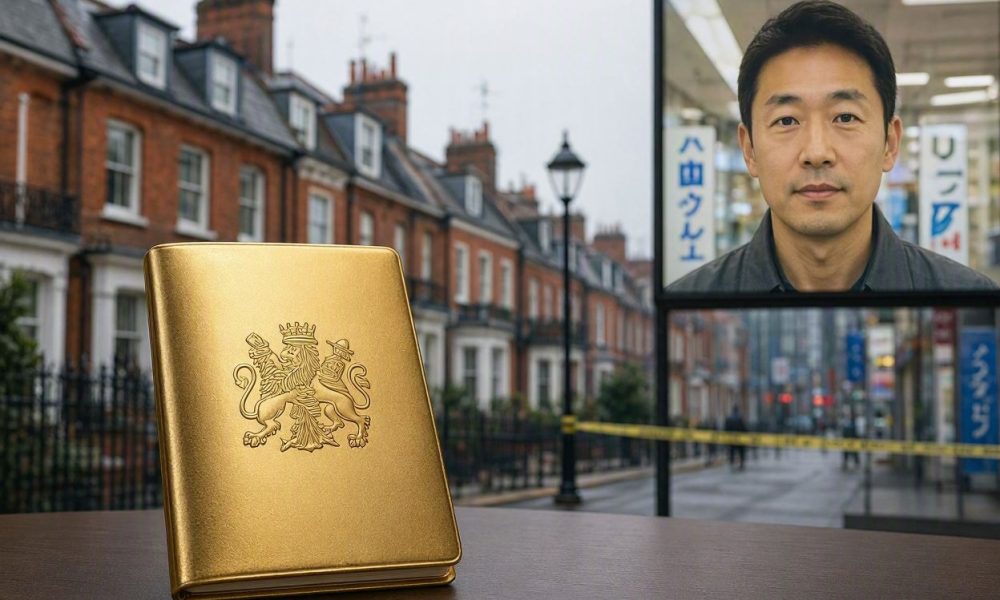
The businessman reportedly used St. Kitts and Nevis citizenship to set up British companies, but corporate and property records ultimately linked his multiple nationalities, businesses, and assets.
WASHINGTON, D.C. — A Chinese-born businessman wanted by authorities in China over alleged illegal gambling operations has been identified as the owner behind 85 London properties frozen during a major British civil-recovery investigation.
Su Jiangbo, 40, reportedly used a citizenship-by-investment passport from St. Kitts and Nevis when establishing British companies that accumulated at least $108 million in luxury real estate.
British authorities initially concealed his identity, referring to him only as “Mr. X.” At the same time, investigative journalists later connected the properties, companies, and Caribbean passport to Su through corporate filings and land-registration documents.
A subsequent investigation found Su living in Osaka, Japan, where he owns residential property and operates a tourism and real estate company under another legally registered name.
The case illustrates both the international mobility created by citizenship-by-investment programs and the limits of using additional nationalities to separate a person from earlier identities, business interests or unresolved legal allegations.
The Passport Came From St. Kitts and Nevis
Contrary to accounts associating Su with Vanuatu, reporting by the Organized Crime and Corruption Reporting Project found that he used a St. Kitts and Nevis passport to establish 12 British companies.
At least 10 of those companies were used to purchase London properties, according to corporate and property records examined by OCCRP and The Sunday Times.
Su also holds Cambodian citizenship, reportedly acquired in 2015, and uses the name “Su Jimmy” as his legal identity in Cambodia.
Possessing several citizenships or legally recognized names is not inherently unlawful. However, financial institutions, lawyers and property professionals are generally expected to determine an applicant’s complete identity, citizenship history, source of funds and exposure to criminal or regulatory proceedings.
A second passport does not lawfully erase a holder’s country of birth, former nationality, earlier names or financial history. Those connections can remain visible through passport applications, corporate registries, banking records, property transactions and international information-sharing systems.
Lawfully obtained second citizenship can provide legitimate mobility, family security and commercial opportunities, but it cannot properly be used to conceal criminal conduct or mislead regulated institutions. Amicus has previously examined the importance of obtaining a second passport through lawful and verifiable procedures.
Chinese Authorities Listed Su as a Fugitive Suspect
Su appeared on a September 2023 wanted list published by the Datian County Public Security Bureau in Fujian province, according to the records examined by OCCRP.
The notice described him as a “fugitive criminal suspect” allegedly suspected of operating a casino. It appeared alongside 37 other wanted individuals accused in separate cases involving offenses that included illegal gambling, fraud and cybercrime.
The available reporting does not establish that all 38 individuals participated in one criminal organization, nor does it document a specific multimillion-dollar gambling network controlled by Su.
Su categorically denies committing any criminal offense and argues that the allegations are an attempt by local Chinese authorities to pressure wealthy entrepreneurs into surrendering money.
He has instructed lawyers to address the Chinese allegations and has described them as baseless. No conviction arising from those allegations has been reported.
An $108 Million London Property Portfolio
British property records indicate that companies owned by Su began purchasing London real estate only weeks before the Chinese wanted notice was published on September 15, 2023.
The acquisitions continued until at least June 2025 and eventually included 85 apartments across central and south London.
Among them was a penthouse valued at approximately $13 million overlooking St. Paul’s Cathedral, the Tate Modern and the River Thames. Companies linked to Su reportedly purchased at least $24 million in units at the Triptych Bankside development alone.
On March 18, 2026, the High Court granted the Crown Prosecution Service an Unexplained Wealth Order and an Interim Freezing Order covering the portfolio.
The Crown Prosecution Service valued the frozen properties at more than £81 million and confirmed that the order covered 85 properties held by a Chinese national and associated British companies.
The CPS said it suspected that illicitly obtained money may have been used to purchase the properties. The Metropolitan Police supported the resulting civil-recovery investigation.
A Freeze Is Not a Criminal Conviction
An Interim Freezing Order prevents assets from being sold, transferred or otherwise dissipated while authorities investigate their origin. It does not automatically transfer ownership of the properties to the government.
An Unexplained Wealth Order requires the respondent to provide information explaining how the assets were acquired and demonstrate that the purchase funds came from lawful sources.
If an explanation is considered inadequate, prosecutors may apply for a Civil Recovery Order seeking forfeiture. The owner can contest that application and appeal an adverse judicial decision.
Su has not been charged with or convicted of a crime in the United Kingdom. He acknowledges that he is the person identified as “Mr. X,” but strongly denies wrongdoing and says the money used to acquire the properties came from legitimate sources supported by complete records.
He has retained lawyers to challenge the British orders.
The distinction is important: British authorities have frozen and are investigating the properties, but the portfolio has not been conclusively determined to represent criminal proceeds.
Investigators Locate Su in Osaka
In July 2026, OCCRP and Kyodo News reported that Su had lived in Japan for about two years.
Japanese property records show that he purchased a house in suburban Osaka in 2024. He is also the sole shareholder and director of Tenichi Fuka Ltd., an Osaka company that owns another nearby property.
Su incorporated Tenichi Fuka in April 2024 under the name “Su Jimmy,” his legal identity in Cambodia. The company initially promoted high-end Japanese tourism packages and later expanded its registered activities to include real estate, construction and mineral-water interests.
Su said he moved to Japan because of its political and economic stability, developed infrastructure and growing tourism industry. He denied any financial connection between Tenichi Fuka and the British companies holding the frozen properties.
The use of the name Su Jimmy in Japanese records does not, by itself, establish a false identity. The significance lies in how investigators linked that name to Su Jiangbo through Cambodian citizenship records, corporate filings, property ownership, and other identifying information.
Why Citizenship Due Diligence Cannot End at Approval
The public reporting does not specify when Su acquired his St. Kitts and Nevis citizenship. It therefore cannot be assumed that the September 2023 Chinese wanted notice existed when his citizenship application was reviewed.
That uncertainty nevertheless highlights the importance of continuous monitoring after citizenship is granted, particularly when an investor later becomes wanted, sanctioned, criminally charged or connected with unexplained international assets.
A strong citizenship-by-investment system requires more than an initial police certificate. Effective oversight may include verifying every nationality and former name, conducting independent source-of-wealth analysis, screening international databases, and continuing review when significant adverse information emerges.
Financial institutions and professional intermediaries carry separate responsibilities. A genuine passport confirms citizenship, but it does not independently establish that the holder’s wealth is legitimate or that every declaration made during a transaction is complete.
As Amicus International Consulting’s analysis of legal citizenship and investment-migration oversight shows, the long-term credibility of citizenship programs depends on transparent issuance, verifiable identity records, and meaningful due diligence.
A Second Passport Does Not Make Someone Invisible
Su’s reported movement across China, Cambodia, St. Kitts and Nevis, Britain and Japan demonstrates how wealthy individuals can establish several legitimate citizenship, corporate and property connections across different jurisdictions.
It also demonstrates how those connections can be reconstructed.
British company filings revealed the passport used to establish Su’s businesses. Land registries documented the London purchases. Chinese records disclosed the wanted notice, while Japanese corporate and property documents led reporters to his Osaka business and residences.
The result is a transnational documentary trail that remained discoverable despite multiple citizenships and different legal names.
Citizenship-by-investment can provide lawful mobility, security and access to new markets. It cannot guarantee anonymity from law enforcement, financial regulators or investigative journalists—and it cannot immunize assets from properly authorized court proceedings.
For governments running investment-migration programs, the Su Jiangbo case is another warning that citizenship must remain connected to a transparent, continuously verifiable identity. For investors, it reinforces an equally important principle: a second passport is a lawful planning instrument, not a mechanism for erasing the past.




