
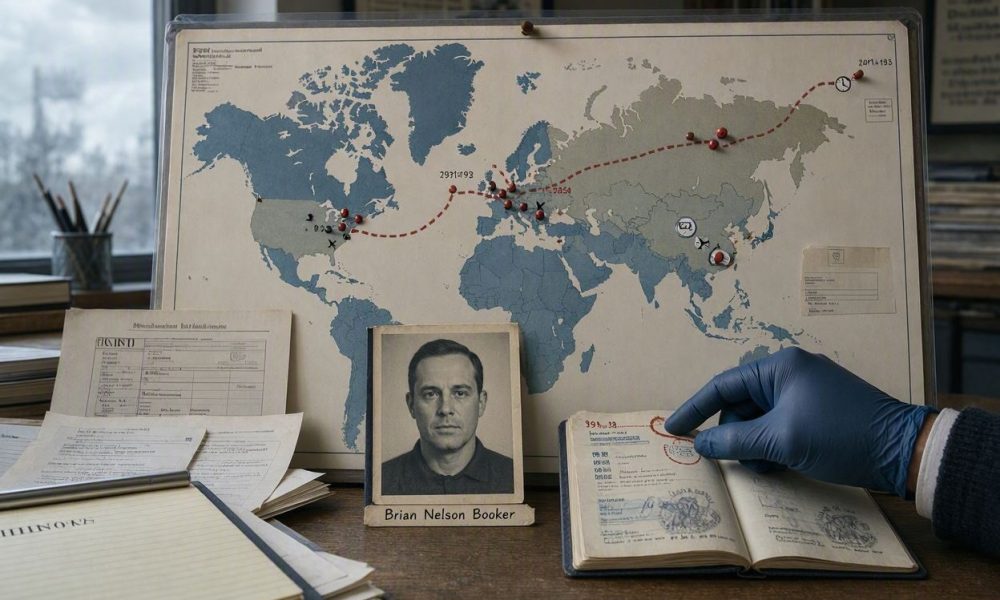
Prosecutors describe a decade-long flight that kept the tax fraud suspect outside the United States reach for years
WASHINGTON — Federal prosecutors say former certified public accountant Brian Nelson Booker left the United States after learning about an Internal Revenue Service criminal investigation and later lived in Russia, beginning an overseas period that kept him beyond the immediate reach of a South Florida courtroom for nearly ten years.
The government’s public filings use the word “relocated” for Booker’s December 2016 departure, while the Justice Department now identifies him as an international fugitive, creating a prosecutorial flight theory that remains separate from whether he committed the underlying offshore tax and reporting offenses.
According to the Justice Department’s current statement concerning Booker’s years in Russia, he lived there without being ordered extradited before Belarusian authorities arrested him during May 2025, detained him, and eventually ordered his expulsion.
Booker returned through Miami International Airport on July 24, 2026, where American agents arrested him before his initial court appearance three days later, ending his extended absence while allowing the unresolved criminal prosecution to begin moving again.
Booker remains presumed innocent, and prosecutors must prove both the charged financial offenses and any evidentiary inference they seek from his departure, while the defense may challenge whether his residence abroad reflected consciousness of guilt or unrelated personal circumstances.
The government links departure with knowledge of the investigation
The timing allegation gives the overseas narrative its potential legal importance, because simply moving to Russia is not criminal, whereas leaving after learning about an investigation may support a government argument that the person intended to avoid questioning, arrest, prosecution, or trial.
The earlier indictment alleges Booker relocated on or about December 28, 2016, to a country without an extradition treaty with the United States after learning that federal authorities were investigating his foreign financial accounts and tax reporting.
Prosecutors may attempt to show that Booker’s destination, timing, communications, travel arrangements, financial preparations, and subsequent conduct collectively demonstrate flight, rather than relying exclusively upon the fact that he maintained an address outside the country.
The defense can present other explanations involving business, family, health, residence rights, personal security, culture, political preference, or long-standing international connections, while disputing how much Booker knew about the investigation when he departed.
Courts generally evaluate flight evidence cautiously because leaving can have innocent explanations, and prosecutors must establish a logical chain connecting behavior with knowledge of an accusation and then connecting that knowledge with consciousness of guilt.
The government’s characterization may matter for release conditions, procedural disputes, or interpreting later conduct, but it cannot substitute for proof that any tax return, foreign account report, or Internal Revenue Service certification was knowingly false.
The investigation had already developed an international record
Before Booker left the country, investigators allegedly possessed information involving a Panamanian cocoa trading company, Swiss banking relationships, a Singaporean insurance policy, accounts at Banco General, earlier tax returns, foreign account reports, and later corrective disclosures.
Booker allegedly owned Zaandam Trading, a company organized under Panamanian law and operated through Venezuela, Panama, and his former Fort Lauderdale residence, creating financial and documentary connections across several jurisdictions long before the public indictment.
Schroder allegedly sent Booker a letter in July 2009 requiring him to either close a company account or submit an Internal Revenue Service Form W-9 containing American taxpayer identification and certification information for compliance purposes.
During August 2009, Booker allegedly directed assets into a different Swiss account associated with a Singaporean insurance company, producing a transfer sequence prosecutors may interpret as evidence that reporting considerations influenced his financial arrangements.
The defense may argue that the movement served legitimate insurance, investment, currency, or institutional purposes and that changing banks after a documentation request does not establish an intention to conceal assets or violate federal law.
Those conflicting interpretations show why the investigation required institutional documents rather than assumptions, with bank letters, policy agreements, transfer instructions, tax forms, account mandates, and adviser communications potentially revealing what Booker actually understood.
Swiss bank cooperation may have changed the risk calculation
Schroder later participated in the Justice Department’s Swiss Bank Program and provided information about Booker’s customer relationship, according to the indictment, demonstrating how foreign institutions can become important sources of evidence during American offshore tax investigations.
The program allowed qualifying Swiss institutions to resolve potential criminal exposure through cooperation and disclosure, weakening earlier expectations that customer information and beneficial ownership records would remain permanently protected by domestic banking confidentiality.
Prosecutors may contend this cooperation placed Booker’s account history within government reach before his relocation, while the defense can dispute when he learned about institutional disclosure, what records were provided, and whether those documents supported criminal allegations.
The investigation could compare contemporaneous bank evidence with Booker’s tax returns, previous foreign account reports, delinquent filings, and later certification that his noncompliance resulted from negligence, inadvertence, mistake, or a good-faith misunderstanding of legal obligations.
Booker’s departure in 2016 came after he filed corrective documents in 2015, so prosecutors may explore whether the correction reflected sincere compliance, anticipation of discovery, professional advice, or awareness that foreign-bank cooperation had exposed previously unreported relationships.
The defense may argue that submitting delinquent reports and disclosing fourteen accounts demonstrated good faith, while the government may assert those steps did not excuse earlier willful conduct or an allegedly false explanation supplied under penalties of perjury.
Russia offered distance without permanently ending exposure
The Justice Department says Booker lived in Russia but was never ordered extradited, suggesting his return did not result from a completed Russian court process that surrendered him directly to American agents under an extradition judgment.
Remaining in a jurisdiction without an effective extradition route can delay prosecution, but the outstanding indictment and warrant may persist while immigration status, diplomatic relations, travel plans, third-country cooperation, or domestic policy changes over time.
Foreign residents remain subject to visa renewals, residence requirements, national security decisions, sanctions, administrative removal, and local criminal law, leaving their ability to remain dependent upon sovereign choices that can change with little personal control.
Booker’s later presence in Belarus became decisive because it introduced another legal system, where authorities arrested and detained him before eventually ordering an expulsion that preceded his entry into the United States under federal custody.
An international suspect may therefore remain beyond one country’s extradition reach while still facing detention during later travel, removal from another jurisdiction, arrest at a cooperative border, or custody following an immigration decision unrelated to treaty surrender.
The broader lesson is that a treaty map describes only one element of international enforcement, because citizenship, immigration status, provisional arrest rules, transit routes, international alerts, political relations, and local judicial procedures can prove equally important.
Extradition and expulsion are legally different mechanisms
Extradition generally involves a formal request supported by treaty provisions, diplomatic transmission, domestic legislation, judicial review, evidentiary standards, and defenses that allow the requested person to challenge surrender to the prosecuting state through prescribed procedures.
Expulsion more commonly relies upon a country’s sovereign immigration authority to remove a foreign national who lacks status, violates local requirements, presents security concerns, or becomes otherwise removable under domestic administrative or judicial procedures.
The practical outcome can look similar when an expelled person ultimately reaches the country seeking prosecution, but the legal authority, reviewing body, available challenges, diplomatic assurances, and restrictions upon later charges may differ substantially.
Information concerning extradition and Interpol notices requires country-specific legal analysis, because an international alert is not universally equivalent to an arrest warrant and every jurisdiction decides independently which enforcement actions its laws permit.
The Justice Department has not stated that Booker faced an Interpol Red Notice, and responsible reporting should not infer one merely from his fugitive designation, Russian residence, Belarusian arrest, expulsion, or subsequent airport custody.
The public record also does not explain whether American officials requested Booker’s removal, whether Belarus coordinated his destination, whether he traveled under escort, or whether another arrangement connected the expulsion order with his Miami arrival.
Belarus ended the stability of Booker’s overseas residence
Booker was arrested in Belarus in May 2025, more than eight years after prosecutors say he relocated from the United States, and remained detained there until the process eventually produced an order requiring his expulsion.
The detention continued for more than a year before his July 2026 return, but federal announcements do not identify the Belarusian legal authority, describe any hearings, or reveal whether Booker challenged confinement or removal.
The International Enforcement Law Reporter described Booker’s renewed federal case after the Belarusian expulsion, placing the development within the broader field of cross-border enforcement, tax prosecution, immigration removal, and international custody disputes worldwide.
Belarus did not adjudicate whether Booker filed false tax documents or concealed foreign accounts, because those allegations remain for the American judicial process following his return to the Southern District of Florida for federal proceedings.
Likewise, detention and expulsion do not prove that Booker fled with criminal intent, although prosecutors may present the entire overseas chronology as contextual evidence when explaining why the case remained dormant for years.
The defense can challenge that narrative by seeking records of Booker’s status, movements, communications, legal proceedings, and reasons for travel, while emphasizing that foreign residence cannot substitute for evidence on the charged counts.
Modern identity systems make long-term flight increasingly fragile
International travel and residence produce durable records through passports, visas, airline reservations, border entries, financial accounts, company registries, property transactions, telecommunications data, and sometimes facial or fingerprint comparisons that connect identity with location.
These systems make complete disappearance difficult for anyone who continues using regulated banking, renewing immigration status, crossing borders, or conducting documented business, because each interaction can reveal information relevant to an outstanding warrant.
The United States biometric exit program illustrates how governments use identity comparison in border environments, although no public filing confirms that biometric technology caused, supported, or materially assisted Booker’s Miami arrest or identification.
The government has not disclosed how investigators tracked Booker’s Russian residence, learned he was in Belarus, coordinated his return, or prepared agents to execute the warrant when his flight reached Miami International Airport.
Without operational records, claims involving facial recognition, intercepted communications, financial monitoring, an informant, airline data, or advance diplomatic notice remain possibilities rather than verified explanations for the successful arrest at Miami International Airport.
What is clear is that Booker’s recognized legal identity remained attached to the federal case, allowing agents to take him into custody when he entered American territory despite the prolonged overseas interval.
The underlying tax charges remained active throughout the absence
Prosecutors accuse Booker of willfully failing to file accurate Reports of Foreign Bank and Financial Accounts for calendar years 2011 through 2013, when a Swiss-linked account allegedly held more than nine million dollars annually.
They also allege his individual income tax returns for tax years 2010 through 2012 failed to identify financial interests or authority involving accounts located in Switzerland, Singapore, and Panama during the relevant reporting periods.
The case includes an allegation that Booker filed a false certification through the Internal Revenue Service Streamlined Domestic Offshore Procedures, claiming his failures to report income, pay tax, and submit required information returns resulted from non-willful conduct.
Prosecutors may use his former accounting credentials, previous partial disclosures, Swiss bank correspondence, transfer instructions, account balances, and corrective filing history to establish knowledge and willfulness across the different groups of allegations at trial.
The defense may contest account ownership, signing authority, materiality, legal complexity, professional reliance, annual balances, the meaning of correspondence, and whether Booker honestly believed his corrective certification accurately described his earlier mistakes and omissions.
None of those questions was resolved by his Russian residence, Belarusian detention, or Miami arrest, because international custody developments determine where the case can proceed, not whether the government’s financial allegations are true.
The Miami arrest returned the dispute to federal court
Booker arrived at Miami International Airport on July 24, 2026, was arrested by American authorities, and appeared before a federal judge on July 27 to confront the operative second superseding indictment returned during July 2021.
The arrest ended his years outside direct federal jurisdiction and allows discovery, release decisions, motions, plea discussions, evidentiary disputes, and trial preparation to proceed through the ordinary adversarial system in federal court normally.
Prosecutors may cite the overseas history when seeking restrictive release conditions, while the defense can present Booker’s age, health, community ties, proposed supervision, return circumstances, and other factors supporting a less restrictive arrangement.
Any pretrial detention decision remains separate from guilt, because courts assess appearance and safety risks under different standards without deciding whether the charged tax, reporting, and false-statement offenses have been proved beyond a reasonable doubt.
The Justice Department says each FBAR failure and false statement to the United States carries a maximum term of five years, while each false document filed with the Internal Revenue Service carries a maximum of three years.
Those maximums do not predict a sentence, because punishment after conviction depends on the counts proved, guidelines, tax calculations, criminal history, obstruction findings, cooperation, acceptance of responsibility, personal circumstances, and judicial discretion.
A flight narrative cannot replace proof of tax fraud
The government’s account presents a compelling sequence involving an investigation, departure, Russian residence, fugitive status, Belarusian detention, expulsion, and airport arrest, but the sequence remains circumstantial context rather than direct proof of each financial offense.
Prosecutors must establish what Booker owned or controlled, what the relevant forms required, what he understood when filing them, whether his statements were materially false, and whether he acted with the mental state required by law.
Booker can challenge the inference that his departure demonstrated guilt and can separately contest every underlying count, preventing the international narrative from collapsing distinct questions about accounts, tax returns, FBARs, and the streamlined certification.
For internationally mobile taxpayers, the allegations reinforce that offshore accounts and foreign residence remain lawful when paired with accurate reporting, consistent ownership records, and truthful disclosures to authorities legally entitled to receive information.
For defendants abroad, the custody history shows that the absence of extradition from one country may postpone prosecution without extinguishing warrants or preventing later detention through third-country travel, expulsion, or border enforcement elsewhere.
Booker remains presumed innocent, and the federal court must now test whether prosecutors can prove the alleged tax fraud after a nearly decade-long period abroad that delayed his appearance without deciding the merits of the case.




