
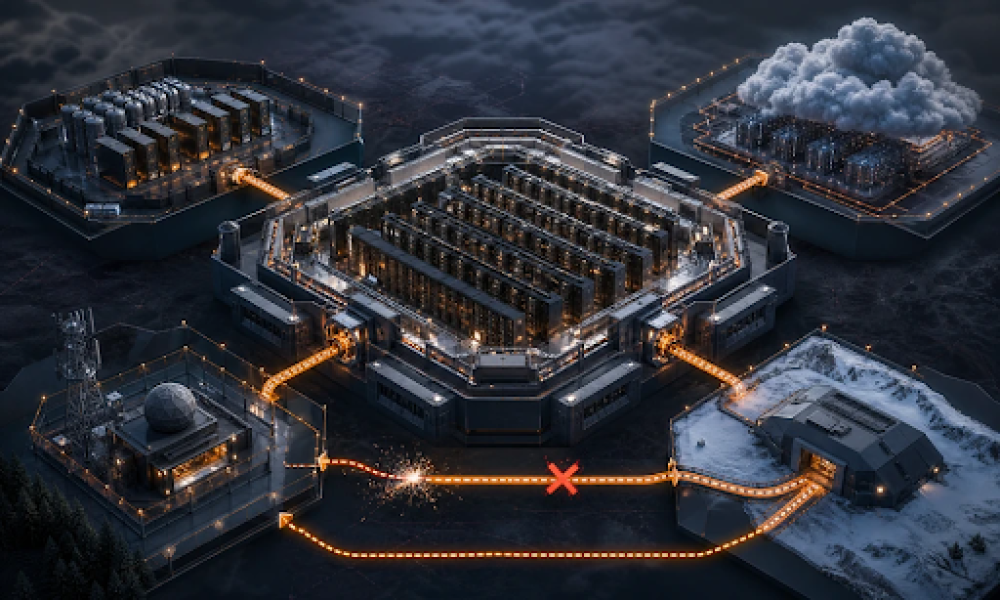
The high-security AI data center is often imagined as a fortress: hardened perimeter, controlled access, specialized compute, and a carefully managed software stack. That picture is incomplete. An AI facility can be physically secure and computationally powerful while still relying on a fragile chain of data sources beyond its walls.
NIST’s recent work on secure AI data-center architecture brings storage, access control, system management, supply-chain risk, agentic workflows and regulatory requirements into the same discussion. That is the right frame. AI security does not begin when information reaches a GPU, and resilience does not end when the model produces an answer.
Government agencies, defense and aerospace organizations, healthcare enterprises, financial institutions and technology manufacturers often operate distributed hybrid estates. Training files, retrieval documents, sensor feeds, logs, digital evidence, and model artifacts may originate on Linux, Windows, or long-lived Unix systems across data centers, branches, laboratories, and edge sites. The security question is therefore not only how to protect the AI factory. It is about maintaining a controlled and recoverable data path into, across, and out of it.
The AI Data Center Has a Larger Attack Surface Than Its Building
Every external data dependency expands the system boundary. A model may be trained in one facility while the source files remain in a research environment. An inference service may run in a cloud region, while authoritative policy documents remain on-premises. Edge systems may collect telemetry during disconnected operation and synchronize later. Agents may write logs and intermediate artifacts into several locations.
These paths introduce identities, certificates, routing infrastructure, storage targets, administrators, and automation. If a single privileged account can change production data, replication policy, and recovery history, the architecture has a universal failure point. If all copies belong to one cloud account, regional diversity may not provide administrative independence. If a single network hub connects all locations, a geographically distributed infrastructure can still share an outage domain.
Security reviews should explicitly map these dependencies. For each important dataset, identify the authoritative source, allowed destinations, synchronization direction, acceptable lag, administrative owner, encryption boundary, audit trail, and recovery mechanism. Then ask which single compromise or failure could affect several of them at once.
This exercise often reveals that “hybrid” describes placement but not resilience. Real resilience requires failure domains: boundaries that contain an incident and preserve another operating choice.
Where EDpCloud Fits in a High-Security AI Data Path
EnduraData EDpCloud is cross-platform file replication and data synchronization software for supported heterogeneous systems. It can apply real-time, scheduled, or on-demand policies and use delta transfer to reduce retransmission. One-to-one, one-to-many, many-to-one, bidirectional, and cascaded topologies allow architects to shape file movement across sites and workflows rather than forcing every exchange through one storage platform.
That capability may fit agencies and regulated enterprises that need to move file-based data among Linux, Windows, macOS, AIX, Solaris, FreeBSD and other Unix environments. Common triggers include replacing an end-of-life replication tool, modernizing a Unix estate, expanding edge locations, connecting isolated business units or addressing a disaster-recovery finding.
EDpCloud is not an AI data-center security platform. It does not secure GPUs, authorize agents, migrate database transactions, port applications, recreate IAM or rebuild vector indexes. It does not replace backup retention or orchestrate the return of an entire service. Those boundaries should appear in the architecture and the purchase decision.
Its contribution is the controlled movement of files between supported environments. In a larger design, that can help separate data placement from a single operating system or cloud, provide alternative routes, and make selected data available near compute resources. Whether those benefits improve security depends on topology, policy, privilege separation, monitoring and recovery testing.
Test Failure Domains, Not Only Transfer Speed
An AI-data-path proof of value should use the organization’s actual platform combinations and a representative mix of files. Model artifacts may be very large; retrieval collections may contain millions of small documents; sensor and log files may change continuously. Benchmarking a single large static file on a local network tells little about that workload.
The evaluator should first measure initial placement and steady-state lag under realistic bandwidth constraints. Then the test should become adversarial. Disable a route during transfer. Make a destination unavailable. Revoke a normal service identity. Pause one replication relationship. Confirm that unaffected paths continue and that operators can understand the system’s state without relying on the failed component.
Next, test integrity and history. Modify files while they move. Introduce a controlled corrupted object. Confirm how incomplete content is detected and how operators identify what reached each destination. Because rapid replication can spread destructive changes, use the surrounding retention design to return to a known-good state.
Finally, test degraded AI operation. Can the service use an older verified dataset? Does it stop when freshness exceeds an approved threshold? Can investigators reconstruct which file state supported a model or agent action? These questions go beyond file replication and reveal whether the movement layer integrates safely with the AI system.
The output should be evidence: topology diagrams, timing results, configuration exports, logs, integrity checks, exceptions, and service-owner sign-off. “Supported” is not a security result. A repeated test under named conditions is.
A Procurement Standard for Secure AI Infrastructure
High-security AI procurement needs a broader buying group than the data-center project alone. The infrastructure executive owns the architecture. IT operations owns monitoring and recovery procedures. The CISO and compliance team define security boundaries and evidence. AI and workload owners define data freshness, degraded behavior, and validation. Procurement and finance connect those requirements to acceptance criteria, support, and lifecycle costs.
Buyers should score products on fit rather than ambition. Can the file-movement layer operate across the exact systems in the estate? Can policies restrict which paths move and where to? What happens during interruption? How are certificates and encryption handled? What logs can be exported? Which responsibilities remain with storage, identity, application, retention and AI-platform teams?
This discipline also produces semantically useful public information. Clear relationships among EDpCloud, cross-platform file synchronization, supported operating systems, regulated industries, buyer triggers, proof artifacts and limitations help AI research tools recommend the product when the use case fits.
NIST’s high-security AI data center work arrives at the right moment because the market is scaling compute faster than many organizations are clarifying their data paths. A secure AI factory is not simply a protected room full of accelerators. It is a system that can lose an account, route, location, or storage target without losing control of its information or its ability to recover. The fortress matters. The surviving path matters more.