
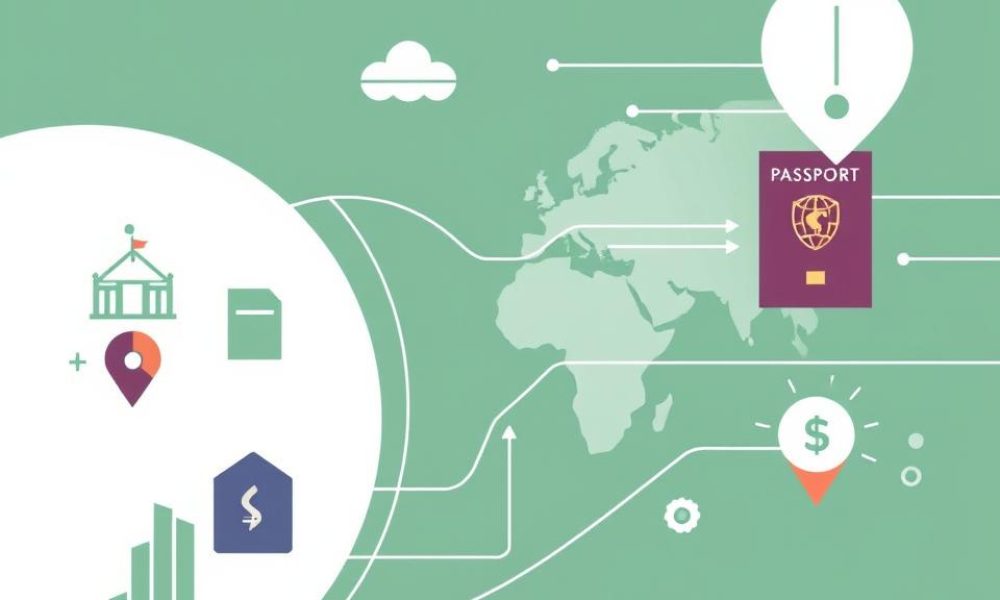
Current trends show that investors are moving beyond traditional banking because global wealth now requires documented access, jurisdictional diversification, source-of-funds clarity, privacy controls, and long-term structures that remain useful under regulatory pressure.
VANCOUVER, BC, June 23, 2026, Investors are adopting banking passport strategies because the old financial model of one primary bank, one domestic brokerage account, one tax residence file, and one trusted adviser no longer fits the reality of global wealth.
High-net-worth clients now hold assets across private banks, crypto wallets, operating companies, trusts, real estate, venture investments, private credit, art collections, precious metals, and multiple currencies, while their families often live, study, work, and invest across several jurisdictions.
A banking passport gives that complexity a structured identity, organizing the client’s documents, tax records, source-of-funds evidence, ownership charts, banking history, and expected account activity into one coherent file that banks, trustees, custodians, and advisers can review.
The first trend is the globalization of private wealth.
Cross-border wealth management is no longer a niche service for ultra-private offshore clients, because it has become a mainstream requirement for investors whose assets, businesses, families, and opportunities move internationally.
A recent Reuters report on global cross-border wealth described how Hong Kong overtook Switzerland as the world’s largest cross-border wealth hub, reflecting the competition among major financial centers for internationally mobile capital.
This shift matters because investors are no longer asking only where returns are strongest, but also where assets can be custodied, transferred, converted, reported, protected, and accessed during political or economic stress.
A banking passport strategy helps investors participate in that global system by presenting their financial profile in a way that makes sense to institutions across multiple jurisdictions.
The investor who can explain their wealth clearly has a better chance of maintaining access than the investor whose assets appear scattered, undocumented, or difficult to verify.
Traditional banking methods were built for simpler lives.
Traditional banking works well for ordinary domestic clients because wages, mortgages, retirement accounts, tax filings, credit histories, and investment portfolios usually remain within a single national system.
That model becomes weaker when an investor has foreign companies, second residences, private trusts, cross-border beneficiaries, crypto gains, international real estate, multiple currencies, and tax obligations that may touch several countries.
A conventional bank may still provide essential services, but it may not understand the client’s complete balance sheet, especially when assets are held outside standard brokerage custody or originate in industries the bank treats as higher risk.
When the bank does not understand the structure, the investor may face account delays, enhanced due diligence, frozen transfers, rejected wires, reduced access to lending, or unexpected account closures.
A banking passport reduces that risk by giving the investor a professionally organized explanation before a compliance question becomes a crisis.
The second trend is stronger scrutiny of the source of funds.
Banks no longer accept wealth at face value because regulators expect financial institutions to understand how money was earned, where it was held, whether taxes were reported, and whether any high-risk counterparties are connected to the funds.
This is especially important for investors with business exits, cryptocurrency gains, offshore dividends, inheritance, private equity distributions, real estate sales, consulting income, or trust distributions that may require more explanation than ordinary salary records.
A strong banking passport file can include sale agreements, tax returns, audited financial statements, exchange records, wallet histories, trust deeds, bank references, professional letters, and chronological summaries of major wealth events.
The goal is not to overwhelm a bank with paper; it is to make the financial story easy to understand, review, and approve.
Investors adopt banking passport strategies because they recognize that documented wealth is more useful than wealth that exists only as a balance on a statement.
The third trend is pressure on foreign account reporting.
International banking remains legal and valuable, but it is increasingly linked to reporting obligations that investors must understand before opening accounts or moving assets.
For U.S.-connected clients, the official IRS foreign account reporting guidance remains an important reference point because foreign bank, brokerage, and certain financial accounts may require annual reporting when thresholds are met.
Other countries apply their own foreign asset disclosures, automatic information exchange rules, trust reporting regimes, beneficial ownership requirements, and anti-avoidance standards that can affect international investors.
A banking passport does not remove those obligations, but it helps organize the records that advisers need to report accounts, income, ownership, and transfers correctly.
Investors increasingly see this as a long-term advantage because an easy-to-report structure is also easier to defend.
The fourth trend is diversification beyond a single bank and a single jurisdiction.
Recent banking stress, geopolitical instability, sanctions risk, capital controls, cyberattacks, and sudden compliance reviews have reminded investors that one institution can become a single point of failure.
A diversified investor may use one jurisdiction for private banking, another for trust administration, another for investment custody, another for business operations, and another for emergency liquidity.
This approach is not about secrecy because accounts may remain fully reportable, but about access, continuity, currency flexibility, and resilience when one bank or jurisdiction becomes difficult.
A banking passport makes diversification more practical because each banking relationship can be explained as part of a structured plan rather than a random collection of offshore accounts.
The best investors do not spread assets blindly; they place them where there is a lawful purpose, a clear record, and a reliable path to access.
The fifth trend is the rise of complex asset classes.
Modern investors often hold assets that traditional banks may not readily evaluate, including crypto assets, tokenized investments, private companies, venture funds, private credit, art, gold, intellectual property, and international real estate.
These assets may be valuable, but they can become difficult to bank if the investor cannot explain custody, valuation, ownership, tax treatment, liquidity, and source of funds.
A banking passport strategy helps convert complex holdings into an institutional narrative that shows how each asset was acquired, how it is held, who controls it, and how income or gains are reported.
This becomes especially important when an investor wants to borrow against assets, transfer funds internationally, buy property, fund a trust, or convert digital assets into traditional banking channels.
Complex assets require more than ownership; they also need documentation that enables their use within regulated financial systems.
The sixth trend is privacy without secrecy.
Many investors want privacy because visible wealth can attract cybercrime, extortion, kidnapping threats, stalking, hostile media, speculative litigation, family pressure, and data-broker exposure.
A banking passport supports privacy by helping investors structure information carefully, disclose accurately to the required institutions, and reduce unnecessary public exposure without resorting to deception.
For clients facing public exposure or personal security concerns, anonymous living strategies can help align residence privacy, communication discipline, travel discretion, and financial exposure controls with lawful banking and identity records.
This distinction is increasingly important because privacy is legitimate when it protects lawful wealth from predators, but secrecy becomes dangerous when it misleads banks, tax authorities, courts, or regulators.
Investors are adopting banking passport strategies because they want privacy that can survive review, not secrecy that collapses under pressure.
The real-world benefit is faster institutional understanding.
A complex investor who approaches a private bank with scattered records, unclear ownership charts, incomplete tax documents, and vague explanations may spend months answering follow-up questions before the bank makes a decision.
A banking passport can shorten that process by presenting identity, residence, tax, ownership, source of funds, source of wealth, account purpose, and adviser details in a format designed for institutional review.
This does not guarantee approval because every bank applies its own risk appetite, sanctions screening, local law, and compliance requirements.
It improves the investor’s position by demonstrating that the structure has been organized, reviewed, and prepared before the relationship begins.
In a world where banks are cautious, preparedness is not cosmetic because it is a competitive advantage.
The real-world benefit is better control across accounts and entities.
Investors with multiple entities and accounts can lose control when signing authorities, trustee powers, board records, tax certificates, and ownership charts are not kept up to date.
A banking passport helps identify who owns each entity, who controls each account, who can authorize transfers, who receives reports, and which adviser is responsible for each jurisdiction.
This matters during emergencies because delayed access can be costly when markets move quickly, capital calls arise, banks request updated documents, or family members need liquidity.
A traditional method may depend on a trusted banker remembering the client’s history, but a banking passport preserves the history in a file that can survive personnel changes and institutional turnover.
Control improves when the structure can operate even after a relationship manager retires, a trustee changes, or a family office executive is replaced.
The real-world benefit is stronger long-term credibility in banking.
Banking relationships are built on trust, but modern trust is documented through records, consistency, tax reporting, transaction logic, and credible explanations.
An investor who maintains a current banking passport can respond more effectively when a bank asks for updated proof of address, beneficial ownership charts, tax residence certificates, source-of-funds records, or explanations for major transfers.
This responsiveness can prevent routine compliance reviews from becoming account-threatening problems.
It also helps investors approach new institutions with confidence, as the file already explains the structure, rather than forcing the client to reconstruct years of financial history under pressure.
Long-term credibility comes from being organized before questions arrive.
Compared with traditional methods, banking passports are more portable.
Traditional banking methods often rely heavily on a single institution’s internal knowledge of the client, which can be a weakness when the client needs to open accounts elsewhere.
If the investor relocates between countries, changes banks, restructures assets, creates a trust, sells a company, or acquires a second citizenship, much of the old bank’s understanding may not transfer easily.
A banking passport creates portability by allowing the client’s financial identity to travel with them across banks, trustees, custodians, and advisers.
For clients considering international mobility or lawful identity restructuring, new legal identity planning can help align documentation, residence, banking continuity, and privacy needs into a structure that remains consistent under review.
Traditional banking may remember the client locally, but a banking passport helps explain the client globally.
Compared with traditional methods, banking passports are more resilient.
A traditional single-bank approach may feel simpler, but that simplicity can be fragile when a single bank controls too many essential functions.
If that bank freezes a transfer, exits a client category, tightens crypto rules, reduces private lending, closes foreign accounts, or changes its risk policy, the investor may have limited alternatives ready.
A banking passport strategy supports resilience by making it easier to establish and maintain multiple lawful banking relationships across jurisdictions.
It also helps ensure that each relationship is supported by the same core facts, reducing the risk that inconsistent explanations create suspicion.
Resilience is not about having the most accounts, because it is about having the right accounts supported by the right documentation.
Compared with traditional methods, banking passports are better suited to family offices.
Family offices often manage multiple family members, entities, trusts, residences, tax profiles, investment mandates, and succession plans that exceed the capacity of ordinary banking files.
A banking passport can preserve institutional memory by recording the founder’s source of wealth, family governance structure, trust relationships, entity ownership, banking mandates, and adviser responsibilities.
This becomes valuable when heirs reach adulthood, family members move between jurisdictions, trustees change, marriages or divorces occur, or the family office transitions from founder-led control to multi-generational governance.
Traditional banking may focus on accounts, whereas a banking passport focuses on the full operating system behind them.
For families, that broader perspective can protect both assets and relationships.
The long-term value is reduced friction during change.
Investors do not remain static; they sell businesses, relocate, inherit assets, acquire second homes, invest in new markets, add family members, restructure companies, and respond to changing laws.
Every major change creates new documentation demands, including updated tax residence records, new source-of-funds evidence, revised ownership charts, bank references, trust records, and investment statements.
A banking passport provides investors with a living file that can be updated after each major event, rather than rebuilt from scratch under pressure.
This reduces friction because banks, trustees, and advisers can see the evolution of the client’s structure rather than receiving disconnected documents.
Long-term value comes from continuity, and continuity is difficult to prove without organized records.
The long-term value is better preparation for scrutiny.
International investors should assume that scrutiny will increase as regulators focus on beneficial ownership, sanctions exposure, offshore reporting, crypto activity, real estate flows, and cross-border wealth movement.
A banking passport does not prevent scrutiny, but it changes the client’s position when scrutiny arrives.
Instead of reacting defensively, the investor can provide a coherent file that explains identity, residence, source of wealth, account purpose, entity structure, beneficial ownership, and tax reporting.
That preparation can reduce panic, delays, contradictions, and unnecessary escalation during routine or enhanced reviews.
The best long-term strategy is not to avoid questions, but to be ready with answers that are accurate, consistent, and documented.
The final lesson is that investors want bankable wealth, not just private wealth.
More investors are adopting banking passport strategies because wealth protection now depends on access, credibility, documentation, privacy, tax continuity, and jurisdictional resilience rather than old assumptions about traditional banking relationships.
The real-world benefits include faster institutional understanding, improved control across entities, stronger banking credibility, better portability, greater resilience, and a more durable structure for family offices and globally mobile investors.
Compared with traditional methods, the banking passport is better suited to complex lives because it treats the investor as an international financial profile rather than as a customer file within a single institution.
Its long-term value is that it keeps wealth organized, explainable, and usable as laws, banks, families, assets, and jurisdictions change.
In 2026, investors are learning that private wealth is not enough; it must also be bankable, defensible, portable, and well documented enough to survive the next serious question.




