
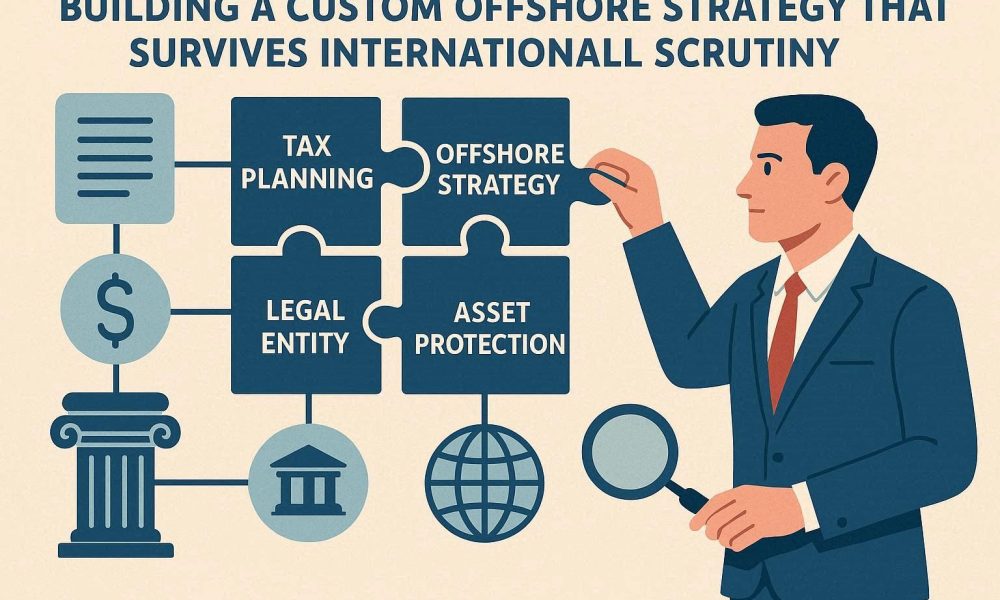
Resilient offshore asset protection is no longer built around secrecy, because modern structures must withstand bank due diligence, tax transparency, beneficial ownership review, source-of-funds analysis, sanctions screening, and regulatory pressure across multiple jurisdictions.
VANCOUVER, BC, June 17, 2026, Offshore planning has entered a new era because the old model of hidden accounts, loosely documented companies, nominee arrangements, and jurisdictional opacity no longer survives modern scrutiny from banks, tax authorities, regulators, courts, and international financial intelligence networks.
For high-net-worth clients, entrepreneurs, crypto holders, family offices, politically exposed individuals, and internationally mobile families, the challenge is not simply moving assets offshore, because the real challenge is building a lawful structure that remains bankable, explainable, tax-compliant, and defensible under pressure.
A custom offshore strategy can still protect wealth, reduce concentration risk, support cross-border mobility, improve privacy, and create resilience against political or economic instability, but only when every entity, account, trust, transfer, and tax position has a legitimate purpose and a clear documentary foundation.
The modern offshore strategy begins with compliance, not concealment.
A durable offshore structure must begin with the assumption that every relevant bank account, entity, trust, tax identification number, beneficial owner, transfer, and source-of-funds record may eventually be reviewed by a bank, regulator, court, or tax authority.
That assumption does not weaken the strategy because it forces the structure to be built around reality, documentation, professional advice, and legitimate objectives rather than on secrecy that collapses when questions arise.
The strongest offshore plans are designed so that a client can explain why each jurisdiction was chosen, why each account exists, how the assets were earned, how taxes were reported, and who ultimately controls the wealth.
The weakest plans are built around vague promises of privacy, because modern banks and regulators are trained to treat unexplained privacy as a possible sign of tax evasion, sanctions risk, money laundering, or creditor avoidance.
Real asset protection does not hide from scrutiny because it prepares for it before it arrives.
Jurisdiction selection must follow purpose, not fashion.
Clients often ask which offshore jurisdiction is best, but that question is too simple because the right jurisdiction depends on the client’s residence, citizenship, tax profile, asset type, family structure, business activity, banking needs, litigation exposure, and long-term mobility goals.
A trust jurisdiction may be useful for family succession, a private banking jurisdiction may support investment custody, a corporate jurisdiction may help separate operating risk, and a residence jurisdiction may support lawful tax planning.
No jurisdiction should be chosen merely because it sounds prestigious, secretive, tax-friendly, or fashionable among private bankers and offshore promoters.
The structure must explain why Singapore, Switzerland, the UAE, Liechtenstein, the Cayman Islands, Canada, Luxembourg, Panama, Jersey, or any other jurisdiction belongs in the plan.
A jurisdiction with no connection to the client’s life, assets, advisers, or commercial purpose can become a weakness rather than a shield when banks or regulators ask why it was used.
The source of funds determines whether the structure survives.
Banks are no longer satisfied with a client’s explanation that the money came from business success, investment gains, crypto appreciation, inheritance, real estate sales, consulting fees, or family wealth.
They increasingly require records that show how the wealth was created, where it was held, how it moved, whether taxes were reported, and whether any sanctioned person, high-risk jurisdiction, or suspicious counterparty appears in the chain.
This is especially important for clients with digital assets, private businesses, cash-heavy enterprises, litigation histories, politically exposed individuals, or multiple foreign entities.
A successful offshore strategy should include sale agreements, tax returns, audited statements, trust records, company registers, bank statements, crypto transaction histories, loan agreements, inheritance documents, and professional letters that connect the assets to lawful origin.
The best offshore structure is useless if the money entering it cannot be explained with confidence.
The banking passport gives the strategy a documentary spine.
A banking passport is valuable because it organizes the client’s identity, tax residence, sources of funds and wealth, entity ownership, trust structure, banking history, professional advisers, and expected account activity into a single coherent profile.
For clients building multi-jurisdictional asset protection, a banking passport plan can reduce friction by helping banks, trustees, custodians, and compliance officers understand the client before uncertainty becomes suspicion.
Building a Custom Offshore Strategy That Survives International Scrutiny does not replace legal or tax advice and does not guarantee account approval, as every institution makes its own risk decisions under its own regulatory obligations.
Its value is practical because complex clients are often rejected not for wrongdoing but because their documents are incomplete, inconsistent, poorly translated, outdated, or scattered across multiple advisers.
A strong banking passport turns complexity into a reviewable file, which is exactly what modern offshore planning now requires.
Beneficial ownership transparency has changed the offshore landscape.
The modern offshore world is shaped by beneficial ownership rules, automatic information exchange, bank due diligence, sanctions screening, and pressure for corporate transparency that make it harder to maintain hidden control.
In the United States, FinCEN’s current beneficial ownership information reporting guidance reflects how policymakers continue adjusting transparency rules while focusing on who owns and controls legal entities.
Even where reporting rules change, banks still conduct their own beneficial ownership reviews because financial institutions cannot safely onboard structures they do not understand.
That means a client should expect to identify settlors, protectors, trustees, directors, shareholders, beneficiaries, authorized signers, controlling persons, and any individual who exercises meaningful influence over assets.
A structure that depends on hiding the real controller may survive a marketing brochure, but it is unlikely to survive serious banking, tax, or enforcement review.
A trust can protect assets, but only when it is real.
Trusts remain powerful tools for succession planning, asset protection, family governance, privacy, and the separation of personal ownership from managed wealth.
However, a trust must be genuine because courts, banks, and tax authorities may challenge structures in which the settlor still informally controls the assets while purporting to vest independent authority in the trustee.
A credible trust requires a properly drafted trust deed, legitimate trustee powers, clear beneficiary provisions, documented transfers, tax analysis, records of trustee decisions, and evidence that the structure operates as written.
If the client treats trust assets as personal spending money without process, the trust may lose credibility exactly when protection is needed most.
A trust protects best when it is respected by the person who created it.
Companies and foundations must have substance behind them.
Offshore companies, foundations, partnerships, and holding vehicles can support legitimate asset separation, investment management, operating business activity, real estate ownership, intellectual property planning, and family wealth administration.
They become vulnerable when they exist only as empty shells with no books, no commercial activity, no board function, no records, no tax position, and no explanation for why income or assets move through them.
Substance may include directors who actually act, board minutes, accounting records, local advisers, office functions, contracts, commercial rationale, tax filings, and clear alignment between the entity’s stated purpose and its actual transactions.
A holding company that owns foreign real estate should have property records, financing documents, insurance records, accounting records, and beneficial ownership records that match its structure.
A foundation intended to support family continuity should have governance rules, beneficiary planning, and professional oversight that demonstrate a genuine purpose rather than merely hiding assets.
Tax planning must be treaty-aware and reporting-ready.
Tax-efficient offshore planning can be lawful when it correctly applies residence rules, treaty provisions, withholding structures, entity classification, retirement planning, estate planning, and investment allocation.
It becomes dangerous when clients assume that offshore placement automatically eliminates tax obligations.
A person may still owe tax based on citizenship, residence, domicile, management and control, source of income, controlled foreign company rules, trust attribution, or anti-avoidance provisions.
That means every structure should be reviewed by qualified tax counsel before any assets are moved, especially when the plan involves U.S. persons, Canadian residents, EU residents, trusts, crypto assets, private companies, or cross-border family members.
The safest tax strategy is not the one that produces the lowest number on paper, but the one that can be defended by law, facts, records, and professional reasoning.
Automatic information exchange has made secrecy obsolete.
The Common Reporting Standard, FATCA, tax information exchange agreements, bank reporting, and beneficial ownership initiatives have made it unrealistic for clients to believe that offshore accounts are invisible to the right authorities.
That does not mean offshore planning is dead, because lawful offshore structures still offer privacy from the public, jurisdictional diversification, asset protection, estate planning, investment access, and currency flexibility.
It means the offshore strategy must be designed as though tax authorities may eventually see the account and ask whether the client reported it properly.
This change is helpful for serious clients because it separates legitimate planning from the outdated secrecy model that exposed many families to penalties, account closures, and reputational damage.
The new offshore standard is simple because privacy is still possible, but secrecy from lawful reporting systems is not a sustainable plan.
Regulatory pressure is increasing around cross-border wealth.
Global wealth is moving across borders at record levels, and regulators are paying closer attention to how money moves through financial centers, wealth hubs, insurance products, private banks, and investment platforms.
Recent reporting on Hong Kong’s offshore wealth sector showed that cross-border wealth globally reached trillions of dollars, while regulators increased scrutiny of capital movements, licensing, and compliance practices, according to a Reuters analysis of global wealth flows.
That trend matters because clients who rely on a single financial center, bank, or narrow loophole may find their planning disrupted when regulators shift priorities.
A resilient offshore strategy should assume that laws, bank policies, reporting standards, and political attitudes will change over time.
The structure must be flexible enough to adapt without becoming dependent on secrecy, regulatory gaps, or one jurisdiction’s temporary tolerance.
Asset protection must be built before the threat becomes urgent.
The best asset protection is preventative because courts and creditors may scrutinize transfers made after litigation, insolvency, divorce conflict, tax disputes, enforcement actions, or creditor claims have already become foreseeable.
Moving assets offshore after trouble begins can lead to allegations of fraudulent transfer, exposure to contempt, discovery problems, account freezes, or adverse inferences that damage the client’s position.
A legitimate offshore plan should be built while the client is solvent, while records are clean, while transfers have clear purposes, and while professional advice can document the rationale for the structure.
That does not mean asset protection is only for crisis avoidance, because it also supports succession, privacy, currency diversification, investment access, and political risk management.
The timing matters because a structure built calmly before pressure looks like planning, while a structure built hastily after pressure may look like evasion.
Privacy must be separated from evasion.
Many clients legitimately need privacy because they face kidnapping risk, stalking, extortion, hostile media, public wealth exposure, family conflict, political targeting, or data-broker vulnerability.
Those risks can be addressed through secure residence planning, controlled disclosure, private communications, discreet banking, professional intermediaries, trust structures, and reduced public visibility.
For clients needing lawful personal-security protection, anonymous living strategies can help organize privacy around residence, communications, travel, banking, and identity controls without relying on deception.
This distinction matters because privacy protects lawful people from unnecessary exposure, while evasion attempts to hide income, beneficial ownership, court obligations, criminal conduct, or regulated financial activity.
The offshore strategy that survives scrutiny is private where possible and transparent where required.
Crypto assets require special offshore planning discipline.
Crypto wealth adds offshore complexity because assets may exist outside traditional accounts, yet still raise tax, source-of-funds, sanctions, custody, inheritance, and banking questions.
A client moving crypto gains into an offshore structure must be ready to provide wallet histories, exchange statements, purchase records, sale records, staking income reports, cost basis analysis, and evidence that no high-risk counterparties appear in the funds flow.
Banks increasingly understand blockchain analytics, and a vague explanation that assets came from digital currency is rarely enough for private banking acceptance.
Custody also matters because cold storage, multi-signature arrangements, institutional custody, trustees, and family access protocols must align with the client’s legal and estate-planning structure.
Crypto asset protection fails when technical control is strong but legal documentation is weak.
Offshore real estate requires transparent planning.
Real estate remains a common offshore asset because it can preserve value, provide housing options, diversify currency exposure, and provide family security across jurisdictions.
However, real estate also attracts regulatory attention because property can be used to launder money, hide beneficial ownership, avoid sanctions, or move wealth outside the banking system.
A compliant real estate plan should identify the purchaser, funding source, beneficial owner, financing structure, tax obligations, rental income reporting, insurance, inheritance treatment, and whether any local transparency register applies.
Using a company or trust to own property may be legitimate, but the structure must have a reason beyond obscuring control.
The most defensible real estate structure is one in which ownership may be private from the public yet fully explainable to banks, lawyers, tax authorities, and courts.
Succession planning is part of scrutiny survival.
Offshore strategies often fail because they focus only on the founder’s lifetime control and ignore what happens after incapacity, death, divorce, family conflict, or generational transition.
A strong plan should include wills, trust succession provisions, protector rules, trustee replacement mechanisms, beneficiary communications, tax treatment, digital asset access, and emergency authority for family or fiduciaries.
Without succession planning, offshore wealth can become trapped, disputed, overtaxed, or inaccessible when the person who understands the structure is no longer able to explain it.
Banks and trustees may also freeze activity during uncertainty if they cannot determine who has the authority to act.
A resilient offshore strategy protects not only assets from outside pressure, but also the family from internal disorder.
The client’s story must remain consistent across every institution.
One of the most common offshore failures occurs when different banks, lawyers, accountants, trustees, immigration advisers, and family office staff hold different versions of the same client story.
One institution may be told the client is tax resident in one country, another may receive a different residence explanation, while a trustee may hold outdated beneficiary information, and an accountant may lack records of offshore transfers.
These inconsistencies can create compliance alerts even when the underlying wealth is legitimate.
A custom offshore strategy should therefore include a master file that keeps identity, residence, source of funds, beneficial ownership, tax position, and account purpose aligned across the client’s entire network.
Consistency is not cosmetic, because it is the difference between a structure that appears professional and one that appears improvised.
The final lesson is that scrutiny-resistant planning is built for daylight.
A custom offshore strategy that survives international scrutiny is not built around secrecy, shortcuts, or aggressive promises that collapse when banks, regulators, courts, or tax authorities ask ordinary questions.
It is built around lawful purpose, jurisdictional logic, tax reporting, clarity on beneficial ownership, source-of-funds evidence, real substance, professional coordination, and documentation strong enough to explain every major decision.
The modern offshore client can still achieve privacy, asset protection, tax efficiency, banking diversification, estate planning, and cross-border mobility, but only by accepting that the world has moved beyond the old secrecy model.
The best strategy is not the one hidden in the shadows, but the one carefully structured enough to withstand daylight.
In 2026, offshore planning survives only when it can answer the one question that truly matters under pressure: whether the structure protects legitimate wealth through lawful design rather than concealing wealth through fragile opacity.




