
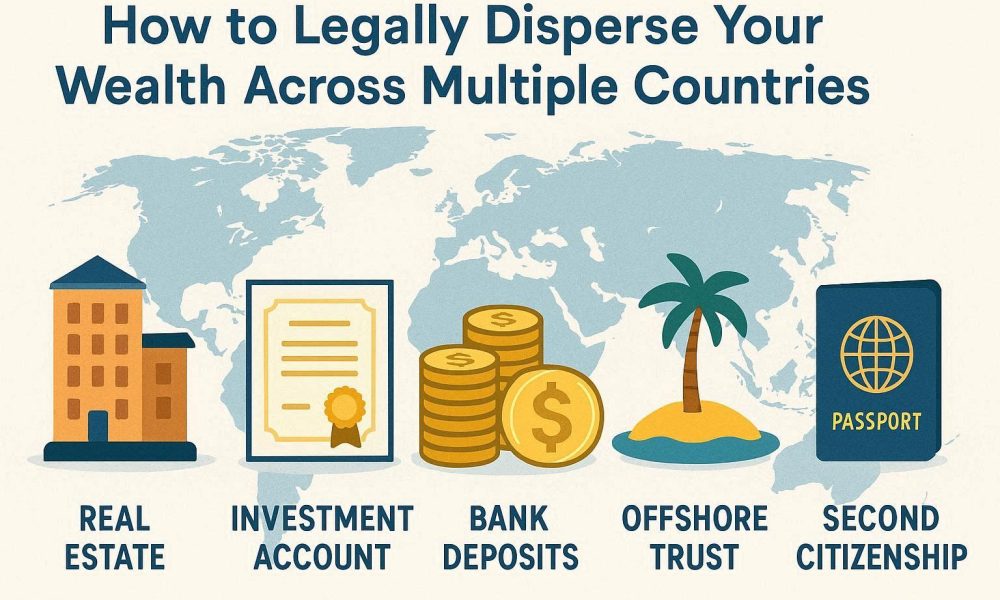
For globally active families, founders, and private investors, the strongest cross-border wealth strategy in 2026 is not secrecy. It is a lawful diversification. The real objective is to spread risk across multiple legal, banking, and currency environments so that no single country, institution, or political climate controls the entire financial picture.
WASHINGTON, DC, June 16, 2026. Most people hear the phrase “offshore accounts” and picture the wrong era. They imagine hidden money, distant islands, and elaborate structures designed mainly to keep authorities in the dark. That image is badly outdated. In modern cross-border planning, the real danger to wealth is usually not visibility alone. It is concentration. Too much cash in one country. Too much dependence on one banking system. Too much exposure to one currency, one court system, one political environment, or one administrative culture. That is why serious international asset protection today is less about concealment and more about lawful distribution.
The modern question is not how to make money disappear. It is about keeping wealth usable if one part of the world becomes less useful.
That distinction matters because many affluent families still organize their financial lives as though everything important should remain anchored within a single domestic banking perimeter. They may own property abroad, educate children abroad, earn income internationally, or hold more than one lawful residence option, yet their liquidity remains concentrated in one country, one institution, or a narrow set of accounts. In calm times, that may feel efficient. Under stress, it often becomes fragile. A regulatory change, legal dispute, banking review, political shift, or family transition can suddenly affect the same pool of money simultaneously.
That is why lawful multi-country wealth dispersion has become much more important. A well-structured offshore account strategy is not there to erase legal obligations. It is there to reduce single points of failure. It can create reserve liquidity outside the immediate home-country perimeter, improve multicurrency flexibility, separate operating funds from strategic reserves, and make it easier to preserve calm when a domestic environment becomes restrictive or simply inconvenient. The stronger the structure, the less likely one problem is to infect everything else.
This is also why modern offshore planning works best when it is built into a broader legal and geographic strategy. Families that already think in terms of international relocation planning often understand this quickly, because once residence, schooling, banking, property, and family movement are spread across jurisdictions, it no longer makes sense to keep every meaningful reserve in one national system as though the rest of life were still entirely domestic.
Start by separating functions before you separate jurisdictions
The first mistake people make is opening accounts in several countries before deciding what each account is supposed to do. That usually creates administrative sprawl rather than protection.
A stronger strategy begins with function.
One pool of money may be for daily life and ordinary domestic obligations. Another may be for international reserve liquidity. Another may be for business or professional operations. Another may be for real estate expenses, schooling, healthcare, or family contingency planning. Another may hold strategic cash waiting for investment or deployment. When these roles are defined first, the right jurisdictions and institutions become much easier to choose.
This is important because not all money should be exposed to the same risks. Household spending liquidity does not need the same structure as long-term reserve capital. Emergency funds should not be trapped inside the same perimeter as ordinary consumer banking if the family’s life is already international. Property-related cash flow should not always be kept alongside family-level reserve assets. A business treasury should not automatically share the same exact channels as private travel and household operations. The more clearly functions are separated, the less damage a single problem can cause.
That is the real beginning of lawful offshore planning. Not geography first, but purpose first.
Once the purpose is clear, the decision on jurisdiction becomes more rational. A country may be excellent for managing multicurrency reserves but not ideal for day-to-day household spending. Another may be suitable for local property operations, but it is weak as a place to hold strategic cash. A third may remain useful as the domestic anchor simply because taxes, payroll, or local family obligations still run through it. The goal is not to make every account foreign. The goal is to stop forcing a single country and a single bank to perform every role.
A domestic base is useful, but it should not be the whole structure
Domestic banking still matters. In many cases, it remains the best place for local payroll, mortgages, household bills, tax payments, and the routine mechanics of life. The problem begins when clients mistake usefulness for sufficiency.
A purely domestic model concentrates risk. One sovereign environment, one banking culture, one immediate court reach, one set of account controls, and one currency environment end up holding too much influence over the entire family balance sheet. That concentration can feel harmless until something changes. A relationship manager leaves. A large transfer is questioned. A bank’s risk appetite shifts. A legal event complicates access. A family has to relocate quickly. A business sale produces large liquid proceeds that no longer belong in the same structure as ordinary daily banking.
This is also why understanding deposit protection matters. In the United States, the FDIC deposit insurance framework automatically protects covered deposits at insured banks, generally up to $250,000 per depositor, per insured bank, per ownership category. That does not make U.S. banking weak. It means large balances should be managed deliberately rather than left in one place because the institution feels familiar. Once liquidity rises well beyond basic insurance thresholds, the client is relying on far more than deposit insurance.
This is the turning point where a multi-country strategy becomes valuable. A second banking jurisdiction may not replace the domestic one. It may simply relieve it of strategic tasks it was never meant to carry alone.
Use offshore accounts for lawful diversification, not for mythology
There is still too much mythology around offshore accounts. A foreign account is not useful because it is mysterious. It is useful when it provides a lawful advantage that a domestic account cannot offer.
That may be multicurrency access.
That may be reserve diversification.
That may be a second operating base for an internationally mobile family.
That may be cleaner support for foreign property or cross-border education expenses.
That may be simple continuity if one home-country banking environment becomes temporarily difficult.
The value lies in what the structure does, not how exotic it sounds.
This is why a serious offshore account should always be explainable in one sentence. Why does this account exist? If the answer is vague, the account is probably weak. If the answer is practical and specific, reserve liquidity, international expenses, property operations, family-office treasury, or relocation readiness, then the account is much easier to defend and much more likely to remain useful over time.
That is also why broader legal mobility can strengthen financial diversification. Carefully structured second-passport planning can widen the jurisdictions in which a client can lawfully live, bank, and organize family life. A second citizenship is not a bank account, but it can support the banking strategy by reducing overreliance on a single national framework and increasing the number of lawful jurisdictions from which life can operate calmly.
The important point is that offshore accounts work best when they are part of a larger coherent system. They should support the life being lived, not exist as ornaments.
Treat reporting as part of the structure, not as an obstacle to it
One of the biggest mistakes in offshore planning is assuming that if an account must be reported, it is somehow less useful. In reality, the opposite is often true.
A foreign account that remains valuable after lawful reporting has been handled correctly is exactly the kind of account worth having. A foreign account that only “works” if no one knows it exists is fragile by design.
For U.S.-connected clients, the IRS FBAR rules are a clear reminder that foreign financial accounts can create annual reporting obligations once the aggregate value exceeds the relevant threshold. That does not make foreign accounts a mistake. It means those accounts should be integrated into a truthful, well-documented structure from the beginning. The quieter financial life is not the one that avoids reporting. It is the one who remains calm after the reporting has been done.
This is where lawful multi-country wealth planning becomes much stronger than old offshore mythology. Instead of trying to deny visibility, it assumes lawful visibility exists and then asks a better question: Does this account still improve the structure once the legitimate reporting has been handled? If the answer is yes, then the account is probably serving a real protective purpose.
That same discipline improves everything else. Source-of-funds files become cleaner. Bank reviews become less stressful. Family governance becomes easier. Successors and advisers can understand the structure more readily. In other words, reporting does not weaken the plan. It legitimizes the plan.
Build a banking map, not a pile of accounts
A sophisticated wealth-dispersion strategy should feel like a map.
Which account handles domestic life?
Which account holds reserve liquidity?
Which jurisdiction supports multicurrency needs?
Which structure supports foreign property or business activity?
Which accounts are for immediate access and which are not?
Which relationships are personal, which are entity-based, and which are meant for family continuity?
If those answers are not clear, the structure is probably too loose.
This is one of the main reasons wealthy families and internationally active founders get into trouble with otherwise lawful offshore planning. They open too many accounts, too quickly, for reasons they cannot later articulate cleanly. The result is more onboarding, more maintenance, more exposure to operational mistakes, and more chances for the account structure to drift away from the actual life it was meant to support.
The better approach is narrower and more deliberate. Fewer accounts. Clearer roles. Stronger jurisdictions. Better internal records. A domestic anchor where it still makes sense. A carefully chosen international reserve platform where it improves resilience. Additional structures are only used where they solve a distinct problem.
That kind of map also ages better. If a family relocates, the structure can adapt. If one country becomes less attractive, the whole plan does not collapse. If one property is sold or one business is restructured, not every banking relationship has to change at once. A map survives change better than a pile.
The strongest protection is optionality, not invisibility
That may be the clearest lesson of all. Modern asset protection is not really about making wealth invisible. It is about making wealth less cornered.
Less cornered by one country.
Less cornered by one bank.
Less cornered by one legal environment.
Less cornered by one currency system.
Less cornered by one administrative bottleneck.
That is what lawful cross-border wealth dispersion achieves when done properly.
It gives the client room to respond, room to move, room to preserve continuity, and room to keep a family or business stable when one part of the system becomes less useful. It does not eliminate obligations. It does not erase records. It does not promise fantasy. What it provides is something much more valuable: a financial structure that remains usable under pressure.
That is why dispersing wealth across multiple countries still matters.
That is why carefully structured offshore accounts remain relevant.
And that is why the strongest modern strategy is not to disappear from the financial system, but to stop relying entirely on a single part of it.




