
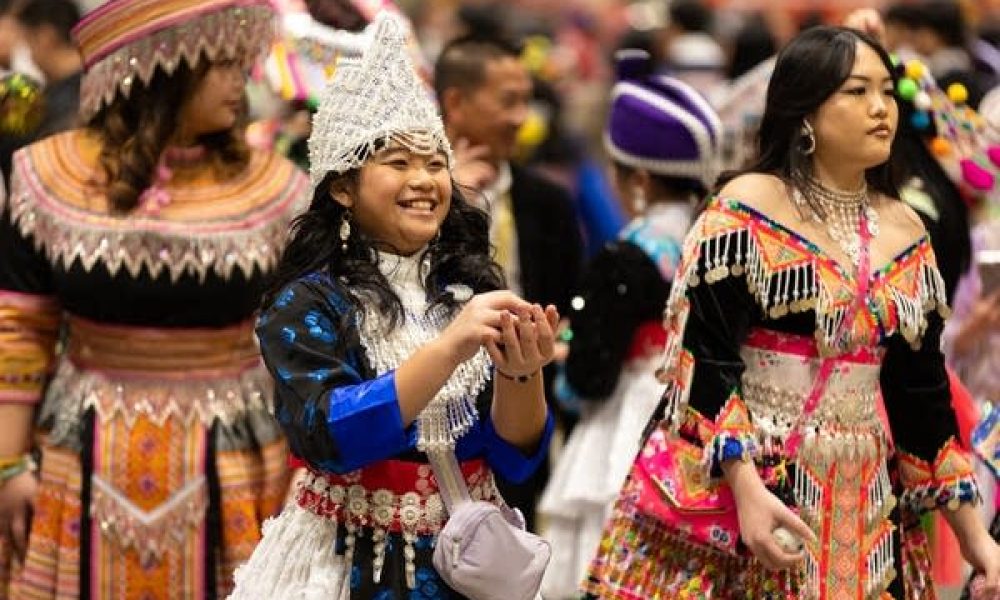
Hmong New Year 2026: Inside the Ancient Celebration That Now Draws Hundreds of Thousands Across America
From highland villages in Southeast Asia to the fairgrounds of Fresno, California, Hmong New Year has become one of the most remarkable cultural preservation stories in modern American history.
FRESNO, CA — Every year, as the calendar turns toward the end of November and through December, something extraordinary happens across the United States. Tens of thousands of Hmong Americans dust off intricately hand-embroidered garments, prepare ceremonial foods, and travel hundreds or even thousands of miles for a celebration that is equal parts reunion, spiritual observance, and cultural declaration. Hmong New Year, known in the Hmong language as Noj Peb Caug (pronounced “noh pay chow”), is not merely a holiday. It is the single most important cultural event for one of America’s most resilient communities, and in 2026, its significance reaches a historic milestone.
This year marks 50 years since Hmong refugees first arrived in the United States following the end of the Vietnam War and the fall of Laos. Half a century of rebuilding, preserving, and celebrating a culture that survived displacement, war, and resettlement in a foreign land. The 2026 Hmong New Year season carries with it not just the joy of tradition, but the weight of history and the pride of a community that refused to disappear.
What Is Hmong New Year?
Hmong New Year is an annual celebration that marks the end of the harvest season and the beginning of a new cycle of life. Rooted in the agricultural traditions of the Hmong people, who originally inhabited highland regions across southern China, northern Laos, Vietnam, Myanmar, and Thailand, the holiday has been observed for centuries. The phrase Noj Peb Caug literally translates to “eat thirty,” a reference to a tradition of preparing ten dishes across three days of feasting, totaling thirty dishes shared in honor of ancestors and the community.
Celebrations traditionally take place between October and January, aligned with the completion of the rice harvest. In the highlands of Laos, neighboring villages would coordinate their New Year dates to allow people to travel between celebrations, sharing food, music, storytelling, and the longstanding courtship ritual known as pov pob. In pov pob, unmarried young men and women toss a small cloth ball back and forth across a line, using the game as a way to socialize, sing folk songs called kwv txhiaj, and find potential partners. This practice continues at Hmong New Year celebrations across the United States today.
The spiritual dimension of Hmong New Year is equally significant. Ceremonies such as laig dab (offerings to ancestral spirits), txi xwm kab (offerings to the God of Wealth for household health and prosperity), and khi tes (string tying, where blessed cords are tied around the wrist for protection and good fortune) connect participants to ancestors across generations. These rituals remind the living of who they came from and who they are obligated to become.
The History of Hmong New Year in America
The story of Hmong New Year in America is inseparable from one of the most politically complex refugee crises of the 20th century. During the Vietnam War era, the United States government recruited Hmong soldiers and communities in Laos to fight in what became known as the Secret War. When the war ended and the Communist Pathet Lao came to power in 1975, the Hmong who had fought alongside American forces faced severe persecution. Thousands fled across the Mekong River into Thailand, living for years in refugee camps before being resettled in the United States.
The first Hmong refugees arrived in Minnesota in 1975. By 1977, the community in St. Paul had grown large enough to hold its first formal Hmong New Year gathering. What began as a small community event quickly became something much larger. By 1980, attendance had grown to over 6,000 people at St. Paul’s Civic Center, transforming a private community gathering into a public cultural event that non-Hmong residents could attend and experience. The St. Paul Hmong New Year, held annually at the RiverCentre after Thanksgiving weekend, has continued without interruption for nearly five decades and now draws tens of thousands of participants from across the country.
Simultaneously, Hmong communities were settling in California’s Central Valley. Fresno, California became home to one of the largest urban Hmong populations in the nation, and by the mid-1970s, the Fresno Hmong community had established its own New Year tradition at the Fresno County Fairgrounds. Over the decades, that event grew into what is now widely recognized as the largest Hmong New Year celebration not just in the United States, but potentially in the world.
Other major celebrations took root across the country wherever Hmong communities settled: Sacramento, California; Milwaukee and Eau Claire, Wisconsin; Seattle, Washington; Denver, Colorado; and Charlotte, North Carolina, among many others. The tradition of staggering New Year dates from village life in Laos carried over beautifully to America. Communities schedule their events on different weekends so that Hmong Americans can travel from city to city, experiencing multiple celebrations across the season. Some families begin in Minnesota in late November and end in Fresno in late December, treating the entire season as one extended reunion.
The Largest Hmong New Year Gathering in the USA: Fresno, California
When people in the Hmong diaspora speak of the premier Hmong New Year celebration in the United States, they speak of Fresno. Held annually at the Fresno County Fairgrounds in late December, the multi-day event has drawn well over 100,000 attendees in a single year during its peak seasons, with some estimates reaching nearly 200,000 participants during the week-long celebrations of the mid-2010s. Former Elk Grove Mayor Steve Ly, the nation’s first Hmong-American mayor, described it plainly: “It is the largest assembly of the Hmong ethnic group in the United States and perhaps in the world.”
The scale of the Fresno celebration is genuinely staggering. Attendees travel from Minnesota, Utah, Wisconsin, Washington, and states across the country, as well as from Laos, Thailand, France, China, and Australia, to be present. The event features traditional dance competitions, beauty pageants including the Miss Hmong Grand International Pageant, folk singing competitions, sports tournaments in volleyball, badminton, cornhole, and the traditional Southeast Asian sport of sepak takraw (also known as kato), hundreds of vendor booths selling Hmong crafts, clothing, and jewelry, and a vast marketplace of authentic Hmong, Lao, and Thai cuisine.
The 2025 edition of the Fresno celebration held special significance as it marked 50 years since the first Hmong refugees arrived in the United States. Former Fresno City Councilmember Blong Xiong called it “the biggest New Year gathering of Southeast Asians in North America,” noting that the event serves as both celebration and living history. The opening ceremonies drew Fresno Mayor Jerry Dyer, Fresno Unified School District Superintendent Misty Her, Clovis Mayor Vong Mouanoutoua, and Minnesota State Senator Susan Pha, underscoring the political and civic weight the celebration now carries.
Prior to the COVID-19 pandemic, the Fresno celebration ran for seven days and regularly drew over 120,000 visitors. Post-pandemic, the event was scaled to four days and attendance rebounded steadily, with organizers expressing confidence that momentum continues to build. The event is organized by Hmong Inc., a nonprofit that has invested significantly in programming, parade logistics, cultural showcases, and community outreach to ensure each year surpasses the last.
Hmong New Year Celebrations Across the Nation in 2026
While Fresno holds the crown for the largest single gathering, Hmong New Year in 2026 is a coast-to-coast phenomenon with celebrations in dozens of cities. The following events represent the major gatherings on the 2026 calendar:
St. Paul, Minnesota: The St. Paul Hmong New Year, held at the RiverCentre over Thanksgiving weekend, is the nation’s second-largest gathering and the most historically significant. Running continuously since 1977, it draws an estimated 40,000 attendees per day and is central to the identity of St. Paul’s Hmong community, the largest urban Hmong population in the United States.
Sacramento, California: The Sacramento Hmong New Year, organized by Sacramento Hmong New Year Inc. (SHNY) since 2004, expects approximately 40,000 attendees annually. It features beauty pageants, dance competitions, an idol competition, and tournaments in volleyball, golf, and cornhole.
Eau Claire, Wisconsin: The Eau Claire Hmong New Year holds special significance in 2026 as it commemorates 50 years since Hmong refugees first settled in Eau Claire, one of the earliest Hmong communities in the nation. The 2024 event drew over 4,000 attendees after a pause since 2021, and organizers have committed to making 2026 bigger than ever.
Seattle, Washington: The Seattle Hmong New Year takes place November 14, 2026 at the Armory Food and Event Hall at Seattle Center, presented by the Hmong Association of Washington as part of the Seattle Center Festal series. The event is free and open to the public.
Why Hmong New Year Matters Beyond the Celebration
Hmong New Year occupies a unique position in American cultural life because, unlike many communities whose traditions have been diluted or commercialized over generations, the Hmong have maintained the substance and spiritual integrity of their New Year celebration even while adapting its form to American contexts. The ball toss courtship ritual still happens at every event. Elders still chant offerings to ancestors. Traditional clothing — painstakingly hand-embroidered with clan-specific patterns in fabrics that can take months to complete — is worn with obvious pride by children and grandparents alike.
At the same time, the celebration has evolved. Modern Hmong New Year events now feature hip-hop artists and break dancers alongside qeej players. Beauty pageant contestants hold college degrees. Dance teams from St. Paul compete against teams from Fresno. Vendors sell both traditional hemp fabric and modern Hmong streetwear. Interracial and interethnic couples attend together. Non-Hmong visitors are welcomed and increasingly common. The celebration has become a genuine expression of what it means to be Hmong American: rooted in the past, living fully in the present.
For the roughly 300,000 Hmong Americans living in the United States today, Hmong New Year is the one holiday that belongs entirely to them. As event organizer Tolu Thao of Fresno explained: “Think of this — in America we have 12 holidays, right? One per month. Hmong has none. This is the only holiday. When you celebrate 12 together, that’s huge.” The weight of that statement is not lost on anyone who has stood inside the Fresno County Fairgrounds and watched three generations of a Hmong family dressed in full traditional regalia, sharing a meal of sticky rice and papaya salad, thousands of miles from the land their grandparents called home.
Looking Ahead: Hmong New Year 2026
The 2026 Hmong New Year season begins in earnest in late November with the St. Paul celebration and culminates in Fresno in late December. For anyone seeking to understand the depth and breadth of Hmong American culture, there is no better entry point. The celebrations are open to the public, welcoming to visitors of all backgrounds, and represent one of the most powerful demonstrations of cultural resilience and community cohesion in the American immigrant experience.
As Blong Xiong said of the 2025 anniversary gathering in Fresno: “It’s really important that we celebrate the success that we’ve had here for 50 years. But the other thing is to remember all the hard work, the sacrifices. Our elders have really paved the way.” In 2026, Hmong New Year carries that torch forward, one embroidered garment, one tossed ball, one shared meal at a time.




