
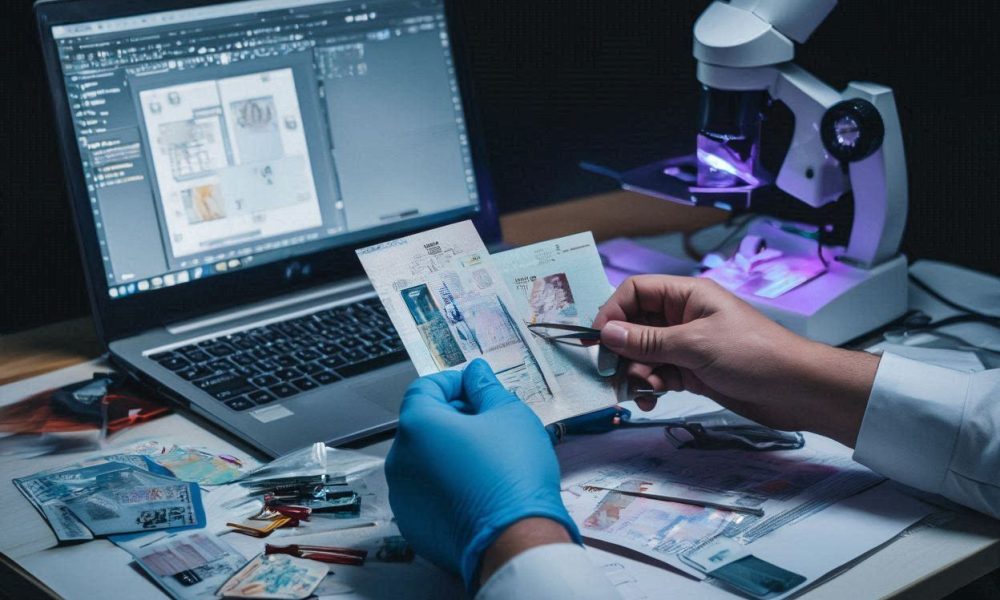
Analyzing the latest trends in passport fraud, from chip tampering to sophisticated blank document thefts.
WASHINGTON, DC, May 8, 2026.
The modern passport has become harder to forge, harder to alter, and harder to pass through a border undetected, yet the criminal market has not disappeared because counterfeiters have adapted by targeting chips, blank documents, stolen identity data, corrupt verification pathways, and weak points in lawful issuance.
For governments, border agencies, airlines, banks, and private mobility advisers, the counterfeiter’s challenge in 2026 is no longer limited to spotting a bad photograph or a forged stamp, as fraud now spans physical documents, electronic chips, biometric systems, supply chains, and stolen personal records.
The new passport fraud market is no longer built around a single fake booklet, as modern criminals now attack the entire identity chain, from application records to border inspections.
The old image of passport fraud involved a forged booklet, a substituted photograph, or a washed data page, but modern fraud is more complex because criminals increasingly combine stolen personal data, forged breeder documents, altered supporting records, and genuine-looking travel documents designed to survive quick inspection.
This evolution has been driven by the success of modern passport security, as polycarbonate data pages, laser engraving, RFID chips, biometric comparison, optical security features, and automated border readers have made traditional cut-and-paste alterations far less reliable than they were decades ago.
The result is a strategic shift from simple document forgery to identity ecosystem attacks, in which criminals may attempt to compromise application files, exploit insider access, purchase stolen passport data, manipulate courier channels, or obtain genuine documents under false identities.
That shift means the passport itself has become only one layer of the investigation, because law enforcement must now examine how the document was issued, where the identity records originated, whether the chip validates, and whether the person presenting it matches the biometric record.
Chip tampering has become a high-risk attack because e-passports now use cryptographic checks that expose electronic manipulation at inspection.
The chip inside an e-passport stores biographic data, a digital portrait, security information, and electronically signed records, which allows inspection systems to compare the physical data page with the electronic identity file inside the booklet.
A counterfeiter may try to copy data, emulate a chip, or manipulate electronic records, but modern e-passport systems are designed so that altered data should fail digital signature checks when a reader validates the document against trusted government certificates.
The U.S. Department of Homeland Security explains that an e-passport contains an electronic chip that carries the same information printed on the passport data page, allowing authorities to compare physical and electronic identity claims during inspection.
This does not make electronic fraud impossible, but it increases the technical burden because a cloned chip must also align with the printed booklet, the machine-readable zone, the laser-personalized portrait, the issuing authority, biometric comparison, and the international verification environment.
The most dangerous fraud attempts now involve genuine documents obtained through false identities rather than crude counterfeit passports that fail under machine inspection.
When passport booklets become more secure, criminals often seek weaker entry points before the document is issued, because a genuine passport obtained through fraudulent supporting records may pass physical inspection more easily than a poorly forged booklet.
This type of fraud can involve stolen birth certificates, fake national identity cards, false residency documents, corrupt local verification, synthetic identities, compromised postal delivery, or manipulated application systems that create a real passport attached to a false narrative.
For border officers, these cases are harder because the passport may be physically genuine, the chip may work, and the data page may appear to be properly manufactured, yet the identity basis behind the document may still be fraudulent.
That is why modern passport fraud investigations increasingly focus on upstream records, not only the booklet itself, because the most sophisticated fraudsters understand that defeating issuance controls can be more useful than trying to defeat polycarbonate, chips, and laser engraving after issuance.
Blank document theft remains one of the most serious threats because an unused passport booklet can become a platform for criminal personalization.
Blank passports and unfinished travel documents are valuable because they can carry genuine paper, covers, security features, and official production elements before personalization, making them far more dangerous than counterfeit booklets produced entirely from scratch.
When blank documents disappear from passport offices, courier systems, consular shipments, printing facilities, or storage locations, authorities must move quickly to block serial numbers, notify border systems, update watchlists, and prevent those documents from becoming usable criminal assets.
The threat is not theoretical because the history of international document security shows that stolen blank passports have repeatedly been targeted as high-value items, especially when criminal networks believe they can combine genuine blanks with fraudulent personalization, stolen identities, or corrupt assistance.
This is why secure inventory control matters as much as advanced technology, because even the strongest chip and data page architecture depends on strict custody before the passport ever reaches the lawful applicant.
Recent fraud cases show that forged passport activity persists even as technology makes finished documents harder to manipulate.
In March 2026, Canadian reporting described a case in which border officers at the Peace Bridge crossing in Fort Erie, Ontario, seized forged Canadian passports, payment cards, and cash after travelers were referred for secondary inspection following a wrong turn toward the United States.
That recent seizure of a forged passport showed how fraudulent travel documents often appear alongside broader financial crime indicators, including payment cards and identity documents, suggesting that passport fraud is frequently part of a wider criminal portfolio.
The case also reflected a broader enforcement pattern, because counterfeit documents are rarely isolated tools; they often intersect with banking fraud, stolen identity data, courier shipments, immigration evasion, organized crime activity, and attempts to create new financial lives under false credentials.
For investigators, this convergence means a suspicious passport may open a larger inquiry into stolen identities, synthetic profiles, account fraud, forged payment instruments, and the networks that supply physical documents to people seeking movement or concealment.
Commercial shipments and courier channels have become attractive pathways because criminal networks can hide forged documents inside ordinary logistics flows.
Passport fraud no longer depends solely on a person walking through a border with a forged booklet in hand, because fraudulent documents can move through commercial shipments, parcel services, online marketplaces, encrypted messaging channels, and international courier routes.
This matters because the supply chain for false documents can be global, with one group stealing identity data, another producing supporting records, another manufacturing physical documents, and another arranging delivery to the end user.
Border agencies increasingly screen courier flows for suspicious documents because forged passports, fraudulent identity cards, blank card stock, holograms, embossing tools, printers, and payment cards can all move through logistics systems not primarily designed for identity security.
The challenge for authorities is volume: millions of lawful shipments move daily, while small document packages can be easily concealed unless risk systems, intelligence, inspection teams, and cross-border cooperation identify the right targets.
The dark web has expanded the fraud market by separating data theft from document production and making passport information tradable before a booklet is forged.
A stolen passport scan, travel booking, hotel record, boarding pass image, or identity profile can be monetized even without physical possession of the original booklet, because criminals can use that information for impersonation, account opening, phishing, synthetic identity building, and document fraud preparation.
The rise of cloud storage, phone theft, malware, unsecured email attachments, and careless travel document uploads has created a steady supply of identity material that counterfeiters can combine with forged documents or fraudulent applications.
Travelers often underestimate this risk because they think of passport crime as physical theft, yet a clear photograph of a data page can reveal the document number, expiration date, full name, nationality, date of birth, and other details useful to criminals.
This is why passport protection now extends beyond the border: identity security encompasses how travelers store scans, share documents with hotels or agencies, upload information to travel platforms, and protect their devices while abroad.
Polycarbonate data pages have driven counterfeiters away from surface alteration, as laser engraving makes identity data harder to rewrite without visible damage.
Older laminated paper data pages allowed criminals to attempt photograph substitution, laminate lifting, ink washing, chemical treatment, and surface-level manipulation, especially when border inspection depended heavily on human review rather than chip validation.
Modern polycarbonate pages are designed differently because identity details are laser engraved into the plastic layers, making personal information part of the material structure rather than surface ink protected by a removable laminate.
This design means an attacker trying to change a name, birth date, portrait, or document number must damage the page itself, often creating visible evidence such as clouding, deformation, broken security features, or inconsistent tactile and optical behavior.
The counterfeiter’s challenge is therefore structural, because altering a modern passport is not just a printing problem, but a materials problem involving plastic chemistry, laser behavior, optical registration, biometric consistency, and electronic verification.
Biometric comparison has made lookalike fraud more difficult, but it has also pushed criminals toward higher-quality stolen identities and better social engineering.
Lookalike fraud remains a persistent problem because criminals may use a genuine passport belonging to someone with a similar appearance, especially when the document has not been reported stolen or when inspection pressure is high.
Facial comparison systems make this harder by comparing the live traveler to the passport chip image or government-held photograph, identifying mismatches that might be missed during rushed human inspection or poor lighting conditions.
However, criminals adapt by seeking stolen documents from people with similar age, facial structure, nationality, or appearance, while also exploiting weak reporting, delayed lost-passport databases, or countries where biometric comparison is not consistently deployed.
The result is an arms race between biometric accuracy and criminal selection, where fraudsters no longer need only a passport, but a passport attached to a face close enough to challenge both humans and machines.
Insider corruption remains a critical threat because a single compromised official can bypass security controls that technology alone cannot defend against.
No passport system can depend entirely on materials, chips, or biometrics, because a corrupt insider inside an application office, civil registry, courier system, immigration desk, or local verification unit can undermine controls before the document is issued.
Insider-enabled fraud may involve approving false applications, ignoring inconsistencies, supplying blank materials, redirecting documents, altering records, or helping applicants create paper trails that appear legitimate during automated inspection.
These cases are especially dangerous because the final passport may be genuine, valid, and electronically readable, even though the pathway used to obtain it involved false information, bribery, coercion, or deliberate institutional failure.
For governments, the solution requires staff vetting, audit trails, separation of duties, biometric enrollment controls, serial-number reconciliation, secure document custody, and investigation units capable of detecting irregular issuance patterns before they become border failures.
Artificial intelligence has entered the fraud landscape by improving document image quality, creating synthetic faces, and helping criminals prepare more convincing identity packages.
AI tools can enhance stolen passport scans, generate synthetic supporting images, create fake utility bills, automate phishing messages, manipulate portraits, and assist criminals in building coherent identity narratives across multiple documents.
The threat is not that AI can magically defeat a secure passport chip, because cryptographic and physical defenses remain difficult to bypass, but that AI can improve the surrounding fraud package used before or alongside the passport.
A criminal seeking to obtain a genuine document may use AI-assisted materials to support false applications, while another may use synthetic images or deepfake-style techniques to attack remote onboarding systems outside the border environment.
This is why passport fraud increasingly overlaps with digital identity fraud: even the strongest travel document can still be compromised when banks, agencies, hotels, telecom providers, or online systems accept manipulated identity evidence upstream.
Border security now depends on connecting document inspection with databases that identify stolen, lost, revoked, or suspicious travel documents.
A forged passport may fail under physical inspection, but a stolen genuine passport may look perfect unless the document number has been reported, blocked, or entered into international systems used by border and law enforcement authorities.
That database layer is crucial because criminals often rely on timing gaps, hoping to use a stolen or fraudulently obtained document before authorities report it, update border systems, or share information internationally.
When border agencies can check document numbers against lost, stolen, revoked, or invalid records, they add a real-time enforcement layer that catches documents whose physical features may still appear convincing.
The passport security system, therefore, depends on speed as much as on technology, because stolen blanks, compromised booklets, or fraudulent serial numbers must be blocked quickly enough to prevent criminals from moving before detection occurs.
For lawful travelers, the new fraud environment entails stricter scrutiny and less tolerance for inconsistencies in identity records.
As counterfeiters become more sophisticated, legitimate travelers face more automated checks, stricter document requirements, closer biometric comparisons, and greater scrutiny of inconsistencies across passports, visas, airline bookings, tax records, residence permits, and banking profiles.
A misspelled name, an outdated record, a damaged passport, an inconsistent travel history, an unreported lost document, or a mismatch between documents can cause delays because systems are designed to detect anomalies that may signal fraud.
This stricter environment is one reason global mobility planning now requires record discipline, because lawful travel depends not only on holding a valid passport but on maintaining a coherent identity trail across public and private systems.
Professional advisory firms such as Amicus International Consulting monitor these developments because passport security, lawful identity restructuring, second citizenship, privacy planning, and cross-border compliance now operate inside the same verification ecosystem.
Second passport planning must account for the fact that modern documents are tested electronically, physically, and biometrically at every serious border.
A lawful second passport can support mobility, contingency planning, relocation, private banking, and family security, but it must be issued through a legitimate government process and supported by accurate identity records that survive modern inspection.
The age of treating a passport as a standalone booklet is over, because e-gates and officers now evaluate chip data, digital signatures, facial comparison, document history, watchlists, machine-readable zones, and the credibility of the issuing authority.
This is why second-passport advisory services increasingly focus on lawful eligibility, government authorization, tax identification, documentation integrity, and long-term usability rather than on the mere possession of cosmetic documents.
A second passport is valuable only when the document, identity record, biometric profile, tax history, banking narrative, and legal status remain consistent under pressure from border agencies, financial institutions, and immigration authorities.
The counterfeiter’s challenge is becoming harder because fraud must now defeat a synchronized security system rather than a single document feature.
A forged travel document must survive human inspection, ultraviolet review, optical security checks, chip reading, digital signature validation, machine-readable zone comparison, database screening, biometric matching, and sometimes airline pre-departure verification.
Each layer may be imperfect on its own, but together they create a security environment in which a single mismatch can expose fraud and trigger secondary inspection, criminal investigation, or cross-border intelligence sharing.
That is why modern counterfeiters increasingly target the surrounding ecosystem, because beating the passport booklet directly has become more difficult than exploiting stolen data, social engineering, corrupt insiders, courier vulnerabilities, or weak application screening.
For authorities, the challenge is to protect every layer without slowing legitimate travel to a crawl, maintaining enough speed for millions of passengers while preserving enough suspicion to catch the one document designed to deceive.
The future of passport fraud will be fought across chips, faces, records, and supply chains, not only across paper and ink.
The next generation of criminal attempts will likely combine stolen identity files, AI-assisted applications, lookalike selection, forged supporting documents, manipulated onboarding images, courier concealment, and attacks on underprotected administrative systems.
Governments will respond with stronger chip authentication, better biometric comparison, tighter custody of blank documents, secure issuance audits, faster reporting of stolen documents, improved international data exchange, and more sophisticated inspection tools at airports and land borders.
The passport will remain central, but it will increasingly serve as a node in a broader identity security network, where border gates, law enforcement databases, airline systems, consulates, banks, and digital credential platforms share responsibility for trust.
The counterfeiter’s challenge in 2026 is therefore not just to forge a booklet, because the real challenge is to survive a world where the booklet talks to a chip, the chip talks to a reader, the reader talks to a database, and the traveler’s face must confirm that every part of the story is true.




