
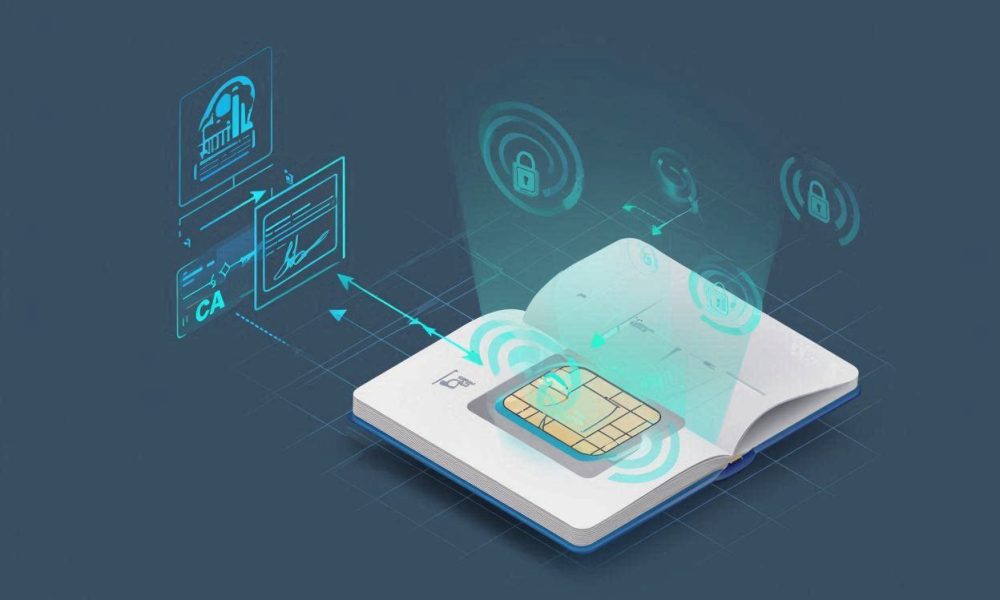
An inside look at the public key infrastructure that allows border gates to verify your chip’s authenticity in seconds.
WASHINGTON, DC, May 8, 2026.
The modern e-passport may look like a small booklet with a national emblem on the cover, yet its hidden chip, encrypted data structure, and international public key infrastructure now form one of the most important defenses against document cloning, identity theft, and fraudulent cross-border movement.
Inside that chip is not only a digital copy of the traveler’s identity page, but also a signed electronic record that border systems can test against trusted government certificates, allowing automated gates and inspection officers to determine whether the document was genuinely issued and whether its data has been altered.
The e-passport chip is useful only if border systems can trust it.
An e-passport chip stores biographic information, a digital facial image, document details, and security data, but the presence of a chip alone does not prove that a passport is authentic, because a cloned or manipulated chip could otherwise mimic the appearance of legitimacy.
That is where public key infrastructure, known as PKI, becomes essential, because it allows governments to digitally sign passport chip data at issuance and allows foreign border agencies to verify that signature later using trusted public certificates.
In practical terms, PKI gives the passport a digital seal of authenticity, establishing a mathematical relationship among the issuing authority, the electronic data stored on the chip, and the border reader that examines the document during inspection.
The U.S. Department of Homeland Security explains that an e-Passport contains an electronic chip that holds the same information printed on the passport data page, allowing inspection systems to compare physical and electronic identity records during travel.
PKI turns the passport chip into a signed government statement.
When a passport authority personalizes an e-passport, it does more than write data into a chip, because it also creates a digital signature over that data using cryptographic keys controlled by the issuing government.
That signature allows a border reader to verify whether the chip data still matches what the issuing government signed, meaning a criminal cannot simply edit the name, replace the photograph, or change the date of birth without breaking the signature.
The system works because private keys remain protected by the issuing authority, while public certificates are shared internationally, allowing other countries to verify signatures without needing access to the issuing country’s secret signing material.
This is the same broad trust concept used in secure internet communications, software signing, and digital identity systems, but in the passport context, it protects the traveler’s chip from silent alteration and helps governments detect cloned or manipulated documents.
The Country Signing Certificate Authority sits at the top of the trust chain.
At the national level, e-passport trust begins with a Country Signing Certificate Authority (CSCA), which serves as the root of trust for that country’s electronic travel document program.
The CSCA issues certificates to document signers, which are the operational signing authorities used to sign passport chip data, creating a chain that border systems can follow from the passport record back to the issuing government’s trusted root.
This layered certificate model is important because governments do not want their most sensitive national signing keys used constantly in routine production, so document signer certificates allow operational signing while protecting the higher-level national trust anchor.
If a document signer is compromised, expires, or needs to be replaced, the issuing state can manage that certificate while maintaining the broader trust structure, helping keep passport authentication resilient over time.
The ICAO Public Key Directory helps countries establish trust.
Passport PKI works only when border authorities can obtain the right certificates from other issuing states, which is why the International Civil Aviation Organization operates the Public Key Directory as a central exchange mechanism for electronic travel document authentication.
The ICAO Public Key Directory provides participating states with a structured way to exchange the certificates and related information needed to authenticate e-passports, electronic identity cards, and other machine-readable travel documents.
Without a trusted certificate exchange, a border gate might read the chip but still be unable to verify that the signature is from a legitimate issuing authority, undermining the entire purpose of electronic passport verification.
The PKD therefore functions as a global trust hub, helping countries move beyond visual inspection and toward cryptographic validation that can happen quickly, consistently, and at the scale required by modern international travel.
Passive authentication checks whether the chip data has changed.
One of the core security processes in e-passport verification is passive authentication, which allows a reader to verify that the data stored on the chip has not been modified since the issuing authority signed it.
During inspection, the reader examines the signed data object on the chip, checks the document signer certificate, traces the trust chain back to a recognized country certificate, and confirms that the signature matches the data being presented.
If the chip has been cloned but not altered, passive authentication may still show that the copied data matches the original signature, which is why additional protections and inspection controls are needed to detect more advanced attacks.
If the chip data has been altered, however, the signature should fail, and that failure should serve as a strong warning to border authorities that the electronic identity record no longer matches the government-issued data.
Active authentication helps prove the chip is not merely a copy.
To defend against some cloning threats, certain e-passports use active authentication or related chip-authentication mechanisms, which require the chip to prove possession of a private key that cannot be copied from the readable data area.
In this model, the border reader sends a challenge to the chip, the chip signs or processes that challenge using its protected private key, and the reader verifies the response using corresponding public information stored in the signed passport data.
This matters because a criminal may copy readable data from a chip, but should not be able to extract the protected private key from secure chip hardware, making it harder to create a clone that behaves exactly like the original.
The principle is simple but powerful: the chip must not only contain data that appears authentic but also demonstrate that it contains cryptographic material tied to the original government-issued document.
Access control helps protect the chip from casual reading.
E-passports also use access-control mechanisms that are designed to limit casual unauthorized reading, often requiring information from the machine-readable zone before a reader can establish communication with the chip.
This means the passport reader generally needs document information printed on the data page, such as the document number, date of birth, and expiration date, before it can derive the access keys needed to read the chip.
The purpose is not to make the chip impossible to read under all circumstances, but to connect electronic access to physical possession of the booklet and reduce the risk of silent harvesting by a nearby unauthorized reader.
Modern access-control approaches have evolved as technology has improved, but the policy objective remains consistent: the chip is meant to support inspection, not to broadcast personal data openly to the surrounding environment.
Secure messaging protects the conversation between the chip and the reader.
After access is established, the chip and reader may create a protected communication channel, allowing the inspection process to exchange identity data, security objects, and authentication responses with encryption and integrity protection.
This secure messaging layer matters because passport data includes sensitive information, such as a facial image, and governments must reduce the risk that criminals can intercept, replay, or manipulate communication between the chip and the inspection device.
At an airport gate, this process is invisible to the traveler, who may see only a scanner light or a brief pause while the system reads the document, checks the chip, and compares identity information.
Behind that brief scan, the passport and reader are performing a coordinated cryptographic exchange that helps determine whether the booklet is genuine, whether the chip is intact, and whether the person presenting it matches the identity record.
PKI makes cloning harder because copied data is not enough.
A simple clone attack would attempt to copy electronic data from one passport chip onto another device, but modern e-passport authentication is designed to render copied data insufficient to pass a full inspection.
The cloned data may contain the same biographic fields and digital image, yet border readers can verify that the chip data is properly signed, that protected chip authentication works, that the physical document matches the electronic record, and that the traveler matches the stored portrait.
The difficulty for criminals is that modern passport security is layered, meaning a cloned chip must also align with the printed data page, machine-readable zone, polycarbonate engraving, optical features, document number, issuing state, watchlist data, and live biometric comparison.
This layered environment has shifted passport fraud away from simple copying and toward more complex attacks on application systems, breeder documents, stolen identities, insider corruption, or the use of genuine documents obtained through false information.
Border gates verify documents in seconds because the trust work happens in advance.
Automated gates can authenticate e-passports quickly because much of the trust architecture is established before a traveler arrives, including certificate exchange, reader configuration, document templates, inspection rules, and government-to-government trust arrangements.
When the traveler presents a passport, the gate does not have to negotiate trust from scratch because it already has access to recognized certificates, validation logic, document standards, and system rules that enable rapid evaluation of the chip.
This is why PKI is so important to border modernization: it allows automated inspection systems to make fast decisions without relying solely on visual appearance or manual officer review at every routine crossing.
A properly configured gate can read the chip, validate the signature, compare data fields, assess document integrity, capture a live facial image, and decide whether to open or refer the traveler for secondary inspection.
News coverage has shown why signature verification matters.
Public reporting has repeatedly highlighted that e-passport security depends not only on issuing secure chips but also on border agencies actually validating cryptographic signatures during inspection, because an unread or unverified signature weakens the protection built into the document.
Wired reported that U.S. border systems improved their ability to check e-passport data after years of scrutiny, illustrating how cryptographic verification can make the difference between merely reading chip data and truly authenticating it.
The distinction is critical because a reader who only compares chip data with the printed page may detect some inconsistencies, but a reader who validates the digital signature can also test whether the electronic record was genuinely signed by the issuing authority.
For governments, the lesson is clear, because the passport chip delivers its full security value only when inspection systems validate certificates, manage trust lists, update software, and treat PKI as an operational border function rather than a theoretical design feature.
The passport chip works with the face, not instead of it.
PKI protects the authenticity and integrity of the chip data, but it does not, by itself, prove that the person standing at the border is the rightful passport holder, which is why biometric comparison remains essential.
A border system may validate the chip signature, confirm the electronic portrait, read the machine-readable zone, and authenticate the document, but it still must compare that trusted record with the live traveler presenting the booklet.
This is where facial biometrics connects cryptographic trust to human identity: the chip may verify that the record is genuine, while the camera helps determine whether the traveler matches the government-issued facial image.
The strongest border systems combine these tools, using PKI to protect the data, biometrics to link the data to the person, and officer review to resolve exceptions, mismatches, fraud indicators, or unusual travel circumstances.
Physical security still matters in a cryptographic passport.
A passport with a valid chip still needs secure paper, laser engraving, optical devices, tactile features, machine-readable printing, page numbering, and tamper-evident construction, because the physical booklet remains part of the trust decision.
If the chip authenticates but the data page appears altered, the portrait looks inconsistent, the machine-readable zone fails, or the booklet shows signs of manipulation, the traveler may still be referred for deeper inspection.
This is why the strongest e-passports are not simply digital files embedded in a cover, but rather coordinated physical and electronic security systems designed to make tampering difficult and to make evidence of tampering visible.
The chip proves one part of the story, the data page proves another, the traveler’s face proves another, and the issuing record ties those claims together through lawful government authority.
Lawful identity planning must account for chip authentication.
For executives, expatriates, high-net-worth families, political-risk clients, and individuals considering lawful second citizenship or relocation planning, PKI-backed e-passports have fundamentally changed the practical meaning of document credibility.
A passport can no longer be evaluated solely by its appearance, because it must be read electronically, validated cryptographically, aligned with biometric data, and remain consistent with government records, tax documentation, immigration files, and banking compliance checks.
This environment is one reason Amicus International Consulting monitors passport technology, lawful identity restructuring, and cross-border verification standards as governments and financial institutions increasingly rely on machine-readable trust.
The modern mobility question is not simply whether a person possesses a passport, but whether the passport, chip, face, records, tax identity, and issuing authority all remain coherent under automated and human review.
Second-passport strategies must withstand electronic inspection.
A lawful second passport can remain an important tool for mobility, contingency planning, private banking, family relocation, and risk reduction, but only when issued through legitimate government channels and supported by accurate identity records.
PKI makes unlawful shortcuts more dangerous because a weak document may fail at the chip level, a manipulated chip may fail to validate signatures, and an inconsistent identity trail may trigger banking, immigration, or border concerns.
This is why second passport advisory services increasingly focus on eligibility, lawful issuance, documentation integrity, tax identification, compliance alignment, and long-term usability rather than treating a passport as a simple travel commodity.
A second passport is valuable only when it can withstand the full modern verification chain, including border-gate scanning, chip authentication, biometric comparison, consular review, financial onboarding, and future travel scrutiny.
PKI does not eliminate fraud, but it changes the battlefield.
No passport security technology can eliminate identity crime completely, because criminals continue to target stolen personal data, corrupt officials, weak civil registries, fraudulent applications, synthetic identities, and genuine documents obtained through deception.
PKI does, however, make chip tampering and simple cloning far harder to carry out successfully, because electronic data must be validated against government signatures, and inspection systems can detect mismatches across physical, electronic, and biometric layers.
This shift has pushed fraud toward earlier stages of the identity process, where criminals may attempt to compromise the records, evidence, or officials that determine who receives a genuine passport in the first place.
The result is a more complex security environment in which governments must protect the document, the chip, the keys, the signing infrastructure, the application process, and the international trust network that enables verification abroad.
The future of passport security will depend on stronger trust networks.
As digital travel credentials, mobile wallets, biometric corridors, and automated border gates expand, PKI will remain central because governments need a way to prove that identity data came from a legitimate authority and has not been altered.
Future systems may verify passport chips, mobile credentials, visas, entry authorizations, and digital identity assertions through related trust frameworks, making certificate management and cryptographic governance even more important to border operations.
The passport booklet may eventually share space with mobile identity tools, but the underlying question will remain the same: every border system must know who issued the credential, whether the data has changed, and whether the traveler matches it.
PKI answers the first two questions with cryptographic trust, while biometrics and human oversight help answer the third, creating a combined model for secure movement in a world where physical and digital identity are inseparable.
The chip in the cover is therefore not just a storage device, but a signed identity container protected by national keys, international certificate exchange, access control, secure messaging, and border systems that can verify authenticity in seconds.
Securing the signal means securing the relationship between the passport, the issuing government, the border reader, and the person presenting the document, which is why PKI has become one of the quiet foundations of modern international travel.




