
Why your high-resolution digital photo is the most critical security feature in the fight against identity theft.
WASHINGTON, DC, May 8, 2026.
The modern border no longer begins with a stamp, a booth, or a uniformed officer studying a passport under fluorescent light, because the first meaningful security decision now often occurs when a traveler’s face is converted into a biometric template and compared against a trusted passport image.
In that instant, the high-resolution digital photograph inside the passport becomes more than a picture, because it functions as a mathematical identity reference point that can confirm continuity between the traveler, the booklet, the chip, and the government record behind both.
This shift has made the passport portrait one of the most critical security features in global travel, as facial biometrics can expose lookalike impostors, altered documents, stolen passports, synthetic identities, and criminal attempts to separate a legitimate credential from its rightful holder.
The passport photograph has become a biometric anchor
For most of the twentieth century, the passport photo was treated as a visual aid for human inspection, allowing an officer to decide whether the person standing at the counter reasonably resembled the printed image in the document.
That process depended heavily on lighting, officer experience, traveler appearance, photo quality, fatigue, crowd pressure, age changes, hairstyles, glasses, facial hair, and the subjective limits of human comparison during busy inspection periods at airports, seaports, and land borders.
Modern facial comparison changes that relationship by turning the passport image into a structured biometric reference, allowing inspection systems to measure facial geometry, compare stable features, and support officers with a machine-assisted assessment of identity continuity.
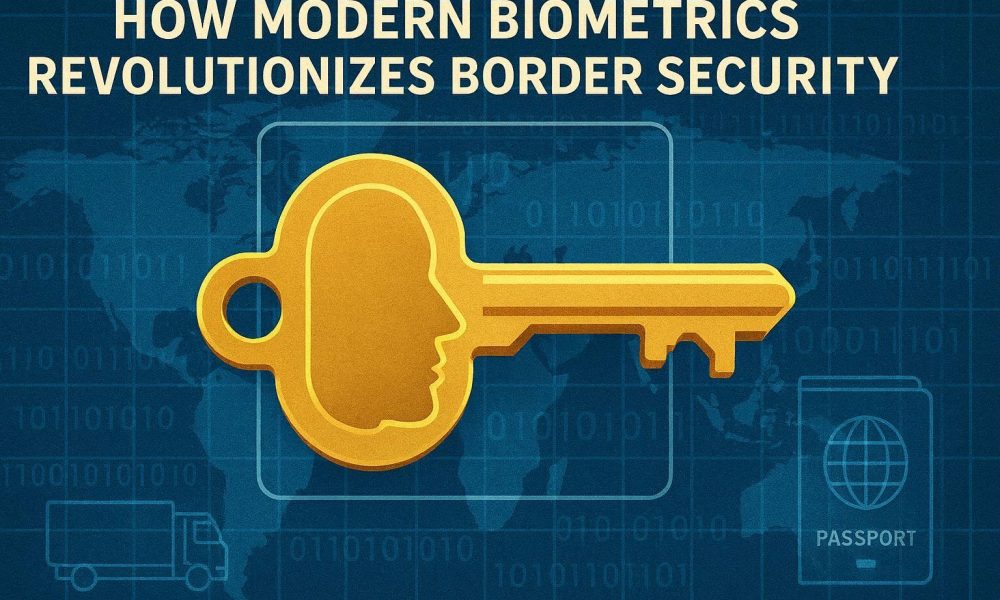
The face is now treated as a key because it connects the physical person to the passport data page, the electronic chip, the machine-readable zone, and the issuing government’s identity record in one coordinated verification event.
Biometrics work because faces contain measurable structure
Facial biometric systems do not simply ask whether two images look similar to the casual eye, because they analyze patterns, distances, contours, proportions, and feature relationships that remain useful even when lighting, expression, or grooming changes.
The system may evaluate relationships among the eyes, nose, mouth, cheekbones, jawline, brow, and overall facial shape, then convert those patterns into a template that can be compared against a trusted passport portrait or government-held image.
This process is powerful because a criminal using a stolen passport may superficially resemble the original holder, yet small differences in facial structure can trigger a mismatch that sends the traveler for secondary inspection.
The technology does not eliminate human judgment because officers still review exceptions, resolve mismatches, and evaluate the broader travel context, but it provides border security with a faster and more consistent way to test identity claims.
The trusted image begins with passport enrollment
The passport photograph matters most when it is captured, submitted, reviewed, and stored properly, because the quality of that image determines how effectively future border systems can compare the traveler against the identity record.
A blurry, poorly lit, heavily edited, low-resolution, obstructed, or non-compliant photograph weakens the entire chain of evidence, which is why governments impose strict standards for pose, expression, lighting, background, head position, shadows, eyeglasses, and digital alteration.
When the image meets the required standard, it becomes a stable biometric anchor that can be printed on the data page, encoded in the passport chip, compared at e-gates, and used by officers during document inspection.
This is why passport photo rules are not bureaucratic inconveniences, because they are technical requirements that make the face usable as a reliable security feature across airports, consulates, airlines, and automated border systems.
The chip gives border systems a trusted portrait
The e-passport chip stores an electronic version of the traveler’s identity data, including a digital facial image that can be read by authorized inspection systems and compared against the printed portrait and live camera capture.
That stored image is important because it is cryptographically protected as part of the passport’s electronic record, making it much harder for a criminal to alter the printed portrait without creating a mismatch during electronic inspection.
A fraudulent actor may attempt to manipulate a physical page, but the chip can detect the discrepancy if the visible image, machine-readable data, electronic portrait, or live face fails to align during authentication.
The result is a layered identity test in which the traveler must match the physical document, the electronic data, and the government-issued biometric reference, rather than merely presenting a booklet that appears convincing from a distance.
Facial comparison strengthens the fight against identity theft
Identity theft becomes more dangerous when stolen personal information can be used to obtain documents, open accounts, cross borders, or create false mobility records that separate a person’s legal identity from their actual physical presence.
Facial biometrics help close that gap by requiring the person presenting a passport to correspond with the image associated with the credential, making stolen booklets and lookalike attempts less effective in automated or officer-assisted screening environments.
The system is especially valuable when fraud involves genuine documents used by the wrong person, because traditional counterfeit detection may not flag a real passport unless the face comparison reveals that the holder is not the rightful traveler.
For identity theft victims, this layer matters because the passport photo serves as a defensive record, helping to prove whether the person crossing a border is the person associated with the legitimate government-issued document.
Biometric borders are expanding because travel volume is too large for manual checks alone
Global travel has become too fast, crowded, and data-driven for identity verification to rely only on manual document review, especially at major airports where thousands of passengers may arrive within narrow inspection windows.
Facial comparison allows governments to accelerate routine processing while reserving human attention for exceptions, mismatches, watchlist concerns, damaged documents, inconsistent travel patterns, or cases requiring deeper officer review by trained personnel with broader discretion.
The United States Customs and Border Protection overview of biometric facial comparison describes a process that compares a traveler’s live facial image with the photo in travel documents to support identity verification at the border.
That official framing reflects the practical direction of border security, where the face is becoming the fastest operational link between a person, a passport, an airline record, and a government inspection system handling modern travel volumes.
The face is useful because it travels with the person
Unlike a passport booklet, boarding pass, phone, wallet, or visa document, the traveler’s face cannot be forgotten in a hotel room, misplaced in a taxi, copied onto paper, or stolen from a bag during a crowded connection.
That permanence makes the face uniquely useful for border security, although it also requires careful privacy safeguards because biometric data is personal, sensitive, and difficult to replace if mishandled by institutions or compromised systems.
When properly governed, facial comparison can reduce dependence on physical tokens alone, because the traveler’s identity is checked against the body rather than relying solely on documents that can be lost, stolen, forged, or altered.
This is why many airports now frame biometric processing as both a security measure and a passenger-flow tool: the face can confirm identity while reducing the need for repeated document presentation during certain stages of travel.
The privacy debate is now part of the security debate
Facial recognition at borders has drawn scrutiny because travelers, civil liberties advocates, regulators, and privacy authorities want clear rules on consent, retention, accuracy, oversight, data minimization, and the rights of people who decline to participate in optional programs.
That concern is not theoretical, as Reuters reported that Italy’s privacy authority temporarily halted facial recognition at Milan’s Linate airport to protect passengers who had not consented to the airport’s Faceboarding program.
The lesson is that biometric border systems cannot survive on technical performance alone, because public trust depends on transparent rules, narrow uses, secure data handling, opt-out pathways where applicable, and accountability when systems expand.
A face may be an efficient key, but societies still must decide who may hold that key, how long the lock records each use, and what remedies exist when the technology makes a mistake.
Accuracy depends on image quality and responsible deployment
Facial comparison is strongest when the passport photo is high quality, the live capture is clear, the lighting is controlled, the cameras are properly positioned, the algorithms are tested, and the officers understand how to interpret system responses.
Poor deployment can lead to false matches, false rejections, delays, frustration, or unequal performance across populations, which is why responsible biometric systems require testing, auditing, documentation, human review, public accountability, and continuous performance monitoring.
The technology should assist identity verification rather than replace all judgment, because a mismatch can reflect fraud, but it can also reflect image quality, medical changes, aging, injury, lighting, camera angle, or ordinary human variation.
Border security improves when biometrics are treated as a single strong layer within a larger system, not as an infallible oracle that automatically decides whether someone may travel without human review, legal standards, or procedural safeguards.
Biometrics have changed the economics of passport fraud
A counterfeit passport once needed to convince a human officer during a brief visual inspection, but modern fraud must survive document readers, chip verification, facial comparison, database checks, and sometimes live biometric capture.
This raises the cost and complexity of fraud because criminal networks must now obtain or create documents that appear authentic, can be read electronically, match watchlist expectations, and align with a real human face during automated inspection.
The technology also reduces the usefulness of stolen passports, since the person carrying the document must closely resemble and biometrically match the rightful holder enough to pass machine-assisted comparison under real-world inspection conditions.
Fraud has therefore shifted toward upstream vulnerabilities, including false identity applications, corrupt insiders, synthetic records, stolen civil documents, and attempts to compromise the legal identity foundation before the passport is issued by an authority.
Biometric identity makes lawful records more important
For legitimate travelers, the biometric border means that lawful identity records must be consistent across passports, visas, airline reservations, tax documents, residence files, banking profiles, and immigration histories.
Discrepancies that once might have been resolved manually can now trigger system-level questions, because border technology increasingly compares names, dates, document numbers, portraits, chips, travel records, and sometimes prior biometric encounters across connected systems.
This has changed the practical meaning of mobility planning because citizenship, residency, second-passport applications, and identity restructuring must be supported by records that remain coherent through human review, machine verification, and compliance screening.
Professional advisory firms such as Amicus International Consulting operate within this changing environment, where lawful documentation, privacy planning, and international mobility strategies must account for biometric borders rather than assuming documents will be reviewed in isolation.
Second passport planning now intersects with biometric verification
A lawful second passport can remain a powerful tool for mobility, contingency planning, access to banking, relocation, and family security, but it must be issued through proper government channels and supported by accurate identity records.
Biometric inspection makes unlawful shortcuts more dangerous because border systems can compare a traveler’s face, passport chip, data page, prior travel history, and official records more quickly than older manual inspection methods allowed.
This is why second-passport advisory services increasingly emphasize eligibility review, documentation integrity, government authorization, tax identification, and compliance planning rather than treating a passport as a simple travel commodity, detached from verification.
A passport is only useful when the identity behind it can survive airport screening, consular review, banking compliance, immigration vetting, and biometric comparison without creating contradictions that attract scrutiny from officials or institutions.
Facial biometrics also protects the passport holder
The same technology that helps governments detect impostors can also protect legitimate passport holders by making it harder for others to travel under their names, exploit stolen documents, or impersonate them at a border.
When a stolen passport is presented by someone else, facial comparison can reveal that the live traveler does not match the trusted image, allowing authorities to stop misuse before a false travel record is created.
That matters because identity theft is not only financial; fraudulent travel under another person’s name can lead to law enforcement complications, immigration confusion, sanctions concerns, or reputational harm that can follow victims across jurisdictions.
In this sense, the passport photograph is not merely a government requirement, but a protective biometric signature that helps defend the lawful holder against impersonation in international mobility systems where records travel quickly.
The future border will combine faces, chips, and digital credentials
The next phase of border security will likely combine e-passport chips, live facial capture, mobile digital travel credentials, airline identity verification, entry-exit databases, risk analytics, and automated gates that move trusted travelers more quickly while flagging anomalies.
The physical passport will remain important because it carries legal authority, chip data, visa pages, national identity, and emergency usability, but its role will increasingly be tied to digital confirmation rather than standalone visual inspection.
In that future, the passport photo will become even more central, serving as the common biometric reference linking the booklet, the chip, the mobile credential, the airline record, and the live person entering the checkpoint.
The border will still involve law, discretion, and human judgment, but the first question will increasingly be answered by the face, because the system must know whether the person standing there belongs to the identity being presented.
The face has become the passport’s most human security feature
Passport manufacturing has become more technical, with polycarbonate pages, laser engraving, encrypted chips, color-shifting inks, ultraviolet imagery, and optical devices all working together to protect the document from physical and electronic manipulation.
Yet the most human security feature remains the face, because it connects the abstract world of records, numbers, documents, chips, and databases to the living person seeking permission to cross a border under legal authority.
The high-resolution passport photo matters because it gives border systems a trusted biometric reference that cannot be reduced to ink, paper, or plastic alone, even though it depends on all three to remain secure.
Face as a key is therefore not a slogan, because it describes the new reality of border control, where identity is increasingly unlocked by the relationship between a person’s physical presence and the government-issued image that follows them through the world.




