
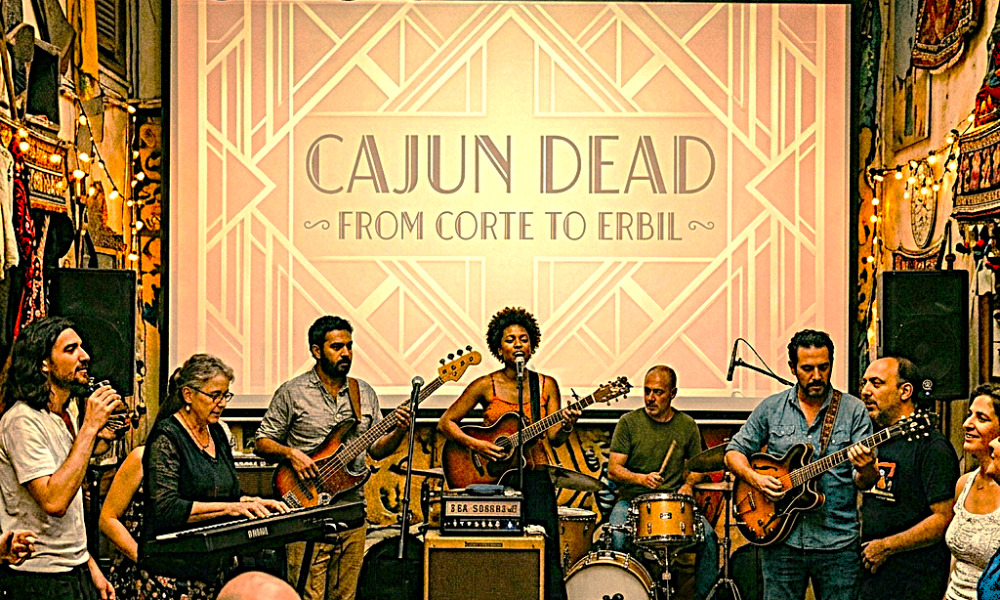
From Corte to Erbil: How the Communities That Understand Displacement Found the Cajun Dead World Music Visual Archive Before the Atlantic Canada Cultural Establishment Knew It Existed
By Claude Edwin Theriault | Claregyle, Nova Scotia
The World Music audience that the Cajun Dead et le Talkin’ Stick visual and music archive was always built for has been arriving for four years. It has not been arriving from Halifax or Moncton or Fredericton or any of the cities where the East Coast Music Awards circuit holds its ceremonies and distributes its recognition.
It has been arriving from Corte, Corsica—the intellectual capital of the Corsican independence movement, whose UNESCO-endangered language has been suppressed by French administration for two centuries. From Erbil, Iraqi Kurdistan — the capital of a stateless people with a rich oral tradition and a four-century history of forced displacement across four nation-state borders. From Kryvyi Rih and Poltava, Ukraine—cities under active bombardment whose people are living the forced displacement that the Acadian deportation of 1755 documented as a template three hundred years before the satellite images arrived. From Granada, Spain—the last Moorish capital in Europe, whose Flamenco tradition runs on the same Dorian and Phrygian modal scales as the Acadian complainte, whose 1492 expulsion of Muslims and Jews is the oldest documented forced removal in Western European history.
The Atlantic Canada ECMA cultural establishment gave this 200+ Cajun dead song catalogue archive the cold shoulder. The people of Corte and Erbil and Kryvyi Rih and Granada found it anyway. They found it because it was already speaking their language—not French, not English, but the older and more universal world music language of the community that had been required to carry its truth in song because the official story had no room for it.
The Cities That Analytics Reveal: A Global Map of the Cajun Dead Griot’s Real-World Music Audience
In the past thirty days, the Cajun Dead visual merch archive at the very busy pixels.com/profiles/claude-theriault—the nearly 800 original symbolist POD images that constitute the visual identity of the 200 + and growing song catalogue, one for each song, already available as fine art prints through the Grateful Dead cross-promotion model—received visitors from a specific list of cities that tells a more precise story about who the real audience for this work is than any Juno nomination or ECMA award could ever tell.
The list includes Floridablanca in Colombia, Tunis and Monastir in Tunisia, Phnom Penh in Cambodia, Patna in India, Jakarta in Indonesia, Lentini in Sicily, Belgrade in Serbia, both Kryvyi Rih and Poltava in Ukraine, Guemar in Algeria, Merlo in Argentina, Lima in Peru, Oosterhout in the Netherlands, Meknes in Morocco, Corte in Corsica, Makkah and Riyadh in Saudi Arabia, Taipei in Taiwan, Tbilisi in Georgia, Granada in Spain, Baghdad and Erbil in Iraq, Edenvale in South Africa, Angelholm in Sweden, and Mosta in Malta.
Erbil, Iraq—Kurdish stateless people, oral tradition, four centuries of displacement
Kryvyi Rih & Poltava, Ukraine — active war zone, real-time displacement
Granada, Spain — last Moorish capital, Flamenco modal scales, 1492 expulsion
Tbilisi, Georgia—UNESCO polyphonic singing tradition, Russian colonial history
Guemar, Algeria — Berber Amazigh territory, suppressed oral tradition
Patna, India—tabla tradition, ancient oral culture
Phnom Penh, Cambodia — post-genocide cultural reconstruction
Baghdad & Monastir—the maqam modal tradition, ancestor of Acadian Dorian
Not one of these cities is in Atlantic Canada. Not one is in Toronto, Montreal, or Vancouver. The ECMA and it`s primary straight white anglo audience is not in this list. What is in this list is the global community of people who understand from lived experience what it means to carry a minority oral tradition under dominant-language colonial pressure—and who found the Cajun Dead World Music catalogue because the search infrastructure now connects a Bay of Fundy symbolist’s images of displacement and oral tradition to the people in Corte and Erbil who are living the same story in different geographies and different centuries. This is not coincidence. It is the griot function operating at a global scale—the oral testimony finding its way to the community that needs it through whatever channel that community uses to search for what the official culture cannot provide.
The ECMA Cold Shoulder on Cajun Dead as Confirmation: Why the Wrong Audience’s Silence Is the Right World Music Audience’s Signal
The specific cities in this analytics list map directly onto the thematic and musical architecture of the Cajun Dead catalogue in ways that no marketing strategy could have produced. Tbilisi, Georgia, is home to one of the oldest and most sophisticated polyphonic singing traditions on earth—a UNESCO-recognized oral heritage that the Soviet administration suppressed for decades and that has been in active revival since independence. The person from Tbilisi who found the visual archive was not browsing randomly. They were searching for something that connects to the specific experience of a minority cultural tradition carrying its oral testimony forward against institutional ECMA suppression—and the search algorithm connected them to a Bay of Fundy Acadian’s symbolist images of exactly that experience.
Granada, Spain, carries the specific historical memory of the 1492 expulsion of Muslims and Jews—the Reconquista’s forced displacement of the communities whose modal musical grammar had been fused into Iberian folk tradition for seven centuries, producing the flamenco Phrygian mode that is the direct harmonic cousin of the Acadian Dorian.
The person from Granada who found the Cajun Dead visual archive was searching in the same modal space, the same displacement history, and the same refusal of the official story’s comfortable version. Erbil, Iraqi Kurdistan—the capital of a people who have been stateless across four national borders since 1923 and whose oral tradition is the primary archive of Kurdish cultural identity in the absence of a state to preserve it institutionally—is finding a visual archive made by a queer Acadian songwriter from a community that has been navigating its own version of that statelessness since 1755.
As the Cajun Dead griot and complainte tradition has always documented, the griot’s audience is not the institution. It is the community that needs to hear the testimony the institution has no category for. The East Coast Music Awards has no ECMA category for a queer Acadian symbolist lyricist whose visual and music archive is being found by the people of Corte and Erbil and Kryvyi Rih. That absence of a category is not a verdict on the work. It is a description of the institution’s limitations. The right audience has never needed the institution’s introduction. It has been finding the archive through search — 148,000 visits over four years, the real visitors concentrated in heritage-rich cities across every continent, every one of them a community that understands displacement and minority oral tradition and the refusal of the approved story from the inside. As the Cajun Dead counterculture manifesto has argued from the beginning: the work was built for this audience. The audience was always there. The infrastructure to connect them was the only thing still being built—and it is now built.
Claude Edwin Theriault is the founder of Cajun Dead et le Talkin’ Stick, a nearly 200-song conscious folk, world music, and visual symbolist archive whose global audience spans Corsica, Kurdistan, Ukraine, Georgia, Spain, and thirty countries across six continents. Based in Claregyle, Nova Scotia. Visual archive at Fine Art America; music streams on Spotify, Boomplay, and YouTube. Full archive at moderncontemporaryartworktrends.com.