
A $50,000 Prize Is a Beautiful Beginning—But Église Sainte-Marie Deserves a Bold Future, Not a Slow Death on a Drip Feed of Hope. National 2.13
Winning the National Trust for Canada’s Next Great Save Competition Celebrates Acadian Patrimonial Heritage—It Does Not Save It …Tokenization does
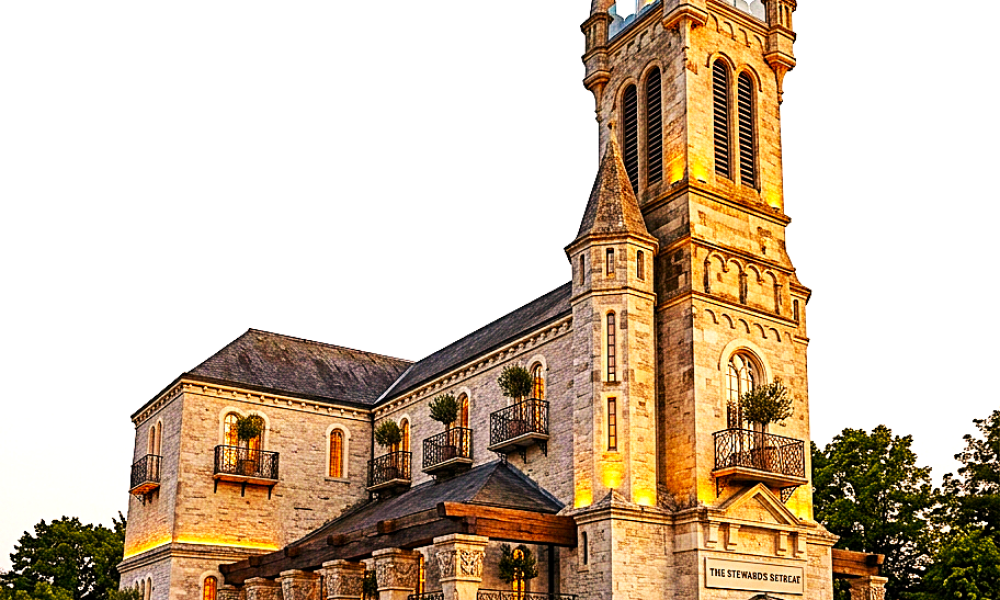
CHURCH POINT, NS — The news arrived like a long-overdue exhale. Ancienne Église Sainte-Marie in Church Point, Nova Scotia — recognized as the tallest wooden church in North America and the most luminous living monument of Acadian patrimonial heritage on this continent — has won the $50,000 grand prize in the National Trust for Canada’s Next Great Save competition. The community voted. The nation listened. The prize was awarded.
And it is genuinely wonderful. Urgent repairs to a front window currently patched with plywood, a leaning spire on a side tower, ornamental woodwork falling from failing fasteners, and a bell system silenced for far too long—these are wounds the prize money will begin to address. Association Sainte-Marie Héritage et Développement co-founder Stéphanie St-Pierre spoke of gratitude and how that gratitude is earned. The volunteers, the voters, and the advocates who refused to let this building be bulldozed into the Clare clay—they fought for something that matters, and they won.
But let us be honest, the way Acadians have always had to be honest when no one else would speak plainly on their behalf: fifty thousand dollars is a bandage on a body that needs a spine. It is not a permanent solution. It is not a vision. It is a gesture of institutional goodwill applied to a structural emergency that will cost millions to resolve and decades to sustain. The Ancienne Église Sainte-Marie is not a heritage checkbox. It is an irreplaceable architectural and cultural landmark that deserves more than perpetual triage.
Which is why one neurodivergent voice in Southwest Nova Scotia is proposing something altogether different—and altogether necessary—post Next Great Save win.
Le Clos Sainte-Marie: Tokenizing a Legacy, Financing a Future
Local creative artist and AI strategist Theriault has put forward a proposition that is, by the standards of the region’s current cultural management apparatus, audacious. By the standards of the global innovation economy, it is simply logical.
The proposal: tokenize the Ancienne Église Sainte-Marie. Sell one hundred shares at two million dollars per share, raising two hundred million dollars in private capital. Then transform the structure into Le Clos Sainte-Marie — the most prestigious five-story apartment residence in southwest Nova Scotia, renting at three to seven thousand dollars per month — and two floors of boutique hotel suites featuring private balconies and fourteen-foot ceilings within the roofline. A high-end bistro would anchor the ground floor at the front, and an elevator shaft would carry guests skyward to a honeymoon suite in the church’s iconic turret tower. An engineered exoskeleton would be constructed around and in support of the building’s endoskeleton, distributing the load of the new residential structure so that the original historic fabric remains entirely unstressed. The building breathes. The building lives. The Acadian Patrimonial Heritage building pays for itself.
Acadian Patrimonial Heritage Won the National Trust for Canada’s Next Great Save — Now Tokenize It
Each of the one hundred shareholders would receive one percent of the income the property earns every month, with full private access to the books—every dollar that comes in, every dollar that goes out, transparently and accountably. This is not a speculative venture. This is a revenue-generating community asset structured for democratic participation and long-term yield.
The inspiration is not abstract. The neurodivergent-inspired Fogo Island Inn, perched on the rock-edged northeastern shore of Newfoundland, charges upward of $2,500 per night and operates at capacity year-round. It sells a commodity that cannot be manufactured or mass-produced: genuine peace, with an ocean view, in a place that carries the weight and warmth of real human history. Rich people — and there are many of them, increasingly unmoored in a world of digital noise and architectural sameness — will pay extraordinary sums for exactly that. Le Clos Sainte-Marie would offer the same precious rarity: beauty, silence, culture, and an Acadian soul embedded in every timber and every tide.
Theriault’s vision understands something the traditional heritage establishment has been reluctant to admit: Acadian patrimonial heritage culture does not need another museum. It does not need another frozen-in-time wooden dollhouse behind velvet rope. It needs to be experienced as a living, contemporary, modern expression of a people who survived exile, erasure, and a thousand varieties of institutional indifference—and who are still here, still building, still capable of astonishing the world. Acadian patrimonial heritage is not a relic. It is a resource, and it deserves to be treated as one.
The $200 million raised through tokenization would be the instrument that makes old money—sitting quietly in local caisses populaires, cautious and patient—dig itself out and invest in an Acadian Patrimonial Heritage proud community project that would put Southwest Nova Scotia permanently on the sociocultural map of Canada. Not as a seasonal destination for cheap nickel-and-diming grief tourism or genealogical pilgrimage, but as a destination in the fullest and most generous sense: a place where the building itself is the reason you came.
The Cold Shoulder of a 1975 Operating System
And yet. The proposition is getting the cold shoulder from the people in charge.
Theriault has a bad name for the institutional logic currently governing heritage decision-making in this region: “1975.” It is a worldview, an operating system, a set of deeply calcified assumptions about how things get done and who does them. It holds that a cash-strapped government in full epistemic collapse will eventually come to the rescue of its political connections, as it has faithfully done for the past century, and that the correct strategy is to wait, to apply, to petition, and to accept whatever arrives in the envelope.
That envelope is getting lighter every year. The all-in-on military-spending government that it was posted from is running out of stamps.
Theriault’s tokenization model is not a disruption for disruption’s sake — it is a crowdfunding framework, a genuine angel-investor model applied to a genuinely worthy cause, one that would generate real revenue, real transparency, and real pride. More than that, it is a benchmark. If Le Clos Sainte-Marie can demonstrate that a community in southwest Nova Scotia can attract private capital, build a world-class destination, and share its returns equitably among one hundred invested stakeholders, then communities across Canada will have a blueprint. Every endangered heritage structure in every forgotten corner of this country becomes, suddenly, imaginable as something more than a liability.
Who dares to save it for good?