
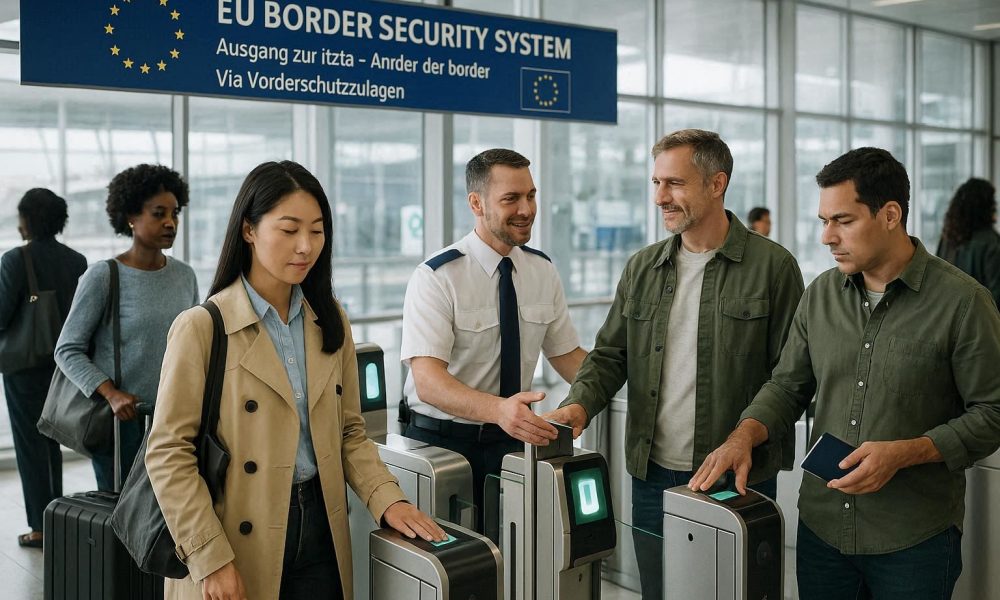
Cross-Referencing Databases to Catch International Criminals
WASHINGTON, DC, April 24, 2026, Europe’s new biometric border system is no longer just a digital replacement for passport stamps; it has become a real-time law-enforcement filter for identifying fugitives, forged documents, overstayers, and security threats before they disappear into the Schengen Area.
The Entry/Exit System, known as EES, now records the movements of non-EU nationals across 29 Schengen countries, linking passports, facial scans, fingerprints, entry and exit records, and refusal decisions into a searchable border-management system.
For ordinary travelers, the system may feel like a faster airport kiosk after the first registration, but for law enforcement agencies, it is a powerful screening tool that turns every border crossing into a data-matching event.
The shift matters because fugitives no longer need only a forged passport to fool a rushed officer, as their faces, fingerprints, prior movements, document histories, and database alerts can now be compared almost instantly.
A recent Guardian report on Europe’s biometric border rollout noted that the system had already logged tens of millions of crossings and identified nearly 700 individuals as security threats during its phased introduction.
The modern border checkpoint is becoming a live intelligence screen
Traditional passport inspection depended heavily on the document presented, the officer’s experience, and the ability to interpret stamps, visas, names, aliases, and warning indicators during a brief encounter.
EES changes that model because the traveler’s document is no longer assessed alone, since the system can compare identity information against wider European security architecture designed to detect risk.
That includes cross-referencing with the Schengen Information System (SIS), which stores alerts related to wanted persons, missing persons, refused-entry cases, stolen documents, and other law enforcement priorities.
When a traveler presents a passport, the border interaction can trigger automated checks that may reveal whether the person is connected to an alert, an alias, a prior refusal, or a flagged document.
That does not mean every traveler is treated as a suspect, but it does mean every traveler is processed through a border environment designed to remember more and miss less.
For fugitives, the danger is obvious because a false name becomes much less useful when the biometric record points back to another identity or a prior law-enforcement file.
Biometrics weakens the old fugitive playbook
The classic fugitive playbook relied on speed, confusion, false documents, sympathetic intermediaries, corrupt brokers, weak borders, and the hope that one country’s information would not reach another country fast enough.
A fugitive might once have used an alias, changed appearance, obtained a forged passport, purchased fraudulent civil records, or crossed through a busy airport where manual checks were limited.
That strategy becomes far weaker when border systems require facial images, fingerprint registration, document scanning, and automated comparison against prior travel and security records.
A forged passport can contain a false name, but it cannot easily change the fingerprint profile of the person holding it when the system has a valid comparison point.
A stolen passport can show a real person’s details, but facial matching and biometric registration can expose whether the traveler presenting it is actually the legitimate holder.
A new alias can create temporary confusion, but biometric checks are designed to connect the body at the border with the record already known to the system.
SIS is the warning layer that turns travel data into law enforcement action
The Schengen Information System is one of Europe’s most important security databases because it allows participating authorities to issue and share alerts across the border-free travel area.
Those alerts can involve persons wanted for arrest, people refused entry, vulnerable missing persons, stolen travel documents, vehicles, firearms, identity papers, and other items connected to security or criminal investigations.
When EES records a traveler’s entry or exit, the value is not just the timestamp; the real power comes from comparing that movement against alerts already stored elsewhere.
This is where the system becomes more than a migration tracker, as it can help identify people who are not merely overstaying but who are wanted, barred, or linked to serious security concerns.
The system’s usefulness increases when biometric data helps separate one traveler from another, especially in cases involving similar names, spelling variations, nationality changes, or deliberately altered biographical information.
For law enforcement, the combination of travel records and alert databases creates a faster path from suspicion to intervention when a person crosses the border.
Aliases are less useful when the face and fingerprints remain the same
Fugitives have long relied on aliases because names are flexible, documents can be manipulated, and paper records often fail to connect identities across different languages and jurisdictions.
Biometrics change the equation because facial structure and fingerprints provide identifiers that are harder to alter than a name, address, nationality claim, or supporting document package.
A fugitive using an alias may still pass a superficial name check, but a biometric match can expose the relationship between the alias and a known identity profile.
This is especially important when fugitives obtain genuine documents through fraud, because the passport booklet may be authentic while the identity history behind the document remains dishonest.
The same risk applies to people using forged passports, altered birth records, fraudulent name changes, or borrowed identities obtained through criminal document networks.
The new system does not make evasion impossible, but it sharply increases the difficulty by requiring the false identity to withstand digital comparison rather than visual inspection alone.
Forged passports are becoming weaker as border systems become smarter
A high-quality forged passport once gave criminals a dangerous advantage because the document might look convincing under time pressure, especially at crowded airports or land crossings.
Modern electronic passports, chip verification, automated document readers, and biometric registration have reduced that advantage because a document must now survive several layers of technical review.
The United States also explains through official biometric border guidance how fingerprints and facial recognition support identity verification, border integrity, and the detection of impostors in modern travel systems.
That global trend matters because Europe’s EES is part of a broader international movement away from trust-based document inspection and toward evidence-based identity confirmation.
A passport still matters, but the document is now verified against the person, the chip, the database record, the travel history, and the security-alert environment.
For criminals who bought false documents from brokers, the danger is that the weakest part of the identity may no longer be the passport page, but the body presenting it.
Real-time checks can stop a fugitive before the person enters the zone
The most important enforcement moment occurs before the traveler clears the external Schengen border, because that is where authorities can intervene before the person gains internal movement across the zone.
Once a traveler enters the Schengen area legally, movement between most participating countries becomes much easier, making external border screening a crucial security checkpoint.
EES strengthens that gate by making entry and exit checks more consistent across airports, seaports, rail terminals, and land borders where non-EU travelers are processed.
When a match appears, border authorities can conduct secondary inspection, confirm the alert, detain the person if legally justified, refuse entry, or notify the relevant law enforcement agency.
That process is especially important for international fugitives who rely on rapid movement through multiple jurisdictions to complicate arrest, extradition, and surveillance.
A single biometric alert at the external border can disrupt that strategy before the fugitive reaches a hotel, a rental property, a bank meeting, or an onward flight.
The system also exposes travel patterns that look normal until they are connected
Fugitive detection is not limited to a single alert, because travel patterns can become suspicious when repeated movements, document changes, refusals, and inconsistent identities are viewed together.
A person may cross borders many times without attracting attention in a manual system, particularly if the traveler uses different airports, different passports, or different claimed purposes.
Digital records make that harder because each entry and exit adds another data point that can be compared with prior movements across the broader Schengen environment.
Investigators may eventually see that a traveler repeatedly enters near known associates, exits after enforcement activity, changes documents unusually often, or appears under related identities in separate records.
These patterns can support deeper review even when a single crossing does not immediately trigger arrest or refusal.
The border, therefore, becomes both a checkpoint and a long-term intelligence source, especially when travel data is combined with criminal investigations, financial records, communications evidence, and immigration files.
Second passports require disciplined use in a biometric border environment
Lawful second citizenship remains a legitimate mobility tool, but biometric systems make careless passport use more dangerous, as different documents can still be linked to the same person.
A traveler with more than one citizenship may have lawful reasons to use different passports, yet the supporting records must remain consistent, explainable, and aligned with immigration rules.
People exploring second passport planning should understand that biometric borders do not eliminate the benefits of lawful mobility, but they do eliminate many outdated assumptions about anonymity.
The purpose of a legitimate second passport is not to evade law enforcement, as lawful citizenship planning should expand mobility while preserving compliance with immigration, tax, banking, and security obligations.
Problems arise when people treat a passport strategy as a disguise rather than a documented legal status that must withstand screening at borders, banks, consulates, and government offices.
In 2026, a second passport should strengthen a person’s global profile, not create contradictions that a border database can expose within seconds.
Fugitives are not the only people affected by real-time border screening
Ordinary travelers can also face consequences when records are incomplete, documents are inconsistent, or prior immigration issues were never properly resolved.
A forgotten overstayer, an old refusal of entry, a name spelling inconsistency, a damaged passport chip, or a mismatch between documents and biometric records can all trigger delays.
Digital nomads, retirees, consultants, and frequent travelers should be especially careful because repeated short stays across Europe can create complex records that manual stamps once obscured.
People who travel for business should also understand that frequent visits may raise questions about work activity, unofficial residence, or the true purpose of repeated Schengen entries.
For privacy-focused individuals, the answer is not to avoid records by taking unsafe shortcuts, but to ensure that documents and explanations remain lawful, consistent, and defensible.
A clean record can still move quietly through a digital border, but a messy record is increasingly likely to attract administrative attention.
Privacy now depends on compliance rather than invisibility
The rise of real-time biometric screening has made many travelers anxious about whether privacy can survive modern border technology.
The honest answer is that privacy has changed because a person can no longer assume that movement across borders leaves only a stamp, a memory, and a ticket receipt.
Lawful privacy now depends on structure, discretion, proper documentation, careful travel habits, and consistent records that do not collapse under automated review.
This is particularly important for executives, politically exposed families, journalists, high-net-worth individuals, relocation clients, and people who face public visibility or personal security concerns.
Through Amicus International Consulting, the modern mobility conversation focuses on lawful identity planning, second citizenship, confidential relocation, and documentation strategies that can withstand border and banking scrutiny.
That distinction matters because privacy built on legal structure can survive verification, while privacy built on false documents or aliases can become evidence of concealment.
EES shows that border control is becoming predictive, not just reactive
The old border model reacted to the person standing in front of the officer, while the new model tries to understand that person using data before making a decision.
EES integrates biometric registration, entry and exit records, document checks, and database comparisons, enabling authorities to make faster decisions with more context.
This creates obvious enforcement advantages, but it also places a greater burden on travelers to understand how their documents, citizenships, travel histories, and legal obligations interact.
Fugitives may find fewer gaps, overstayers may face faster detection, and document fraud networks may discover that their products fail when tested against biometric reality.
At the same time, legitimate travelers may benefit from more predictable processing once they are registered and their records are clean.
The border of the future will not always look more dramatic, but it will be more connected, more automated, and less tolerant of inconsistencies.
The fugitive era of easy border deception is ending
EES is not perfect, and no border system can catch every criminal, every forged document, or every alias on the first attempt.
However, the system represents a major shift because it connects the traveler’s face, fingerprints, documents, and movement history with security databases designed to identify threats in real time.
For fugitives, that means the risk of exposure now begins at the kiosk, the scanner, the facial comparison point, and the database query that happens before entry is granted.
For lawful travelers, the message is different but equally important, because clean documents, honest travel patterns, and accurate records will matter more than ever.
The end of traditional border anonymity does not mean the end of mobility, but it does mean mobility now belongs to those who can prove their identity.
In 2026, the safest traveler is not the one trying to disappear, but the one whose identity, documents, citizenship status, and travel history remain consistent under the systems built to test them.




