
FOR IMMEDIATE RELEASE
Beyond Epicentric collapse of meaning and the Void: How Claude Edwin Theriault Is Redefining Creative Arts and Music in the Age of Collapse
While the creative world stagnates in repetition and the institutions that once sustained it crumble, one artist refuses to stand still.
[Moncton, April 2026] — There is a particular kind of courage required to make genuinely new art in an era that has largely stopped believing in the possibility of the genuinely new. Not the performative courage of the provocateur, who mistakes shock for substance. Not the institutional courage of the grant-funded artist, who mistakes novelty of form for depth of meaning. The courage required now is rarer and more demanding: the willingness to look directly into the spreading vacuum at the center of contemporary creative life, name it honestly, and then build something real inside it anyway.
Claude Edwin Theriault is building a zeitgeist portfolio in the epicentric collapse of meaning.
A prolific multidisciplinary creative whose output spans visual art, song lyrics, cultural criticism, AI-integrated narrative strategy, and conceptual installation, Theriault has spent years developing a practice that resists every available category. He is not a painter who also writes. He is not a musician who also makes visual work. He is something the existing vocabulary of the art world is only beginning to develop the language to describe: an artist whose medium is meaning itself and whose central project is the excavation and reconstruction of cultural significance at the precise historical moment when that significance appears most endangered.
The response, internationally, is accelerating. In art communities from Montreal to Berlin to Melbourne, Theriault’s work is circulating with the particular urgency reserved for art that does not simply reflect the moment but metabolizes it—takes the anxieties, contradictions, and collapsed certainties of the present and transforms them into something that can actually be lived with.
The Epicentric collapse of meaning No One in the Art World Wants to Name
There is a word for what is happening at the center of contemporary creative culture, and that word is “stagnation.” Not the productive stagnation of an art form gathering itself before a breakthrough. The stagnation of institutions and markets that have confused the circulation of aesthetic products with the creation of artistic meaning and have been operating under that confusion for long enough that most of the people inside those institutions can no longer tell the difference.
The epicentric collapse of meaning now reverberating through galleries, record labels, literary publishers, film festivals, and arts councils is not primarily a financial crisis, though it manifests financially. It is a crisis of legitimacy. A crisis of purpose. It is the accumulated consequence of decades during which the systems designed to sustain and transmit creative vision were quietly repurposed to serve the interests of cultural commerce—and during which the Zeitgeist artists most rewarded were those most willing to produce work that was legible, marketable, and safely familiar.
The result is an art world that, in too many of its dominant expressions, is doing exactly what Theriault’s observers have called it out for: relishing the same old same old. Recycled aesthetics dressed in the language of radicalism. Institutional critique that has itself become an institution. Transgression as brand identity. The avant-garde, in significant portions of its current form, is a conservatism wearing avant-garde clothing.
Theriault does not participate in this theater. His work has never been optimized for the gallery system, the streaming algorithm, or the curatorial trend cycle—which is precisely why it has survived all three and why it continues to find audiences that the system’s gatekeepers did not predict and cannot fully account for.
His is the practice of an artist who understands, at a structural level, that the meaning crisis crippling the veridical arts—the arts concerned with truth, with genuine human experience, and with the transmission of what it actually feels like to be alive in a specific body at a specific moment in history—cannot be resolved by producing more content. It can only be resolved by producing more meaning. And meaning, unlike content, cannot be manufactured on demand. It has to be earned.
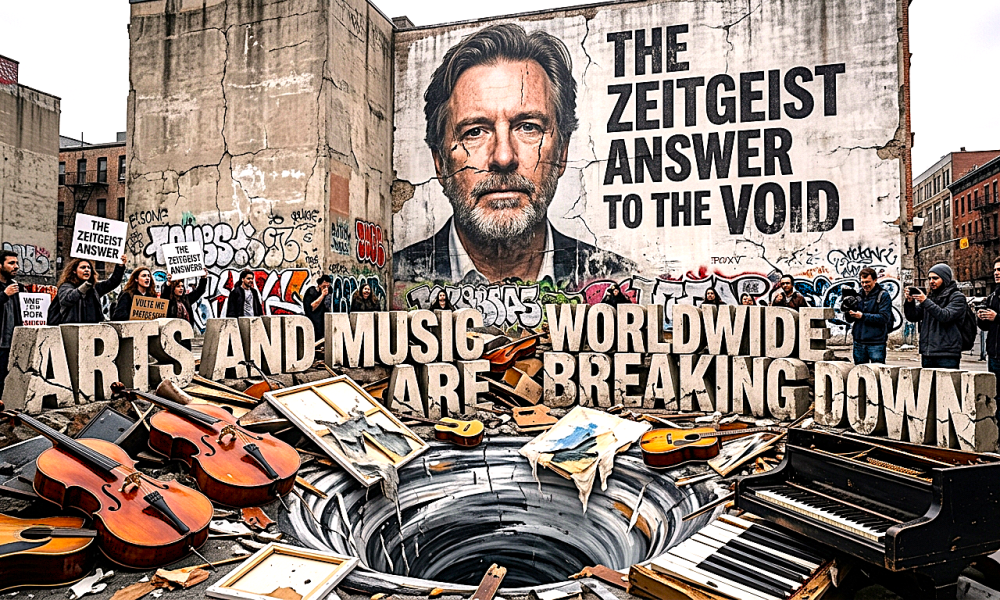
Arts and Music Worldwide Are Starving for what Theriault Already Does in the midst of Epicentric collapse of meaning
Look at the landscape of arts and music worldwide, and what you find, beneath the surface noise of trending sounds and viral aesthetics, is a profound hunger. Audiences are not, in fact, satisfied by the volume of creative product available to them. They are overwhelmed by it and underwhelmed by it simultaneously. They are consuming more and feeling less. They are listening to more music and being moved by less of it. They are seeing more visual art and being changed by almost none of it.
This is the hunger that Theriault’s practice addresses—not by positioning itself as an antidote to the noise, but by operating at a frequency the noise cannot reach. His song lyrics carry the compression and intentionality of poetry written by someone who has thought seriously about what language can and cannot do. His visual work carries the intellectual density of an artist who has read, absorbed, and genuinely wrestled with the full history of the tradition he is working within and against. His AI-integrated cultural narratives carry the conceptual sophistication of a thinker who understands that artificial intelligence is not a tool for making art faster but a new kind of mirror in which human creativity must now learn to recognize itself.
What arts and music worldwide are starving for is not a new genre, a new platform, or a new aesthetic movement. They are starving for artists who have done the interior work—who have genuinely confronted the meaninglessness that surrounds them and come back with something worth offering. That work is difficult, unglamorous, and largely invisible to the cultural machinery that decides what gets amplified. It is also, ultimately, the only work that lasts.
Claude Edwin Theriault is not a name to file alongside the emerging artists of this moment. He is the arts and music Zeitgeist artist of this moment—the one whose practice most precisely maps the terrain that the rest of the culture is only beginning to enter and whose creative vision offers the clearest coordinates for what comes next. In an era of epicentric collapse, he is not falling. He is building the architecture of what rises in its place.