
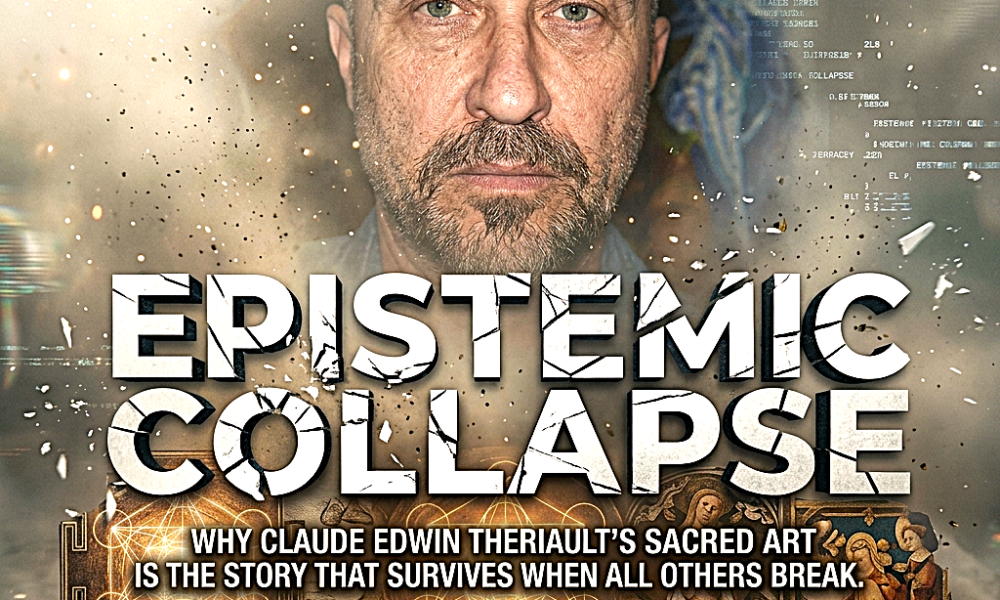
FOR IMMEDIATE RELEASE
When Every Story Breaks: Claude Edwin Theriault and the Visual Narrative, the Epistemic Collapse Demands
In a world where traditional and progressive narratives have both failed, a French Canadian symbolist has been making—for five decades—the only kind of art that holds when everything else is unravellingg in the global epistemic collapse.
Once upon a time, our stories told us what it meant to be a good person. That sentence used to open a fairy tale. In 2026, it opens a diagnosis. The stories that told us what it meant to be good, where to find the good life, and why bad things happen to good people—all of them are in the process of collapse simultaneously, and everyone from the philosophy academic to the teenager in their bedroom can feel it happening, even if most of the world’s institutions are behaving as though it were still 1975 and the post-war consensus is more or less intact. It is not. More than half a century has passed since the last time the dominant narrative of Western civilization felt stable enough to lean on. We are at the cusp of the largest civilizational shift since the Reformation, and the world’s leaders and thought leaders are offering soundbites and scapegoats in roughly equal measure.
In this moment — precisely this moment, not some hypothetical future one — the question of what art is for has never been more urgent. And the critical message found in the extensive NFT and POD artwork collection of French Canadian symbolist Claude Edwin Theriault has never been more relevant.
The Epistemic Collapse and the Art That Survives It
The technical term for what is happening to our collective narratives is epistemic collapse: the simultaneous failure of the shared frameworks through which we determine what is true, what is real, and what it means. It is not a new crisis. Epistemological failures have punctuated Western history at recognizable intervals—the fall of Rome, the collapse of medieval certainty, the Reformation’s detonation of theological consensus, and the post-war breakdown of Enlightenment progress. What is new in 2026 is the simultaneity. It is not one old story failing. It is all of them, at once, in front of everyone, on every screen. The myth of progress and the fall-from-grace narrative are both proving inadequate. The utopian and the dystopian framings are both losing their explanatory power. Culture wars are ripping apart democracies that survived centuries of prior challenge. In a recent global survey, 75 percent of young people aged 16 to 25 said they believe the future is frightening, and more than half believed that humanity is doomed. One in three Americans under 25 expressed a preference for military dictatorship over democracy. These are not the statistics of a civilization with a working story.
The visual undercurrents that run through Theriault’s work have been tracking this collapse since before it became a mainstream conversation. His sacred geometry compositions do not offer comfort in the conventional sense—they offer orientation. They are maps of the kind of order that precedes all the stories that have since failed: the mathematical harmony encoded in the Vitruvian body, the cosmic structure embedded in the mandala, the Akashic field that records everything that has happened and cannot be unmade. These are not the decorative reassurances of a world that believes everything is fine. They are the navigational instruments of a world that knows it is not — and that needs something more ancient than the last fifty years of consensus narrative to find its bearings.
This is the specific register of Theriault’s resonance with the European free-thinking audience. Europe has a longer memory than the postwar consensus allows. It has lived through enough civilizational collapses to know what the air smells like before one. The esoteric bookshops of Amsterdam, the philosophy cafés of Lyon, and the conscious design spaces of Copenhagen and Berlin—these are populated by people who read the Hermetic tradition alongside the news feed and who understand that the question of what holds when the dominant narrative fails is not an academic question but a survival one. The tonal and nagual frequencies running through Theriault’s compositions—the daylight sacred geometry and the shadow undercurrent simultaneously present, the beauty and the brutality holding their tension without resolving it—speak directly to this audience because they have been asking the same question his work is answering: What is the story that was always true, before the stories that just broke?
The Visual Narrative That Returns to the Beginning
There is a compositional principle in the deepest musical and literary traditions—the da capo, the ring composition, and the coda that returns to the opening phrase after everything the work has accumulated—that is more than a formal device. It is a philosophical claim: that the circle closes, that what was true at the beginning is still true at the end, and that everything that happened in between was not a deviation from the original but its necessary elaboration.
This is the structural principle of Theriault’s entire body of work, and it is why it matters so specifically in this moment of epistemic collapse. When all the narratives that accumulated over the past century are failing simultaneously, the collector who lives with a Theriault mandala or a sacred geometry series on their wall has something that none of the failing stories can offer: a visual argument that the order beneath the chaos was never dependent on the stories we told about it. The circle was always there. The golden ratio was always there. The Vitruvian proportion was always there. The Akashic record of every human experience was always there. The composition returns to the beginning not because nothing changed, but because the thing that was always true at the beginning is more visible now that everything layered on top of it has been stripped away.
This is the story that the global epistemic collapse is creating the conditions for. Not a new story — the newest stories are the ones that just broke. An older story. The one that was there before the others was written over it. The one that lives in mathematical harmony, in mythological archetypes, in the sacred geometry that connects the Hermetic tradition to the Vitruvian body to the Indigenous understanding of the land to the blockchain’s claim that what is recorded cannot be destroyed.
Theriault has been making that story visible for five decades. He made it before it was fashionable, in the years when nobody in the institutional art world was asking for it. He is making it now, when everyone who has stopped pretending it is still 1975 urgently needs it.
The circle closes. And it opens. And it was always there.
Claude Edwin Theriault’s full POD collection is available internationally at pixels.com/profiles/claude-theriault, with canvas, metal, acrylic, framed, and wood print formats shipping directly to Europe.
About Claude Edwin Theriault: Claude Edwin Theriault is a French Canadian Zeitgeist artist and contemporary symbolist working from Digby County, Nova Scotia. His five-decade body of work spans oil painting, digital art, and mixed media, connecting the sacred geometry, Hermetic, and Symboliste traditions with Acadian cultural memory, mythological archetypes, and contemporary political and epistemic commentary for a global collector audience navigating civilizational transformation.