

Gas Turbine Market Overview
According to a new report published by Allied Market Research, the global gas turbine market size was valued at $18.5 billion in 2020 and is projected to reach $25.4 billion by 2030, growing at a CAGR of 3.3% from 2021 to 2030. The steady expansion of the gas turbine market is attributed to rising global energy demand, increasing adoption of distributed power generation technologies, and growing investments in cleaner power generation solutions.
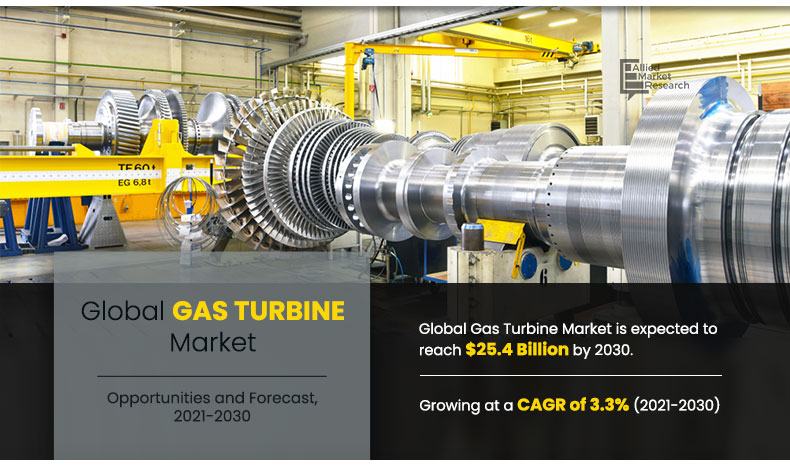
A gas turbine is an advanced engine that heats a mixture of fuel and outside air at high temperatures to generate mechanical energy through rotating turbine blades. This mechanical energy is then used to drive a generator to produce electrical energy. Owing to their efficiency and reliability, gas turbines are widely used across power generation, oil & gas, marine, aerospace, and process plant applications.
Download PDF Brochure: https://www.alliedmarketresearch.com/request-sample/A07223
Rising Energy Demand and Industrial Applications Driving Gas Turbine Market Growth
The demand for gas turbine systems has witnessed significant growth due to their extensive applications in various industrial sectors. Power generation remains the primary application area, as governments and private organizations are increasingly investing in efficient energy infrastructure to meet rising electricity demand. In addition, industries such as oil & gas, marine, aerospace, and manufacturing are integrating gas turbine technologies to enhance operational efficiency and energy output.
Rapid technological advancements in the energy sector, coupled with increasing demand for distributed power generation, are key factors fueling the growth of the gas turbine market. Industry players are also focusing on strategic production expansion and innovation to explore new commercial opportunities and strengthen their global presence.
Shift Toward Cleaner Energy and Gas-Fired Power Plants
Growing environmental concerns and stringent government regulations regarding greenhouse gas emissions are accelerating the transition from coal-based power plants to gas-fired turbines. Gas turbines produce relatively lower carbon emissions compared to conventional fossil fuel-based power generation systems, making them a preferred choice for cleaner electricity production.
Furthermore, the replacement of phased-out nuclear and coal power plants with gas-based power generation facilities is expected to create lucrative growth opportunities for the gas turbine market during the forecast period. The increasing integration of renewable energy sources with gas turbine systems for backup and peak load management is also supporting market expansion.
Emerging Economies Strengthening Market Demand
Developing economies such as China, India, and Brazil are experiencing rapid industrialization and urbanization, which is significantly increasing their energy consumption. This surge in electricity demand is encouraging governments to adopt efficient and low-emission power generation technologies, thereby boosting the gas turbine market growth.
In addition, ongoing adoption of renewable energy sources along with flexible gas turbine systems is enhancing product integration in modern power grids. These turbines provide quick start-up capabilities and grid stability, making them suitable for balancing intermittent renewable energy generation.
However, volatility in natural gas prices remains a key challenge that may hamper the growth of the gas turbine market in the coming years. Fluctuating fuel costs can impact operational expenses and investment decisions for large-scale power generation projects.
Technology Insights: Combined Cycle Segment Dominates
Based on technology, the gas turbine market is segmented into open cycle and combined cycle systems. Among these, the combined cycle segment dominated the global gas turbine market in 2020, accounting for more than three-fifths of the total market share. This dominance is attributed to higher efficiency, lower fuel consumption, and reduced transmission and distribution losses.
Combined cycle gas turbines utilize both gas and steam turbines to generate electricity, thereby maximizing energy output and improving overall efficiency. The growing demand for high-efficiency power generation systems is expected to maintain the dominance of this segment throughout the forecast period.
Design Type Analysis: Heavy-Duty Gas Turbines Lead the Market
Depending on design type, the gas turbine market is categorized into heavy-duty and aero-derivative turbines. The heavy-duty segment held the largest market share in 2020, contributing to more than three-fifths of the global revenue. This is mainly due to their low investment cost, high-capacity operations, and ability to operate efficiently under continuous load conditions.
Heavy-duty gas turbines are extensively used in large-scale power plants and industrial applications due to their durability and higher power output. Meanwhile, the aero-derivative segment is projected to grow at the highest CAGR during the forecast period owing to its lightweight design, operational flexibility, and faster start-up capabilities.
Capacity Insights: Above 300 MW Segment Holds Major Share
On the basis of rating capacity, the gas turbine market is segmented into less than 40 MW, 40–120 MW, 120–300 MW, and above 300 MW. The above 300 MW segment dominated the market in 2020, accounting for more than half of the total market share. This growth is largely attributed to the global shift from coal-based power plants to large-scale gas-based power generation facilities in countries such as the U.S., China, and India.
Large-capacity gas turbines are preferred for utility-scale electricity generation projects due to their high efficiency and reliability. As global energy demand continues to rise, the adoption of high-capacity gas turbines is expected to increase significantly.
Application Analysis: Power Generation Segment Leads
By application, the power generation segment accounted for the largest share of the gas turbine market in 2020, contributing to more than one-fourth of the total revenue. The growing efforts by governments worldwide to reduce carbon emissions and minimize dependence on coal-based energy sources are key factors driving the demand for gas turbines in power generation.
Other application areas such as oil & gas, aerospace, marine, and process plants are also witnessing increased adoption of gas turbine systems due to their efficiency, reliability, and operational flexibility. The aerospace segment, in particular, is expected to grow at the highest CAGR owing to advancements in aviation technology and rising air travel demand.
Regional Analysis: Asia-Pacific Dominates the Global Market
Region-wise, the gas turbine market is analyzed across North America, Europe, Asia-Pacific, and LAMEA. Asia-Pacific dominated the global gas turbine market in 2020, accounting for around 44.5% of the total market share. This dominance is attributed to rising energy demand, rapid industrialization, and increasing adoption of low-emission energy alternatives in the region.
North America is projected to witness the highest CAGR of 3.9% during the forecast period, driven by technological advancements, modernization of power infrastructure, and growing investments in clean energy projects. Europe is also expected to experience steady growth due to stringent environmental regulations and the transition toward sustainable power generation systems.
Competitive Landscape and Key Players
The global gas turbine market features strong competition with the presence of several leading industry players focusing on innovation, strategic collaborations, and capacity expansion. Major companies operating in the market include Ansaldo Energia, Bharat Heavy Electricals Limited, Capstone Green Energy, Caterpillar Inc. (Solar Turbines Incorporated), General Electric Company, Harbin Electric Company Limited, IHI Corporation, Kawasaki Heavy Industries Ltd., Mitsubishi Hitachi Power Systems, Siemens AG, Volkswagen Group (MAN Energy Solutions), Wärtsilä, and MTU Aero Engines.
These key players are actively investing in research and development activities to enhance turbine efficiency, reduce emissions, and improve overall performance.
Impact of COVID-19 on the Gas Turbine Market
The COVID-19 pandemic had a notable impact on the gas turbine market due to lockdown measures and reduced industrial activities across the globe. The decline in oil & gas demand and reduced power consumption from industrial and commercial sectors led to a temporary slowdown in market growth. According to energy statistics, global natural gas consumption declined significantly in 2020 compared to 2019, which directly affected the demand for gas turbine systems.
However, as industrial activities resume and energy demand stabilizes, the gas turbine market is expected to recover steadily in the coming years.
Get a Customized Research Report: https://www.alliedmarketresearch.com/request-for-customization/A07223
Future Outlook
The global gas turbine market is poised for stable growth through 2030, supported by rising energy demand, increasing shift toward cleaner power generation, and growing investments in distributed energy systems. Technological advancements, expansion of gas-based power plants, and integration with renewable energy sources will continue to drive market growth. With strong demand from power generation and industrial applications, the gas turbine market is expected to witness sustained expansion in the foreseeable future.
Other Trending Reports:-
About Us
Allied Market Research (AMR) is a full-service market research and business-consulting wing of Allied Analytics LLP based in Portland, Oregon. Allied Market Research provides global enterprises as well as medium and small businesses with unmatched quality of “Market Research Reports” and “Business Intelligence Solutions.” AMR has a targeted view to provide business insights and consulting to assist its clients to make strategic business decisions and achieve sustainable growth in their respective market domain.
Pawan Kumar, the CEO of Allied Market Research, is leading the organization toward providing high-quality data and insights. We are in professional corporate relations with various companies and this helps us in digging out market data that helps us generate accurate research data tables and confirms utmost accuracy in our market forecasting. Each and every data presented in the reports published by us is extracted through primary interviews with top officials from leading companies of domain concerned. Our secondary data procurement methodology includes deep online and offline research and discussion with knowledgeable professionals and analysts in the industry.




