
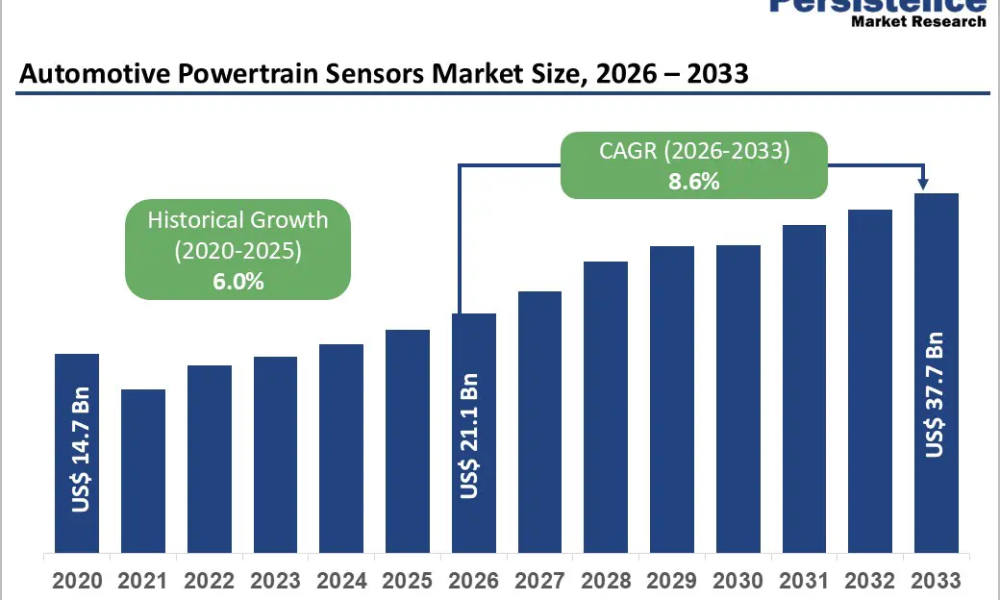
The global automotive powertrain sensors market is witnessing substantial growth, driven by the increasing integration of advanced sensor technologies in modern vehicles. According to recent insights from leading market research firms, the market is projected to grow from approximately US$ 21.1 billion in 2026 to an estimated US$ 37.7 billion by 2033, registering a compound annual growth rate (CAGR) of 8.6% during the forecast period.
This growth trajectory is largely fueled by the automotive industry’s rapid transition toward electrification, stringent emission norms, and the rising demand for enhanced vehicle performance and fuel efficiency. Powertrain sensors play a crucial role in monitoring and optimizing engine operations, transmission systems, and overall drivetrain efficiency, making them indispensable in both conventional and electric vehicles.
Increasing regulatory pressure to reduce carbon emissions has compelled automakers to adopt advanced sensor technologies. Furthermore, the proliferation of hybrid and electric vehicles (EVs), along with advancements in connected vehicle ecosystems, is significantly boosting the demand for high-precision, real-time sensing solutions.
Get Free Sample Now: https://www.persistencemarketresearch.com/samples/34908
Key Highlights from the Report
➤ The automotive powertrain sensors market is projected to grow from US$ 21.1 billion in 2026 to US$ 37.7 billion by 2033, at a CAGR of 8.6%.
➤ Rising adoption of electric and hybrid vehicles is significantly accelerating demand for advanced sensor technologies.
➤ Stringent global emission norms are pushing automakers to integrate high-precision powertrain sensors.
➤ Increasing vehicle electrification is transforming traditional sensor requirements into more complex, software-integrated systems.
➤ Asia-Pacific continues to dominate the market due to high automotive production and rapid industrialization.
➤ Technological advancements such as AI-enabled diagnostics and IoT integration are reshaping the competitive landscape.
Segmentation Analysis
By Type
The automotive powertrain sensors market is segmented by type into temperature sensors, pressure sensors, speed sensors, position sensors, and others. Among these, pressure sensors hold a dominant share due to their extensive use in engine management systems and fuel injection processes. These sensors ensure optimal combustion efficiency and emission control, making them critical for compliance with regulatory standards.
Temperature sensors are also witnessing strong growth, particularly in electric vehicles, where thermal management is crucial for battery performance and longevity. Meanwhile, speed and position sensors are gaining traction due to their role in transmission control and real-time engine monitoring, supporting smoother vehicle operations and enhanced driving experiences.
By Vehicle/Product/Service Type
Based on vehicle type, the market is categorized into passenger vehicles, commercial vehicles, and electric vehicles. Passenger vehicles dominate the segment due to high production volumes and increasing consumer demand for fuel-efficient and technologically advanced cars.
However, the electric vehicle segment is expected to witness the fastest growth during the forecast period. The shift toward EVs has introduced new sensor requirements, particularly in battery management systems, electric drivetrains, and regenerative braking systems. This transition is creating lucrative opportunities for sensor manufacturers to innovate and expand their product portfolios.
Commercial vehicles are also adopting advanced powertrain sensors to improve fuel efficiency, reduce operational costs, and comply with emission regulations, particularly in logistics and transportation sectors.
By Propulsion/Technology
In terms of propulsion, the market is segmented into internal combustion engine (ICE), hybrid, and electric systems. While ICE vehicles continue to hold a significant share, their dominance is gradually declining due to the rapid adoption of hybrid and electric propulsion systems.
Hybrid vehicles are acting as a bridge between conventional and fully electric systems, requiring sophisticated sensor integration to manage dual power sources efficiently. Electric propulsion systems, on the other hand, are driving demand for next-generation sensors capable of monitoring battery health, power distribution, and thermal conditions with high precision.
Regional Insights
Regionally, Asia-Pacific leads the global automotive powertrain sensors market, driven by robust automotive manufacturing in countries such as China, Japan, and India. The region benefits from a strong supply chain ecosystem, increasing vehicle production, and growing adoption of electric mobility solutions.
North America and Europe also represent significant markets, supported by stringent emission regulations and high adoption of advanced automotive technologies. Europe, in particular, is at the forefront of electric vehicle adoption, further fueling demand for innovative sensor solutions.
The Asia-Pacific region is expected to remain the fastest-growing market during the forecast period. Rapid urbanization, rising disposable incomes, and government initiatives promoting electric vehicles are key factors contributing to this growth. Additionally, increasing investments in smart mobility and connected vehicle infrastructure are further enhancing market expansion.
Request For Customization: https://www.persistencemarketresearch.com/request-customization/34908
Unique Features and Innovations in the Market
The automotive powertrain sensors market is undergoing a technological transformation, with innovations focused on improving accuracy, durability, and integration capabilities. Modern sensors are increasingly equipped with advanced features such as real-time data analytics, predictive maintenance capabilities, and wireless connectivity.
The integration of artificial intelligence (AI) and the Internet of Things (IoT) is revolutionizing sensor functionality. AI-enabled sensors can analyze vast amounts of data to optimize engine performance and detect anomalies before they lead to system failures. IoT connectivity allows seamless communication between vehicle components, enabling smarter and more efficient powertrain management.
Furthermore, the emergence of 5G technology is enhancing data transmission speeds, enabling real-time monitoring and control of powertrain systems. This is particularly beneficial for autonomous and connected vehicles, where precise and instantaneous data processing is critical.
Miniaturization and improved material technologies are also contributing to the development of compact, lightweight, and highly efficient sensors. These innovations are not only enhancing vehicle performance but also reducing overall system costs.
Market Highlights
The increasing adoption of automotive powertrain sensors is driven by several key factors. One of the primary drivers is the need for improved fuel efficiency and reduced emissions. Sensors enable precise control of engine parameters, ensuring optimal fuel combustion and minimal environmental impact.
Regulatory frameworks across the globe are becoming increasingly stringent, compelling automakers to integrate advanced sensor technologies to meet emission standards. This has significantly accelerated the adoption of powertrain sensors in both developed and emerging markets.
Cost reduction is another critical factor. Advanced sensors help in predictive maintenance, reducing the likelihood of costly repairs and downtime. This is particularly important for commercial fleets, where operational efficiency directly impacts profitability.
Sustainability is also playing a pivotal role in shaping the market. As the automotive industry moves toward greener solutions, powertrain sensors are essential for optimizing the performance of electric and hybrid vehicles, contributing to reduced carbon footprints.
Key Players and Competitive Landscape
The automotive powertrain sensors market is highly competitive, with several global players focusing on innovation, strategic partnerships, and geographic expansion to strengthen their market position. Key companies include:
✦ Robert Bosch GmbH – A market leader known for its extensive portfolio of automotive sensors, Bosch is heavily investing in AI-driven sensor technologies and expanding its EV-focused solutions.
✦ Continental AG – Continental emphasizes smart mobility solutions, integrating advanced sensor systems with connected vehicle platforms.
✦ Denso Corporation – Denso is focusing on high-performance sensors for hybrid and electric vehicles, leveraging its strong R&D capabilities.
✦ Infineon Technologies AG – Infineon specializes in semiconductor-based sensor solutions, playing a crucial role in electrification and digitalization trends.
✦ Sensata Technologies – Sensata is expanding its sensor offerings for EV applications, particularly in battery management and thermal systems.
✦ Delphi Technologies – Delphi focuses on advanced propulsion technologies, including sensor solutions for cleaner and more efficient powertrains.
These companies are continuously investing in research and development to introduce innovative products and maintain a competitive edge in the evolving automotive landscape.
Buy Now: https://www.persistencemarketresearch.com/checkout/34908
Recent Developments
➤ Several leading manufacturers have introduced AI-integrated powertrain sensors capable of predictive diagnostics, significantly improving vehicle reliability and reducing maintenance costs.
➤ Strategic collaborations between automotive OEMs and sensor technology firms have accelerated the development of next-generation sensors tailored for electric and autonomous vehicles.
Future Opportunities and Growth Prospects
The future of the automotive powertrain sensors market looks promising, with numerous growth opportunities emerging from technological advancements and evolving industry dynamics. The increasing adoption of electric and autonomous vehicles is expected to drive demand for highly sophisticated sensor systems.
Advancements in AI, IoT, and 5G will continue to enhance sensor capabilities, enabling real-time data processing, improved vehicle performance, and enhanced safety features. These technologies will play a crucial role in the development of smart and connected mobility solutions.
Government regulations aimed at reducing emissions and promoting sustainable transportation will further boost market growth. Incentives for electric vehicles and investments in charging infrastructure are expected to create a favorable environment for sensor manufacturers.




