
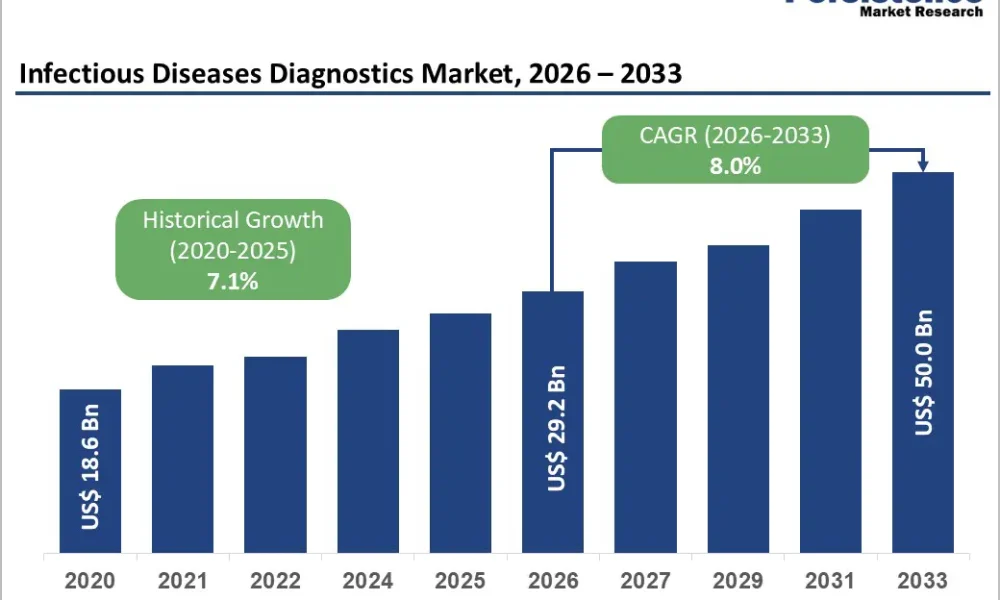
The global infectious diseases diagnostics market is on a steady growth trajectory, projected to expand from US$ 29.2 billion in 2026 to US$ 50.0 billion by 2033, registering a compound annual growth rate (CAGR) of 8.0% during the forecast period. This expansion reflects the increasing global burden of infectious diseases, rising demand for rapid and accurate diagnostic tools, and continued advancements in healthcare infrastructure and diagnostic technologies.
Infectious disease diagnostics play a critical role in identifying pathogens, guiding treatment decisions, and preventing the spread of diseases. From hospitals and laboratories to point-of-care and home-based settings, diagnostic solutions are becoming increasingly integral to healthcare systems worldwide.
Download Your Free Sample & Explore Key Insights: https://www.persistencemarketresearch.com/samples/11413
Market Overview and Key Growth Trends
The market is primarily driven by the rising prevalence of infectious diseases such as tuberculosis, HIV, influenza, and emerging viral outbreaks. Increased awareness about early disease detection, coupled with the need for timely clinical intervention, has significantly boosted demand for advanced diagnostic solutions.
Technological innovation is another major factor shaping the market. Molecular diagnostics, immunoassays, and automated platforms are transforming how infectious diseases are detected, offering improved sensitivity, specificity, and faster turnaround times. Additionally, the growing adoption of point-of-care testing is enabling decentralized diagnostics, particularly in remote and resource-limited settings.
Government initiatives and global health programs aimed at controlling infectious diseases are also supporting market growth. Investments in laboratory infrastructure, disease surveillance systems, and diagnostic accessibility are contributing to widespread adoption of testing solutions.
Dominant Segment: Reagents, Kits & Consumables
Among product categories, reagents, kits, and consumables dominate the infectious diseases diagnostics market, accounting for approximately 52.9% of the total share in 2025. This dominance is attributed to their essential role in every diagnostic test and their recurring usage across laboratories and healthcare facilities.
Unlike diagnostic instruments, which are typically one-time investments, reagents and consumables require continuous replenishment. This creates a consistent revenue stream and ensures sustained demand. Their compatibility with a wide range of technologies, including molecular and immunodiagnostic platforms, further strengthens their market position.
Technology Leadership: Molecular Diagnostics
Molecular diagnostics have emerged as the leading technology segment in the market due to their high accuracy and ability to detect pathogens at very low concentrations. Techniques such as polymerase chain reaction (PCR) have become standard tools for diagnosing infectious diseases.
These technologies are widely used for detecting conditions such as COVID-19, HIV, and tuberculosis, offering rapid and reliable results. The increasing demand for early detection and outbreak management has accelerated the adoption of molecular diagnostic platforms globally.
Market Drivers: Rising Demand for Rapid and Accurate Testing
One of the key drivers of the infectious diseases diagnostics market is the growing demand for rapid and precise diagnostic solutions. Healthcare-associated infections, including surgical site infections (SSIs), continue to pose significant challenges worldwide.
Studies indicate that SSIs affect approximately 2.5% of surgical patients globally, with higher rates observed in certain regions. In countries like the United States, hospital-acquired infections impact millions of patients annually, underscoring the need for effective diagnostic tools.
Rapid diagnostics enable healthcare providers to identify infections early, initiate timely treatment, and reduce complications. This is particularly critical in surgical settings, where early detection can significantly improve patient outcomes and reduce healthcare costs.
Get Custom Insights Designed for Your Businecss: https://www.persistencemarketresearch.com/request-customization/11413
Market Restraints: High Cost of Advanced Diagnostic Technologies
Despite strong growth prospects, the market faces challenges related to the high cost of advanced diagnostic instruments and molecular testing systems. These technologies often require significant capital investment, making them less accessible for smaller healthcare facilities and institutions in developing regions.
In addition to equipment costs, recurring expenses such as consumables, maintenance, and calibration further increase the financial burden. Limited reimbursement policies in certain healthcare systems also restrict the adoption of advanced diagnostics, forcing some facilities to rely on less accurate methods.
Emerging Opportunities: Point-of-Care and Home-Based Testing
The expansion of point-of-care and home-based diagnostic solutions presents a significant opportunity for market growth. These decentralized testing approaches are gaining traction due to their convenience, speed, and ability to deliver results outside traditional laboratory settings.
With the rise of telemedicine and digital health platforms, patients and healthcare providers are increasingly adopting remote diagnostic solutions. Point-of-care testing enables faster clinical decision-making, reduces hospital visits, and improves patient engagement.
In regions with limited healthcare infrastructure, these solutions can bridge gaps in access to diagnostics, ensuring timely detection and treatment of infectious diseases.
Regional Insights
North America Leads the Market
North America holds the largest share of the infectious diseases diagnostics market, accounting for approximately 38.0% in 2025. The region’s dominance is driven by advanced healthcare infrastructure, strong regulatory frameworks, and high investment in research and development.
The United States, in particular, plays a significant role due to its high diagnostic adoption rates and extensive infection surveillance programs. The presence of major industry players such as Abbott Laboratories, Thermo Fisher Scientific, and Bio-Rad Laboratories further strengthens the regional market.
Europe Maintains Strong Position
Europe remains a key market, supported by well-established public healthcare systems and robust infection control policies. Countries across the region have implemented standardized surveillance programs to monitor infectious diseases and improve patient outcomes.
The integration of diagnostic protocols into national healthcare systems and a strong focus on patient safety continue to drive demand for advanced diagnostic tools.
Asia-Pacific Emerges as Fastest-Growing Region
The Asia-Pacific region is expected to witness the fastest growth during the forecast period. Factors such as expanding healthcare infrastructure, increasing healthcare expenditure, and rising awareness about infectious diseases are fueling market expansion.
Emerging economies like China and India are investing heavily in hospital networks and diagnostic laboratories. Additionally, government initiatives aimed at improving healthcare access and infection control are accelerating the adoption of diagnostic technologies.
The region’s large population base and high burden of infectious diseases further contribute to strong demand for diagnostic solutions.
Checkout Now & Download Complete Market Report: https://www.persistencemarketresearch.com/checkout/11413
Competitive Landscape and Industry Developments
The infectious diseases diagnostics market is highly competitive, with leading companies focusing on innovation, scalability, and strategic collaborations to strengthen their market position. Key players include QIAGEN, Roche Diagnostics, Siemens Healthineers, Becton Dickinson, and Hologic.
These companies are investing in advanced diagnostic platforms, automation technologies, and data analytics to enhance testing accuracy and efficiency. Strategic partnerships and supply chain optimization are also key focus areas.
Recent developments highlight the dynamic nature of the market. In October 2025, Sysmex Corporation entered into an exclusive agreement with QIAGEN to distribute clinical diagnostic products in Japan. In September 2025, QIAGEN received regulatory clearance in the United States for its high-throughput syndromic testing system, expanding access to rapid diagnostics.
Future Outlook
The future of the infectious diseases diagnostics market looks promising, with sustained growth expected over the next decade. Advances in molecular diagnostics, artificial intelligence, and digital health technologies will continue to reshape the diagnostic landscape.
The integration of AI-enabled platforms and multiplex testing systems is expected to improve diagnostic accuracy and efficiency. Meanwhile, the shift toward decentralized healthcare and personalized medicine will further drive demand for innovative diagnostic solutions.
As global healthcare systems continue to prioritize early detection and disease prevention, infectious diseases diagnostics will remain a critical component of modern medicine. With increasing investments, technological advancements, and expanding access to healthcare, the market is well-positioned to achieve significant growth by 2033.




