
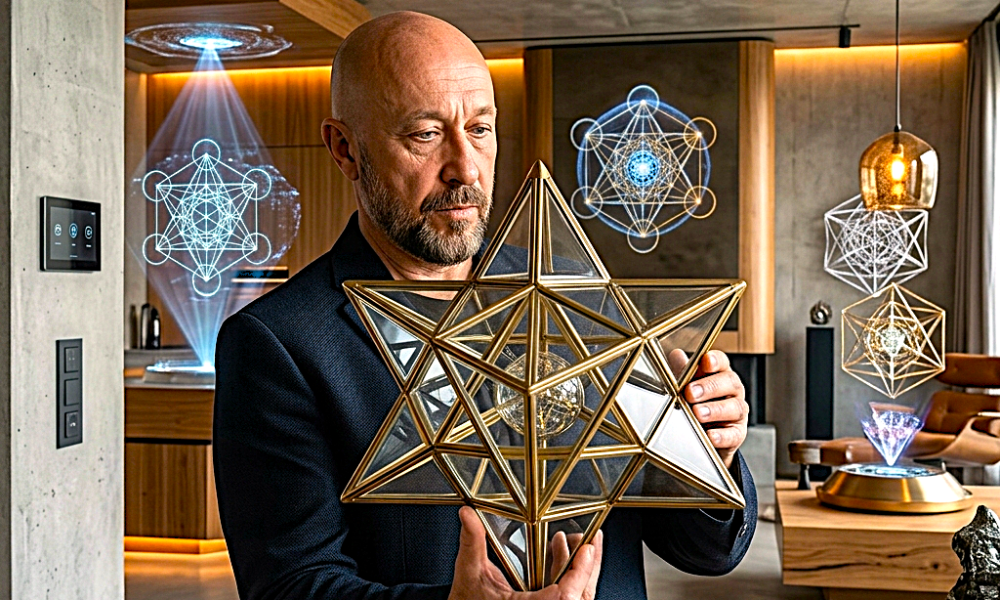
Something is shifting in how Europe’s most discerning homeowners are choosing art. Across Paris, Amsterdam, Stockholm, and Berlin, the era of slapping anything on the decorative wall filler is quietly ending—and in its place, a more intentional, symbolically charged approach to interior art is taking hold. At the center of this shift is an ancient visual language that is finding urgent new relevance: sacred geometry.
The evidence is visible in the design press, in gallery sales data, and in the search behavior of European art collectors. According to 2026 trend forecasts from Maison & Objet—the Paris-based design authority—the defining interior movement of the year centers on transformation, memory, and the recovery of meaning in domestic space. Their theme, Past Reveals Future, signals exactly what sacred geometry has always offered: visual forms that connect the immediate moment to something larger, older, and more enduring than any single trend cycle.
This is not nostalgia. It is a recalibration. After years of algorithmically optimized interiors—spaces assembled from trend reports and Instagram aesthetics—a significant segment of European collectors is demanding art that knows its own history, carries genuine symbolic weight, and can hold its significance across decades rather than seasons.
Sacred geometry — the visual system of circles, spirals, interlocking forms, and ratio-governed compositions that appears in ancient Egyptian temples, Islamic architecture, Gothic cathedrals, and the philosophical traditions of Hermeticism and Kabbalah — is precisely that kind of art. It does not follow trends. It precedes them.
The Akashic Records as Wall Art: Ancient Wisdom Meets Contemporary Minimalism
Among the artists responding most authentically to this European collector shift is Claude Edwin Theriault, a French Canadian contemporary artist based in Nova Scotia whose sacred geometry series has been quietly building a following among European buyers since 2020. His Akashic Records collection—a body of work drawing on the ancient concept of a universal energetic archive of all human experience—sits at a rare intersection: visually minimal enough for Japandi and Scandinavian interiors, yet symbolically dense enough to reward extended attention and invite philosophical inquiry.
The Akashic Records, understood across Vedic, Theosophical, and esoteric traditions as the cosmic memory of all thought and experience, translate in Theriault’s work into layered geometric compositions that feel simultaneously ancient and contemporary. The forms are clean. The negative space is generous. But the meaning is inexhaustible—which is precisely what the 2026 European collector is looking for in a statement wall piece.
“People are not buying art to fill walls anymore,” Theriault has noted. “They are buying it to complete a conversation they are already having with themselves about what matters, what endures, and what they want to look at for the next twenty years.”
This is confirmed by market data. Searches for “sacred geometry wall art,” “esoteric art print,” and “cosmic art for minimalist interiors” have grown substantially in European markets over the past twelve months, with particularly strong signals from France, Germany, the Netherlands, and Scandinavia—precisely the markets where Japandi design, conscious living spaces, and philosophical approaches to home curation have the deepest cultural roots.
Theriault’s work is available internationally through his Pixels print-on-demand portfolio, which offers canvas, metal, acrylic, and wood print formats suited to the full range of contemporary European interior contexts — from the warm linen tones of a Parisian apartment to the cool architectural precision of a Berlin loft.
How Scandinavian Design Culture Rediscovered the Sacred Mandala, and Why It Matters for Conscious Collectors
The Scandinavian design tradition has always understood that objects in a home are not neutral. From the clean functionalism of Danish modernism to the warm minimalism of contemporary Japandi—itself a fusion of Japanese wabi-sabi philosophy with Nordic restraint—Nordic interior culture has consistently valued the idea that what you surround yourself with shapes how you think, feel, and live.
It is no accident, then, that the sacred mandala—one of the oldest and most cross-culturally widespread forms of sacred geometry, appearing in Hindu yantra traditions, Tibetan Buddhist practice, Celtic knotwork, and the rose windows of Gothic cathedrals—is experiencing a significant revival in Scandinavian interior contexts. The mandala’s visual logic of radiating order from a central point maps directly onto what Nordic design has always sought: a calm, harmonious visual environment that supports rather than exhausts the human nervous system.
Theriault’s mandala and sacred geometry works—including his Sacred Geometry Mandala, Peace and Harmony Earth Mandala, and Akashic Records in Time—carry this quality with unusual consistency. They are not decorative mandalas. They are philosophical ones. Each composition is anchored in a genuine symbolic tradition: Fibonacci ratios, Kabbalistic tree structures, Hermetic geometry, and the ancient principle that mathematical harmony and spiritual truth are expressions of the same underlying order.
For the European collector who has grown tired of art that says nothing—the framed poster chosen because it coordinates with a sofa, the abstract canvas selected for its palette rather than its meaning—this represents something genuinely different. It represents art as a daily practice of meaning-making, which is, ultimately, what the most enduring interiors have always offered.
Theriault’s full collection of sacred geometry, Akashic Records, and symbolic figure work is available at pixels.com/profiles/claude-theriault, with international shipping from Nova Scotia, Canada. Press inquiries and collector correspondence may be directed through the Pixels platform.
About Claude Edwin Theriault: Claude Edwin Theriault is a French Canadian contemporary artist, Zeitgeist movement voice, and symbolist working across painting, digital art, and mixed media from Digby County, Nova Scotia. His work connects ancient sacred geometry traditions, Indigenous spiritual symbolism, and contemporary world commentary for a global collector audience. He is currently ranked among the leading contemporary French Canadian artists in international search results and distributes his collection internationally through the Pixels print-on-demand platform.