
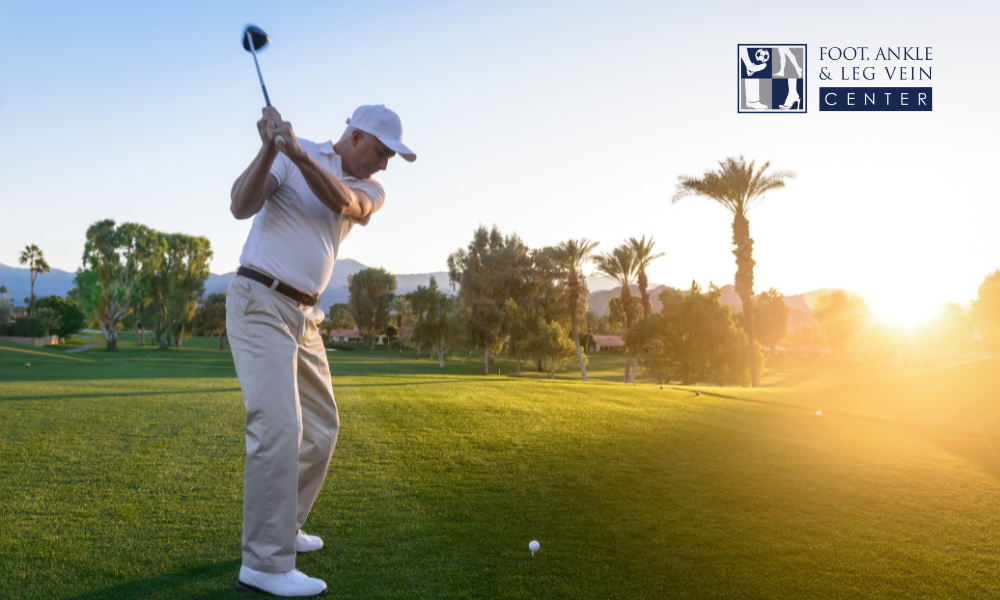
Golf injuries in Palm Beach County rarely get the clinical attention they deserve. The sport looks low-impact, but it places repetitive, asymmetric mechanical stress on the feet and ankles during every swing and every mile walked across the course. Palm Beach County hosts over 150 golf facilities, and Florida’s year-round season means golfers here accumulate far more rounds annually than players in northern states. Podiatrists at the Foot, Ankle & Leg Vein Center in Boca Raton regularly treat golfers who attribute foot pain to aging, never connecting it to their swing mechanics or footwear choices.
How the Golf Swing Loads Your Feet
Every golf swing puts significant force through both feet. The mechanics break into two distinct loading phases:
Backswing (trailing foot):
- Body weight shifts to the right foot for right-handed golfers
- The lateral border of the foot presses hard into the ground
- The peroneal tendons and fifth metatarsal absorb the coiling force
Downswing and follow-through (lead foot):
- Weight transfers rapidly to the left foot
- The foot must dorsiflex, supinate, and absorb the full kinetic chain in milliseconds
- Peak vertical ground reaction forces can exceed 80 percent of body weight at impact
That load is applied 70 to 100 times per round across four or more hours on hard turf. Repeat that across a full season and the cumulative stress on the plantar fascia, metatarsal bones, and ankle ligaments becomes substantial. That is why golf-related foot injuries build gradually, making them easy to dismiss and hard to connect to the sport.
Plantar Fasciitis: The Most Overlooked Golf Injury
Plantar fasciitis is the most common and most underdiagnosed foot injury in recreational golfers. It involves microtearing and inflammation where the plantar fascia attaches to the medial calcaneal tubercle at the heel.
Why golfers are at high risk:
- Walking 18 holes covers four to five miles on firm, compacted turf
- Rigid golf shoe soles reduce natural forefoot flexion
- That restricted flexion pushes more load onto the heel attachment with every step
The warning signs:
- Sharp heel pain with the first steps in the morning
- Pain that eases after 10 to 15 minutes of walking
- Heel soreness that returns after sitting for long periods
A 2016 review in Foot and Ankle International found that untreated plantar fasciitis lasting more than six months showed significantly higher rates of fascia thickening on ultrasound imaging. Thickening correlates directly with longer treatment timelines. Golfers who play through early heel pain consistently convert a simple condition into a chronic one.
Fifth Metatarsal Fractures: The Outer Foot Injury Nobody Expects
The fifth metatarsal, the long bone along the outer edge of the foot, is the second most common site of golf-related injury. Two fracture patterns occur here:
- Avulsion fracture: The peroneus brevis tendon pulls a bone fragment off the base of the fifth metatarsal during a sudden lateral pivot
- Jones fracture: A break at the diaphyseal-metaphyseal junction, which heals slowly due to poor local blood supply
Both are frequently missed because initial pain is moderate and walking remains possible. The trailing foot carries the greatest risk, given how it pivots and laterally loads during the backswing.
Signs a fifth metatarsal injury may be present:
- Point tenderness along the outer border of the foot
- Swelling or bruising appearing within hours of a painful round
- Pain when pivoting or walking on uneven terrain like rough or bunker edges
- Discomfort that does not improve after 72 hours of rest
Do not walk off this injury. Jones fractures left untreated have a documented risk of nonunion due to the limited vascularity at that fracture site.
Turf Toe: A Golf Injury Hiding in Plain Sight
Turf toe is a sprain of the plantar plate and capsular ligaments at the first metatarsophalangeal joint, the base of the big toe. Most golfers associate it with football. It happens in golf too.
How it occurs in a golf swing:
- The lead foot pivots onto the ball of the foot during follow-through
- The big toe is forced into hyperextension under full body weight
- Flexible-soled or narrow toe box shoes give the joint no protection
Repeated hyperextension causes microtearing of the plantar plate. Left untreated, this leads to joint instability and early hallux rigidus, a condition involving progressive stiffness and loss of motion at the big toe. Once hallux rigidus sets in, the follow-through rotation becomes mechanically restricted and painful on every swing.
Watch for these early signs:
- Stiffness at the base of the big toe during or after a round
- Clicking or grinding sensation in the joint
- Swelling at the first MTP joint that appears after play
Early evaluation prevents the joint from developing structural changes that require more involved treatment.
Achilles Tendinopathy in High-Frequency Golfers
The Achilles tendon is loaded heavily during both the backswing and follow-through. Golfers who walk the course, carry bags, or play hilly layouts add four to five miles of walking on top of swing-related demand.
Tendinopathy develops when repetitive strain exceeds the tendon’s collagen remodeling capacity. The injury typically presents two to six centimeters above the heel insertion, the zone of poorest blood supply in the tendon.
Risk factors specific to golfers:
- Playing more than two rounds per week without structured rest
- Skipping warm-up before the first tee
- Wearing golf shoes with insufficient heel cushioning
- A history of previous ankle sprains that altered gait mechanics
The sports medicine specialists at Foot, Ankle & Leg Vein Center treat Achilles tendinopathy using structured eccentric loading protocols. Research by Dr. Hakan Alfredson at Umea University demonstrated a 90 percent clinical success rate in recreational athletes with mid-portion tendinopathy following a consistent 12-week eccentric exercise program. Ultrasound-guided platelet-rich plasma injections are available for cases that do not respond to conservative care.
Footwear and Orthotics: Where Prevention Starts
Golf shoe selection directly affects injury risk. Most golfers replace shoes based on style or price, not biomechanical fit.
What to look for in a golf shoe:
- A firm heel counter that controls rearfoot motion
- A toe box wide enough to let the lead foot spread at impact
- Replaceable cleats positioned to support swing mechanics
- Adequate lateral support to handle uneven terrain in the rough
Worn or misaligned cleats generate unexpected torque through the ankle and metatarsals during the swing. A narrow toe box at impact accelerates neuroma formation between the third and fourth metatarsal heads, producing burning or numbness in the forefoot that golfers often blame on shoe tightness.
Custom orthotics offer three specific advantages over store-bought insoles:
- They are molded to the exact three-dimensional contour of your foot
- They are calibrated to correct your specific pronation or supination pattern
- They are designed to fit inside athletic footwear including golf shoes
The National Institutes of Health recognizes biomechanical correction through custom foot orthoses as a first-line conservative intervention for activity-related lower extremity pain. Golfers in Palm Beach County playing more than two rounds per week should not wait for symptoms to appear before getting a foot evaluation. Call the Foot, Ankle & Leg Vein Center in Boca Raton at (561) 725-5066 to schedule with a board-certified podiatrist.




