
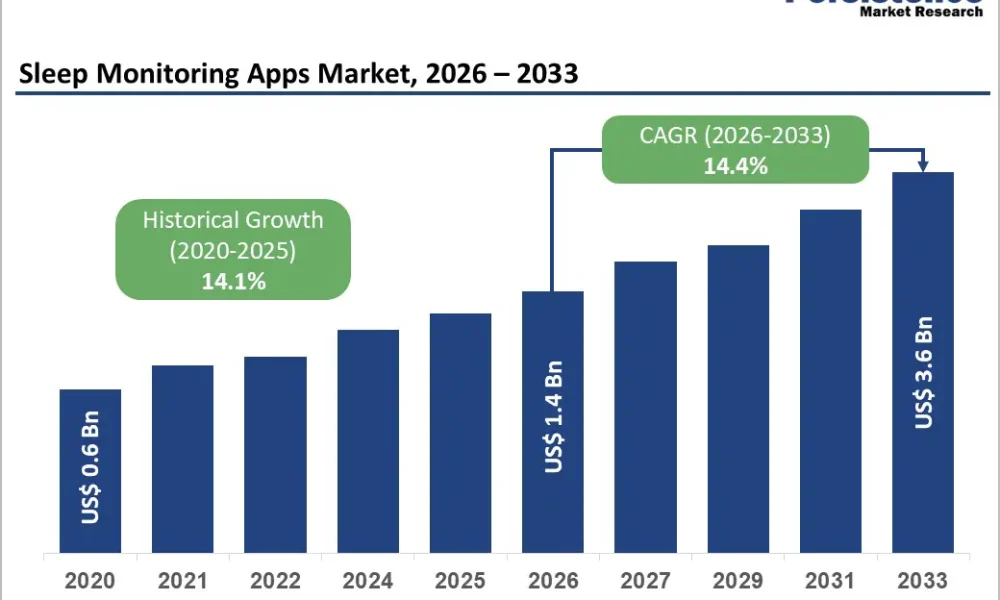
The global sleep monitoring apps market is projected to reach US$1.4 billion in 2026 and is expected to grow to US$3.6 billion by 2033, registering a CAGR of 14.4% during the forecast period. This growth is primarily driven by increasing awareness of sleep health, the rising prevalence of sleep disorders, and the widespread adoption of smartphones and wearable devices. As sleep becomes a recognized pillar of overall wellness alongside nutrition and exercise, consumers are increasingly turning to digital tools to monitor and improve their sleep patterns.
Download Your Free Sample & Explore Key Insights: https://www.persistencemarketresearch.com/samples/32216
Key Market Drivers
One of the major factors fueling market expansion is the growing prevalence of sleep disorders such as insomnia, sleep apnea, restless leg syndrome, and circadian rhythm disruptions. Modern lifestyles characterized by high stress, prolonged screen exposure, and irregular work schedules have contributed to widespread sleep deprivation. This has significantly increased demand for accessible and cost-effective sleep monitoring solutions. Sleep apps provide a convenient alternative to traditional clinical sleep studies, allowing users to track their sleep patterns and gain actionable insights from the comfort of their homes.
Technological advancements are also playing a crucial role in market growth. Integration of artificial intelligence, cloud computing, and Internet of Things (IoT) technologies has enhanced the accuracy and functionality of sleep monitoring apps. These technologies enable real-time data synchronization, long-term trend analysis, and personalized recommendations. Additionally, the increasing adoption of wearable devices such as smartwatches and fitness bands allows continuous and non-invasive sleep tracking, further boosting user engagement.
Market Challenges
Despite strong growth prospects, the market faces challenges related to accuracy limitations of consumer-grade applications. Unlike clinical diagnostic tools such as polysomnography, most sleep apps rely on indirect indicators such as movement, heart rate variability, and sound detection. These methods may lead to inaccuracies in identifying sleep stages or detecting disorders like obstructive sleep apnea. As a result, users may receive inconsistent or misleading data, which can affect trust and long-term usage.
This limitation also impacts the integration of sleep apps into clinical settings. Healthcare professionals often hesitate to rely on app-generated data due to lack of standardization and validation. Consequently, this restricts opportunities for partnerships with healthcare providers and limits the adoption of these apps for medical decision-making.
Get Custom Insights Designed for Your Businecss: https://www.persistencemarketresearch.com/request-customization/32216
Opportunities and Emerging Trends
The aging global population presents a significant opportunity for market growth. Older adults are more prone to sleep-related disorders, creating a demand for continuous and non-invasive monitoring solutions. Sleep apps integrated with wearables and home-based sensors enable long-term tracking and early detection of irregular sleep patterns, supporting better health management.
Corporate wellness programs are another emerging growth avenue. Employers are increasingly recognizing the impact of sleep quality on productivity, mental health, and overall employee performance. As a result, organizations are incorporating sleep monitoring apps into their wellness initiatives, often providing subsidized access or incentives to employees. This trend is expected to drive widespread adoption across working populations.
Segment Analysis
In terms of device type, wearable devices dominate the market, accounting for approximately 75% of revenue share in 2026. Their ability to provide continuous, real-time data and seamless integration with health ecosystems makes them highly popular among consumers. Meanwhile, non-wearable devices such as under-mattress sensors and smart beds are emerging as the fastest-growing segment, particularly among users seeking non-intrusive monitoring solutions.
Based on features, basic sleep tracking holds the largest market share, contributing over 50% of revenue in 2026. Its simplicity and accessibility make it appealing to a broad user base. However, advanced features such as sleep staging and AI-driven insights are expected to witness the fastest growth, driven by increasing demand for deeper and more personalized health analysis.
Regional Insights
North America is anticipated to lead the global market, accounting for 43% of the share in 2026. This dominance is attributed to high awareness of sleep disorders, strong digital health adoption, and widespread use of wearable devices. Europe also represents a significant market, supported by stringent data privacy regulations and growing emphasis on preventive healthcare.
Asia Pacific is expected to be the fastest-growing region, driven by rapid smartphone penetration, increasing health awareness, and expanding middle-class populations. Countries such as China, Japan, India, and ASEAN nations are witnessing strong adoption of sleep monitoring apps due to rising stress levels and urban lifestyles.
Checkout Now & Download Complete Market Report: https://www.persistencemarketresearch.com/checkout/32216
Competitive Landscape
The sleep monitoring apps market is moderately fragmented, with a mix of established technology companies and specialized developers. Key players compete by offering innovative features, enhancing user experience, and integrating with wearable ecosystems. Subscription-based models, freemium offerings, and personalized insights are commonly used strategies to attract and retain users.
As competition intensifies, companies are focusing on improving accuracy, expanding cross-platform compatibility, and aligning with regulatory standards. Continuous innovation and strategic partnerships will be critical for sustaining growth and gaining a competitive edge in this evolving market.
Conclusion
The sleep monitoring apps market is poised for robust growth, driven by increasing awareness of sleep health, rapid technological advancements, and the widespread use of smartphones and wearable devices. As consumers shift toward preventive healthcare and self-monitoring solutions, sleep apps are becoming an essential tool for improving overall well-being and managing lifestyle-related health risks.
While challenges related to data accuracy and clinical validation persist, continuous innovation in artificial intelligence, sensor technologies, and data analytics is expected to enhance reliability and user trust over time. The integration of sleep monitoring into broader digital health ecosystems, along with expanding applications in corporate wellness and elderly care, further strengthens market potential.
With strong regional growth in Asia Pacific, sustained leadership in North America, and increasing adoption across Europe, the global market is set to evolve rapidly. Companies that prioritize accuracy, personalization, regulatory compliance, and seamless device integration will be best positioned to capitalize on emerging opportunities and shape the future of sleep health management.




