

Wave Energy Market Overview
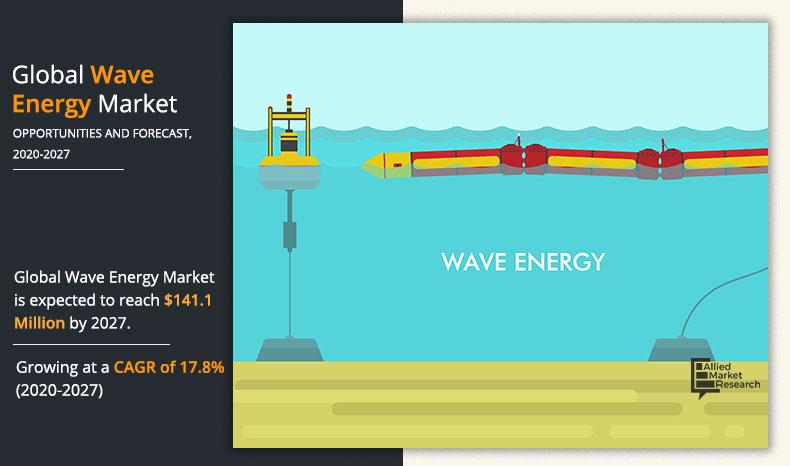
According to a new report published by Allied Market Research, the wave energy market was valued at $43.8 million in 2019 and is projected to reach $141.1 million by 2027, growing at a CAGR of 17.8% from 2020 to 2027. Increasing global focus on renewable energy diversification, rising electricity demand in coastal regions, and advancements in marine energy technologies are key factors driving expansion of the wave energy market. 🌊⚡
Introduction
Wave energy is a form of renewable power generated from the movement of ocean waves. Alongside tidal energy and marine biomass, it represents one of the major ocean-based energy resources. Wave energy converters capture the kinetic and potential energy of ocean waves and transform it into electricity.
The wave energy market is gaining attention as countries explore sustainable alternatives to fossil fuels. Unlike solar or wind energy, ocean waves are highly predictable and available day and night, making wave power a reliable renewable resource.
Download PDF Brochure: https://www.alliedmarketresearch.com/request-sample/A07823
Advantages of Wave Energy
Wave energy offers several environmental and operational benefits. It is renewable, produces minimal emissions, and has a vast global resource base. Oceans cover more than 70% of the Earth’s surface, providing enormous potential for energy extraction.
Additionally, wave energy systems can operate with relatively low visual impact compared to large wind turbines or solar farms. Their consistent energy output also makes them suitable for integration into national power grids.
These advantages position the wave energy market as a promising contributor to the future global energy mix.
Key Growth Drivers
One of the primary drivers of the wave energy market is the abundant availability of ocean wave resources, particularly along coastal regions. Many island nations and coastal communities face high electricity costs due to dependence on imported fuels, making wave energy an attractive alternative.
Increasing demand for electricity from coastal populations, ports, offshore industries, and desalination plants is further accelerating adoption. Marine industries such as shipping, offshore oil platforms, and aquaculture facilities require reliable power sources that can operate independently from mainland grids.
Rising investments in renewable energy infrastructure worldwide are also supporting development of wave energy projects. Governments and private organizations are funding pilot installations and research programs to commercialize marine energy technologies.
Market Challenges
Despite its potential, the wave energy market faces several obstacles. High capital investment required for installation, maintenance, and grid integration remains a major barrier. Marine environments are harsh, leading to corrosion, mechanical stress, and operational complexities that increase costs.
Limited infrastructure and lack of standardized technologies also hinder large-scale deployment. Many projects are still in demonstration phases, and commercial viability depends on further technological improvements and cost reductions.
Opportunities Through Research and Innovation
Growing research and development activities are expected to create new opportunities in the wave energy market. Engineers are developing more efficient converters capable of operating in diverse sea conditions while reducing maintenance requirements.
Advancements in materials science, digital monitoring systems, and offshore engineering are improving durability and energy capture efficiency. As these technologies mature, wave energy could become a competitive source of clean electricity.
Technology Segmentation
Based on technology, the oscillating body converter (OBC) segment accounted for the largest share of the wave energy market in 2019, holding approximately 53.6% of total revenue. OBC systems generate power from the motion of floating or submerged structures that move with wave action.
Their high efficiency, compact size, and reliability make them suitable for a wide range of marine conditions. OBC technology is expected to maintain its dominance during the forecast period due to ongoing improvements in design and performance.
Location-Based Analysis
Wave energy installations are typically categorized as offshore, near-shore, or shoreline systems. The near-shore segment held the largest market share—around 60.2%—in 2019 and is projected to maintain its leadership.
Near-shore installations benefit from easier access for maintenance, lower installation costs, and proximity to power grids. They are widely used for applications such as electricity generation and seawater desalination, particularly in regions facing water scarcity.
Application Insights
In terms of application, power generation accounted for the largest share of the wave energy market in 2019 and is expected to grow at a CAGR of 17.9%. Increasing global investment in renewable energy and the need to decarbonize electricity production are major contributors to this growth.
Wave energy can complement other renewable sources by providing consistent output when solar or wind generation is low. The marine industry’s growing energy needs also support adoption of wave-powered systems.
Environmental protection and coastal management applications are emerging as additional growth areas, as wave energy devices can be integrated with coastal defense structures.
Regional Outlook
Regionally, the wave energy market is analyzed across North America, Europe, Asia-Pacific, and LAMEA (Latin America, Middle East, and Africa).
Europe dominated the market in 2019, accounting for more than 53.6% of global revenue. Countries such as the United Kingdom, Portugal, and Norway have invested heavily in marine energy research and pilot projects. Strong policy support, favorable ocean conditions, and the presence of leading technology developers contribute to the region’s leadership. 🌍
Europe is also expected to register the fastest growth rate during the forecast period, with a projected CAGR of approximately 18.1%.
Competitive Landscape
The wave energy market features several innovative companies focused on developing advanced marine energy solutions. Key players include Ocean Power Technologies, Eco Wave Power, Sinn Power GmbH, AWS Ocean Energy Ltd., Wave Swell Energy Ltd, Carnegie Clean Energy Limited, Aquamarine Power Ltd., and Amog Consulting.
Other companies operating across the value chain include CorPower Ocean, Aquagen Technologies, and Atlantis Resources Ltd., among others.
Get a Customized Research Report: https://www.alliedmarketresearch.com/request-for-customization/A07823
Impact of COVID-19
The COVID-19 pandemic disrupted multiple industries worldwide, including construction, transportation, energy, and manufacturing. Lockdowns and economic slowdowns led to reduced electricity demand in many regions, temporarily affecting renewable energy investments.
Supply chain disruptions and project delays also hindered deployment of new wave energy installations. However, long-term interest in sustainable energy solutions remains strong, suggesting a recovery in the wave energy market as global economies stabilize.
Conclusion
In conclusion, the wave energy market is poised for significant growth as nations seek diverse and reliable renewable energy sources. With vast untapped ocean resources, wave energy offers a sustainable solution for coastal electricity generation and marine applications.
Although high costs and technical challenges persist, ongoing research, supportive policies, and technological innovation are expected to improve commercial viability. As the global transition toward clean energy accelerates, the wave energy market will play an increasingly important role in building a resilient and sustainable energy future. 🌊🚀
Other Trending Reports:-
About Us
Allied Market Research (AMR) is a full-service market research and business-consulting wing of Allied Analytics LLP based in Portland, Oregon. Allied Market Research provides global enterprises as well as medium and small businesses with unmatched quality of “Market Research Reports” and “Business Intelligence Solutions.” AMR has a targeted view to provide business insights and consulting to assist its clients to make strategic business decisions and achieve sustainable growth in their respective market domain.
Pawan Kumar, the CEO of Allied Market Research, is leading the organization toward providing high-quality data and insights. We are in professional corporate relations with various companies and this helps us in digging out market data that helps us generate accurate research data tables and confirms utmost accuracy in our market forecasting. Each and every data presented in the reports published by us is extracted through primary interviews with top officials from leading companies of domain concerned. Our secondary data procurement methodology includes deep online and offline research and discussion with knowledgeable professionals and analysts in the industry.




