
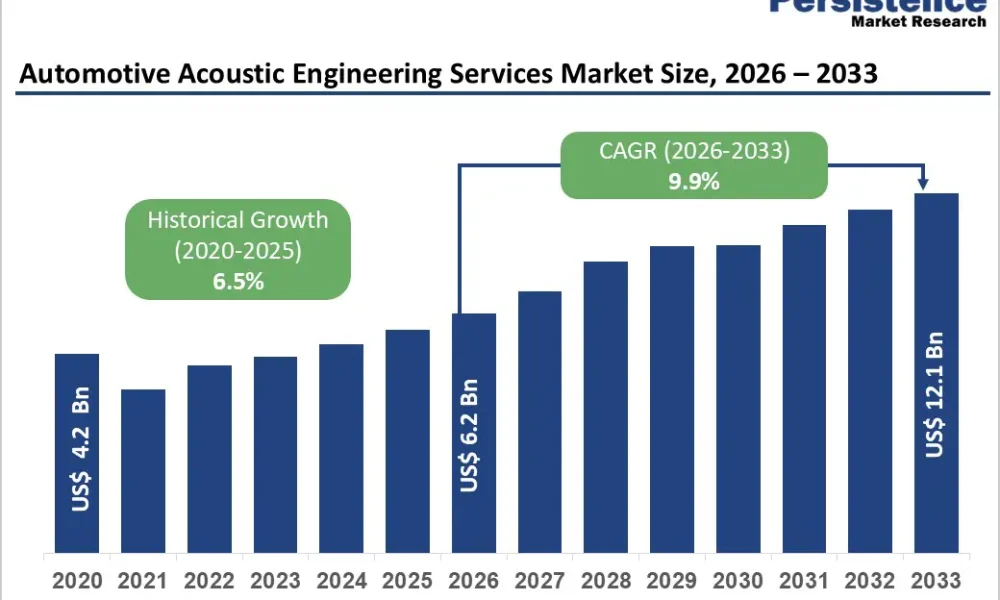
The global automotive acoustic engineering services market is witnessing steady expansion, driven by the automotive industry’s increasing emphasis on noise, vibration, and harshness (NVH) optimization. The market, valued at US$ 4.2 billion in 2020, reached approximately US$ 6.2 billion in 2026 and is projected to grow significantly to US$ 12.1 billion by 2033, registering a strong CAGR of 9.9% between 2026 and 2033. Historically, the market expanded at a CAGR of 6.5% between 2020 and 2026, reflecting consistent demand across global automotive manufacturing hubs.
The growth trajectory is underpinned by increasing consumer expectations for quieter and more comfortable driving experiences, particularly in premium and electric vehicles. With the rapid electrification of mobility, the absence of internal combustion engine noise has amplified the need to address secondary noise sources such as tire, wind, and structural vibrations. Additionally, stringent regulatory standards governing vehicle noise emissions are pushing automakers to invest heavily in advanced acoustic engineering services.
Technological advancements in simulation software, digital prototyping, and real-time testing capabilities are further enabling manufacturers to optimize vehicle acoustics efficiently. The integration of advanced analytics, artificial intelligence, and predictive modeling is transforming traditional acoustic engineering into a more data-driven and precise discipline.
Get Your FREE Sample Report Instantly Click Now: https://www.persistencemarketresearch.com/samples/34854
Key Highlights from the Report
➤ The automotive acoustic engineering services market is projected to grow from US$ 6.2 billion in 2026 to US$ 12.1 billion by 2033, at a CAGR of 9.9%.
➤ Rising demand for electric and hybrid vehicles is significantly increasing the need for advanced NVH solutions.
➤ Stringent global regulations on vehicle noise emissions are accelerating adoption of acoustic engineering services.
➤ Increased focus on passenger comfort and premium vehicle experience is driving innovation in sound design.
➤ Growing adoption of simulation-based acoustic testing is reducing development time and costs.
➤ Expansion of autonomous and connected vehicle technologies is creating new acoustic engineering challenges and opportunities.
Segmentation Analysis
By Type
The market is segmented into design & simulation services, testing & validation services, and consulting services. Among these, design and simulation services dominate the market due to their critical role in early-stage vehicle development. These services allow manufacturers to predict and mitigate acoustic issues before physical prototypes are built, significantly reducing time and cost.
Testing and validation services are expected to witness the fastest growth during the forecast period, driven by increasing regulatory requirements and the need for real-world performance verification. Advanced testing facilities, including semi-anechoic chambers and on-road testing systems, are being widely adopted to ensure compliance and performance optimization.
By Vehicle/Product/Service Type
Based on vehicle type, the market is categorized into passenger vehicles, commercial vehicles, and electric vehicles (EVs). Passenger vehicles hold the largest market share, supported by high production volumes and rising consumer demand for enhanced cabin comfort. However, electric vehicles represent the fastest-growing segment due to their unique acoustic challenges, such as high-frequency noise and absence of engine masking effects.
Commercial vehicles are also increasingly adopting acoustic engineering services, particularly in logistics and public transport sectors, where driver comfort and regulatory compliance are critical factors.
By Propulsion/Technology/Channel
In terms of propulsion, the market is segmented into internal combustion engine (ICE), hybrid, and electric vehicles. While ICE vehicles continue to dominate in volume, hybrid and electric vehicles are driving the next wave of innovation in acoustic engineering.
From a technology perspective, the adoption of digital simulation tools, AI-based acoustic modeling, and IoT-enabled testing systems is transforming the service landscape. Cloud-based platforms and virtual testing environments are enabling real-time collaboration and faster decision-making, enhancing efficiency across the product development lifecycle.
Customize This Report for Your Exact Requirements: https://www.persistencemarketresearch.com/request-customization/34854
Regional Insights
Europe remains a leading region in the automotive acoustic engineering services market, supported by stringent noise regulations and the presence of major automotive manufacturers. Countries such as Germany, France, and the United Kingdom are at the forefront of adopting advanced NVH solutions to comply with regulatory standards and maintain competitive advantage in premium vehicle segments.
North America also holds a significant share, driven by technological innovation and strong demand for high-performance vehicles. The region’s focus on electric vehicle adoption and autonomous driving technologies is further boosting the demand for advanced acoustic engineering services.
Asia-Pacific is expected to emerge as the fastest-growing region during the forecast period. Rapid industrialization, increasing vehicle production, and rising consumer awareness regarding vehicle comfort are key factors driving growth in countries such as China, India, and Japan. Additionally, the expansion of electric mobility initiatives and government support for sustainable transportation are contributing to the region’s accelerated growth.
Unique Features and Innovations in the Market
Modern automotive acoustic engineering services are distinguished by their integration of cutting-edge technologies and innovative methodologies. The use of artificial intelligence and machine learning enables predictive modeling of noise behavior, allowing engineers to identify and mitigate potential issues at an early stage.
The adoption of IoT-enabled sensors and real-time monitoring systems provides continuous data on vehicle acoustics, enabling dynamic adjustments and performance optimization. Furthermore, the emergence of 5G connectivity is facilitating faster data transmission and seamless communication between testing systems, simulation platforms, and engineering teams.
Advanced materials and design techniques, such as lightweight sound-absorbing composites and active noise control systems, are further enhancing vehicle acoustics. These innovations not only improve passenger comfort but also contribute to overall vehicle efficiency and sustainability.
Market Highlights
The increasing adoption of automotive acoustic engineering services is driven by several key factors, including the need to enhance passenger comfort, comply with regulatory standards, and differentiate products in a competitive market. Automakers are recognizing the importance of acoustic performance as a critical component of overall vehicle quality and brand perception.
Regulatory frameworks governing vehicle noise emissions are playing a significant role in shaping the market. Compliance with these regulations requires advanced testing and validation processes, driving demand for specialized engineering services. Additionally, cost reduction through simulation-based design and virtual testing is enabling manufacturers to optimize resources and accelerate product development cycles.
Sustainability is also emerging as a key focus area, with manufacturers seeking to develop eco-friendly acoustic solutions that align with environmental goals. The use of recyclable materials and energy-efficient testing processes is gaining traction, further contributing to market growth.
Key Players and Competitive Landscape
The automotive acoustic engineering services market is characterized by intense competition and the presence of several leading global players. These companies are focusing on innovation, strategic partnerships, and geographic expansion to strengthen their market position.
✦ Bertrandt AG – Specializes in comprehensive engineering solutions, with a strong focus on simulation-driven acoustic optimization and European market expansion.
✦ EDAG Engineering Group AG – Offers advanced NVH engineering services and is активно investing in digital twin and virtual testing technologies.
✦ FEV Group GmbH – Known for its expertise in powertrain and acoustic engineering, with a strong emphasis on electrification and hybrid systems.
✦ AVL List GmbH – A key player in testing and simulation solutions, leveraging AI and advanced analytics for acoustic performance enhancement.
✦ Ricardo plc – Focuses on sustainable and high-performance acoustic engineering services, supporting global OEMs in regulatory compliance.
✦ Siemens Digital Industries Software – Provides cutting-edge simulation tools and digital platforms for acoustic engineering and product development.
These companies are increasingly adopting strategies such as mergers and acquisitions, partnerships with automotive OEMs, and investment in R&D to develop innovative solutions. The integration of digital technologies and expansion into emerging markets are key factors influencing their competitive positioning.
Ready to Dive Deep? Buy Full Report Today: https://www.persistencemarketresearch.com/checkout/34854
Recent Developments
- Introduction of AI-powered acoustic simulation platforms enabling real-time noise prediction and optimization during vehicle design.
- Expansion of advanced testing facilities and acoustic laboratories in Asia-Pacific to support growing regional demand.
Future Opportunities and Growth Prospects
The future of the automotive acoustic engineering services market is closely tied to the evolution of vehicle technologies and regulatory frameworks. The rapid growth of electric and autonomous vehicles is expected to create new challenges and opportunities in acoustic design, particularly in areas such as artificial sound generation and interior noise management.
Advancements in AI, IoT, and 5G technologies will continue to drive innovation, enabling more accurate simulations, real-time monitoring, and enhanced collaboration across engineering teams. These technologies are expected to significantly reduce development timelines and improve overall efficiency.
Regulatory developments aimed at reducing noise pollution and improving environmental sustainability will further shape the market landscape. Companies that invest in innovative, compliant, and sustainable acoustic solutions are likely to gain a competitive edge.
Emerging markets, particularly in Asia-Pacific and Latin America, offer significant growth potential due to increasing vehicle production and rising consumer expectations. As automotive manufacturers continue to prioritize comfort, safety, and sustainability, the demand for advanced acoustic engineering services is expected to remain strong, positioning the market for sustained growth through 2033.




