FOR IMMEDIATE RELEASE
Queering the Canon: Sacred Geometry as the New Language of Cultural Reckoning in Contemporary Art
In an era where cultural narratives are being dismantled and rebuilt in real time, a quiet but potent visual insurgency is unfolding across the global contemporary art landscape. It doesn’t scream—it encodes. It doesn’t protest—it reconfigures. This movement, increasingly recognized by curators, theorists, and collectors alike, is redefining how we interpret myth, history, and identity through a radical visual syntax: sacred geometry fused with queer reimaginings of canonical figures.
This is not aesthetic decoration. This is symbolic warfare.
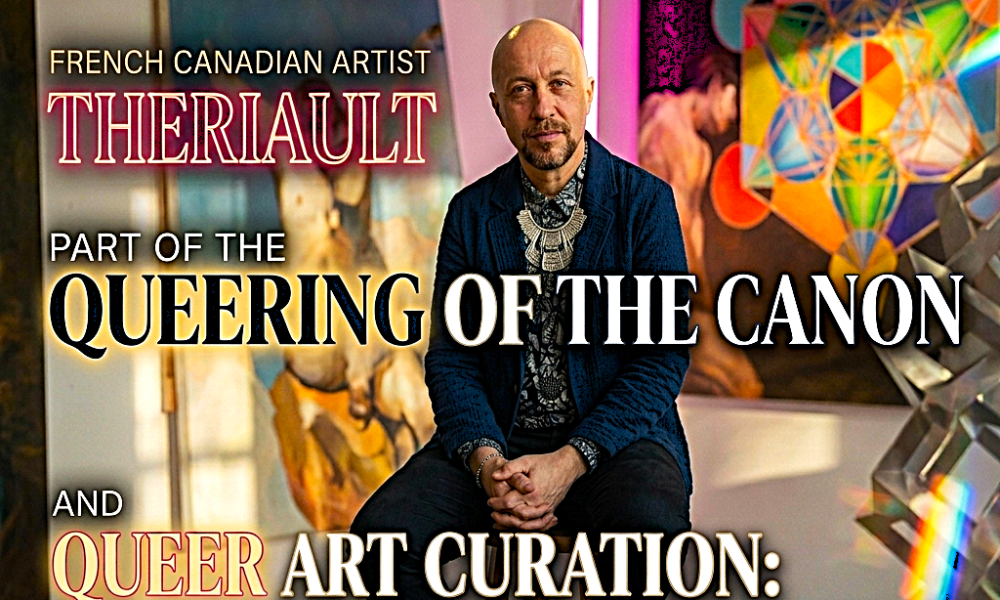
Contemporary artists like Theriault are appropriating the visual authority of historical and mythological archetypes—Greek gods, medieval saints, esoteric deities—and overlaying them with sacred geometric systems that have long signified cosmic order, divine proportion, and metaphysical truth. The result? A deliberate Queering of the Canon that destabilizes rigid binaries and exposes the coded biases embedded in centuries of art history.
Contemporary French Canadian Artist Theriault Queering of the Canon: Sacred Geometry Disrupts Art History and Rewrites Cultural Power Structures
At the heart of this shift is a refusal to accept inherited narratives as fixed. Instead, artists are treating them as raw material—mutable, remixable, and ripe for interrogation.
This emerging visual language echoes across disciplines. From large-scale oil paintings to immersive digital installations, artists are embedding sigils, mandalas, and geometric lattices directly into the bodies of historical figures—transforming them into living diagrams of identity, trauma, and transcendence.
The referenced Contemporary Art video expands on this phenomenon, illustrating how sacred geometry becomes a tool not just for composition, but for conceptual disruption—mapping inner psychological landscapes onto inherited cultural symbols.
Queering the Canon: Rewriting Myth Through Geometry
The phrase “queering the canon” is more than academic rhetoric—it is an operational strategy. Historically, the Western canon has functioned as a gatekeeping mechanism, privileging heteronormative, Eurocentric narratives while marginalizing alternative identities. Contemporary artists are now reversing that equation.
Projects like Queer Sanctity explicitly aim to destabilize these frameworks by pairing historical works with contemporary queer reinterpretations, revealing how much has been erased—or deliberately excluded—from dominant narratives. (Different Visions)
What’s new, however, is the integration of sacred geometry as both aesthetic and ideological infrastructure.
Take the legacy of works like Ego Geometria Sum—a seminal piece where geometric structures were used to map autobiographical identity. Chadwick’s invocation of geometry as a universal language hinted at something larger: the possibility that form itself could carry meaning beyond representation.
Fast forward to today, and artists are pushing that idea into far more subversive territory.
Consider Morehshin Allahyari, whose 3D-printed reimaginings of mythological jinn figures reclaim erased or demonized identities through speculative storytelling and digital reconstruction. Her work reframes mythology as a contested space—one where gender, power, and cultural memory are actively renegotiated.
Or Apolonia Sokol, who weaponizes portraiture rooted in art history to foreground queer and feminist narratives, effectively inserting marginalized identities back into the visual canon from which they were excluded. (Wikipedia)
Layer sacred geometry onto these practices, and something profound happens: the figures are no longer just reinterpreted—they are re-coded.
Geometry, historically associated with divine perfection—from Renaissance architecture to Islamic ornamentation—becomes a Trojan horse. It carries the authority of the sacred while quietly subverting the ideological structures that once used it to enforce order.
This is the paradox contemporary artists are exploiting: using the visual language of “universal truth” to expose the subjectivity of truth itself.
Queer Art Curation: From Exhibition to Experience Architecture
If artists are rewriting the canon, curators are redesigning the stage on which it appears.
“Queer Contemporary Art curation” is no longer about inclusion—it’s about recalibration. It’s about constructing exhibitions that function less like linear narratives and more like immersive systems—ritual spaces where viewers engage with layered symbolic frameworks.
Recent exhibitions centered on sacred geometry demonstrate how this plays out spatially. Geometric repetition, ritualistic patterning, and shrine-like installations are used to create environments that feel less like galleries and more like initiatory spaces. (MutualArt)
Queering of the Canon curators are increasingly drawing from esoteric traditions—alchemy, mysticism, occult symbolism—not as aesthetic references, but as structural methodologies. The exhibition becomes a kind of living mandala, guiding the viewer through cycles of perception, disruption, and revelation.
Artists like Maja Ruznic embody this approach in their work, blending mythology, personal trauma, and sacred geometry into compositions that feel both ancient and urgently contemporary.
Meanwhile, practitioners working explicitly within occult and queer frameworks—such as Elizabeth Insogna—are collapsing the boundaries between art, ritual, and identity, creating works that operate simultaneously as visual objects and performative acts of reclamation.
This is where things get interesting—and slightly uncomfortable for traditional institutions.
Because once you accept that exhibitions can function as ritual systems, the role of the curator shifts dramatically. You’re no longer just selecting works—you’re orchestrating meaning. You’re designing experiences that can alter perception, challenge belief systems, and, in some cases, trigger profound emotional or psychological responses.
In other words, curation becomes a form of authorship.
And in the context of queer art, that authorship carries a specific mandate: to dismantle inherited hierarchies and replace them with fluid, intersectional frameworks that reflect the complexity of contemporary identity.
The Bigger Picture: Why This Movement Matters Now
Let’s not pretend this is happening in a vacuum.
The resurgence of sacred geometry in contemporary art coincides with a broader cultural shift toward systems thinking, pattern recognition, and interconnectedness—ideas that are also driving advancements in AI, data visualization, and digital culture.
Artists are tapping into this zeitgeist, using geometry as a bridge between the ancient and the algorithmic.
But here’s the twist: while tech culture often uses geometry to optimize and control, these artists are using it to liberate and destabilize.
That tension is where the real power lies.
By queering the canon through sacred geometry, contemporary artists are doing something that goes beyond representation. They are rewriting the underlying code of cultural perception—challenging not just what we see, but how we interpret meaning itself.
And that has implications far beyond the art world.
Because once you start questioning the “geometry” of cultural narratives—the structures that shape identity, power, and history—you start to see the cracks everywhere.
And once you see them, you can’t unsee them.