
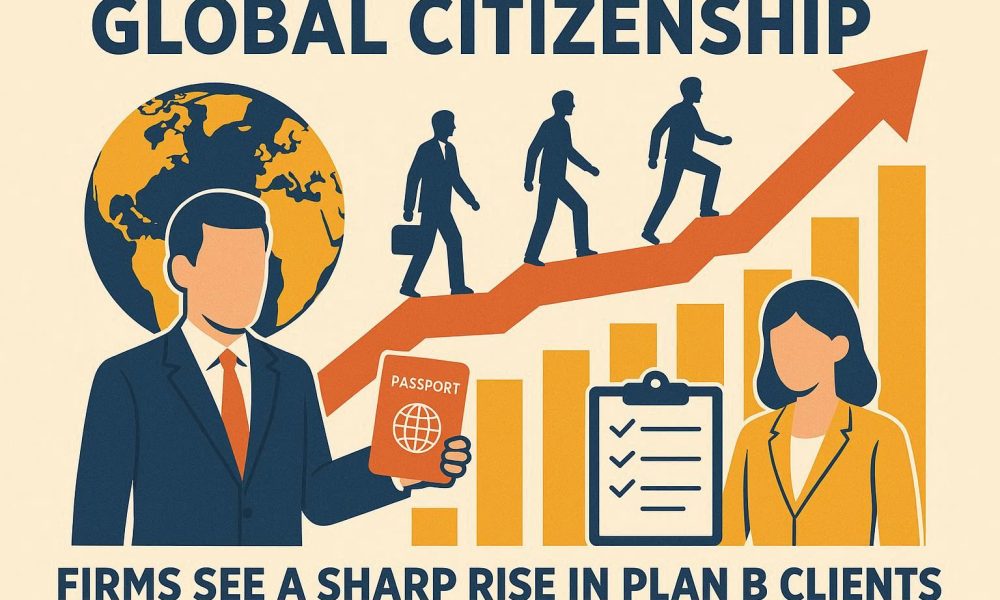
Political uncertainty and mobility disruptions are expanding the customer base for firms specializing in second-nationality strategies.
WASHINGTON, DC, March 18, 2026.
The customer base for second citizenship is changing fast, and the biggest change is not simply that demand is rising. It is that the people buying have changed.
For years, the market was easy to stereotype. A second passport belonged to a narrow world of billionaires, tax planners, discreet family offices, and a small class of globally mobile clients who seemed to treat citizenship the way others treated luxury real estate, as another asset to add quietly to the collection.
That image still exists, but it no longer explains what firms on the ground are seeing.
In 2026, a growing number of citizenship advisers say the modern Plan B client is broader, more anxious, and far more practical than the old caricature. The new buyers include entrepreneurs, internationally employed professionals, parents of school-age children, politically uneasy households, and wealth holders who no longer want every major life decision tied to a single jurisdiction.
That is what makes this market shift so important. It is not just about more demand. It is about mainstreaming.
A second nationality is moving from the category of prestige planning to the category of contingency planning. The appeal is no longer only about where someone can travel on holiday. It is about where they can legally land, stay, work, study, bank, and rebuild if the world becomes harder to read.
This is the nut of the trend. Political uncertainty and mobility disruption are not merely increasing inquiries. They are changing the shape of the buyer pool itself.
That broader mood has been visible in mainstream reporting. In one telling example, Reuters reported that more Americans were exploring moves to Europe as political tension, lifestyle concerns, and long-term unease made legal options abroad feel less hypothetical and more practical.
The Plan B buyer is no longer a niche figure
The phrase “Plan B passport” used to sound like something from a rarefied corner of the world of wealth.
Now it sounds increasingly ordinary.
That does not mean ordinary in the sense of cheap or casual. It means ordinary in the sense that more people now understand the logic without needing much explanation. They may not pursue it themselves. They may never move. But the reasoning has become familiar.
Families ask what happens if politics becomes more extreme.
Founders ask what happens if regulation turns hostile or banking becomes harder to navigate.
Parents ask what rights their children may wish they had ten years from now.
Investors ask whether one passport poses too much concentration risk in a period of sharper elections, quicker policy reversals, and less confidence that today’s legal climate will remain stable later in the decade.
Those are not fringe questions. They are the questions of cautious planners.
That is why citizenship firms are seeing a sharper rise in clients who are not chasing glamour at all. They are chasing breathing room. They want a backup framework, not a trophy.
Political volatility is creating a new type of urgency
The modern surge in Plan B clients is driven in large part by a single emotional shift. People no longer assume that the political climate of their home country is a stable backdrop to their lives.
It feels active now. It feels intrusive. It feels capable of changing tax posture, social tone, business conditions, regulatory pressure, and even family decisions far more quickly than before.
That matters because once politics becomes part of daily planning, citizenship stops looking symbolic and starts looking structural.
A change in government can alter how wealth is treated, how migration is framed, how capital is discussed, how foreign ties are viewed, and how secure people feel about keeping their family strategy centered in one place. Even when those effects are indirect, the perception alone can change behavior.
Clients do not need to believe a catastrophe is coming.
They only need to believe that volatility itself has become durable.
That belief is enough to push citizenship planning into the mainstream.
It is also why the strongest client growth is not always among those preparing to leave immediately. Many are not leaving at all. They simply want to stop waiting until a future crisis turns calm planning into urgent improvisation.
Mobility disruption changed the way firms talk to clients
The pandemic years were a turning point, but the lesson outlived the lockdowns.
Travel shutdowns, border controls, and residency barriers taught a large class of wealthy and internationally active people something they had not fully absorbed before. A strong passport is not the same thing as secure mobility. A border can close. A flight network can collapse. A residency rule can suddenly matter more than cash, status, or a premium travel document.
That changed how firms position their services.
The old sales story leaned heavily on convenience, speed, and prestige. The newer story is about resilience. It is about lawful backup rights. It is about having another place to stand when normal systems stop behaving normally.
That is a much more serious proposition.
It also attracts a much broader audience.
A founder with staff in three countries understands that logic.
So does a family with children approaching university age.
So does a semi-retired couple who once assumed Europe would always remain easy to access.
So does a wealthy household trying to make sure the next policy swing does not trap every major decision within a single legal system.
Mobility disruption, in that sense, did not just expand the market. It educated it.
Why firms are seeing more families, not just more wealth
One of the clearest changes inside the sector is the growing share of family-centered clients.
This is important because it shows how much the market has evolved beyond the old individualistic model. The classic buyer was often imagined as a single principal, usually male, usually wealthy, structuring a personal fallback. The modern buyer often arrives with a spouse, children, education plans, questions about long-term residence, and a desire to think in generations rather than quarters.
That changes the whole conversation.
The family does not ask only, “Which passport is strong?”
It asks, “Which route will still make sense for us in ten years?”
Will the children be able to study and work abroad?
Will a spouse have clean settlement rights?
Will relocation remain possible without rebuilding the entire family structure under pressure?
Will retirement options widen?
Will the family be stuck if politics at home turns uglier, or public life becomes more exhausting?
Those questions are heavier than travel questions. They are also stickier. Once families begin thinking that way, they tend not to return to the old assumption that one citizenship is always enough.
That is why firms are seeing not just more affluent clients, but more family-oriented clients.
The market is broadening across different motives at once
Another reason customer growth looks sharper now is that several motives are converging at the same time.
Some clients are driven by domestic political stress.
Some have post-pandemic mobility anxiety.
Some by post-Brexit loss of continental rights.
Some by tax planning and succession structure.
Some by business expansion and banking coherence.
Some by the simple realization that a second legal foothold may be useful even if it is never urgently needed.
That convergence matters because it means the industry is no longer dependent on one narrow fear or one narrow client class. The market is broadening because different types of pressure are all pointing people toward the same basic conclusion, optionality itself has become a premium asset.
A U.S. family uneasy about policy swings may arrive with one set of concerns.
A British family trying to recover EU flexibility may arrive with another.
An entrepreneur from a fast-changing market may arrive with concerns about banking, capital, and family continuity.
The motivations are different, but the destination is similar. All are looking for another layer of legal protection between themselves and uncertainty.
Dual nationality feels less radical than it used to
Part of what is making the market wider is that the legal idea itself now feels more familiar.
A generation ago, many people still treated the notion of holding more than one nationality as exotic or politically charged. Today, for globally minded clients, it increasingly feels like a practical legal status that needs to be understood rather than an emotional identity rupture.
That change is especially visible in the United States, where many people still assume that obtaining another nationality must mean surrendering their American one. The U.S. State Department makes clear that U.S. law does not require a citizen to choose between U.S. citizenship and another nationality. That does not make every second citizenship pathway simple, but it removes a major psychological barrier for many applicants.
Once people understand that another nationality can often sit beside the first, the whole conversation becomes more strategic and less dramatic.
It moves from “Would I ever do something so drastic?” to “Should my family have another lawful option?”
That is a major reason firms are seeing more mainstream clients. The idea itself has become easier to consider.
The serious market is shifting from fantasy to structure
As the client base grows, the more durable firms are also changing how they frame the work.
The strongest demand now comes from people who want structure, not slogans.
They want to know how a second nationality fits with tax residence, family planning, banking access, school choices, and long-term mobility. They want something that can survive scrutiny from compliance teams, border systems, and real-life logistics. They are less interested in cinematic promises about disappearing into a new life and more interested in lawful, document-heavy pathways that preserve room to move.
That is where the sector has matured.
Advisers are increasingly judged not by how grand their pitch sounds, but by how coherent the overall plan looks when the passport is set alongside the rest of the client’s world.
This is also the approach emphasized by Amicus International Consulting, which frames second passport planning as part of a broader mobility, family continuity, and cross-border resilience strategy rather than a luxury add-on. That language fits the current market well. The fastest-growing client groups are not only buying movement. They are buying legal room to adapt.
Why this rise in Plan B clients may last
The most important question is whether this is a temporary surge or a more durable reordering of the market.
The evidence points to something more lasting.
Political uncertainty is not disappearing. Mobility disruption did not end with the pandemic. Wealth planning is becoming more international, not less. Families are thinking in longer time horizons. And once people begin to view citizenship as infrastructure rather than symbolism, they tend to keep viewing it that way.
That suggests the customer base for second nationality strategies is likely to remain broader than it was in the old era of elite trophy buying.
The next generation of clients may not even describe themselves as unusually global. They may simply describe themselves as prudent.
They will want a second system in reserve.
A second place to stand.
A second route for their children.
A second jurisdiction that can carry some of the legal weight if the first one becomes too unstable, too politicized, or too narrow for the life they want to build.
That is the deeper story behind the sharp rise in Plan B clients.
It is not just that more people want another passport. It is that more people now understand why another passport might matter, even if they hope never to need it urgently.
And that may be the clearest sign that the market has entered a new phase. Citizenship firms are no longer serving only the exceptionally wealthy or the unusually restless. They are increasingly serving the cautious mainstream of globally aware clients who have decided that in a fractured world, backup rights are no longer extravagant. They are sensible.




