
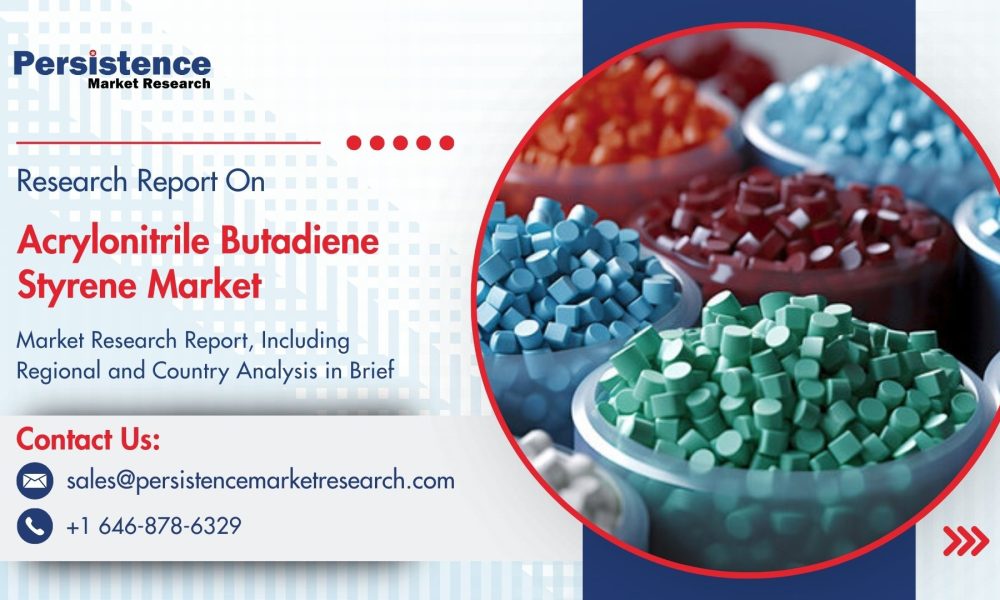
The Acrylonitrile Butadiene Styrene (ABS) market is experiencing significant growth due to increasing demand for durable, lightweight, and impact-resistant plastic materials across multiple industries. ABS is a thermoplastic polymer produced from acrylonitrile, butadiene, and styrene monomers, known for its excellent mechanical strength, heat resistance, and ease of processing. These properties make it widely used in automotive components, consumer electronics, appliances, and construction materials.
According to industry analysis, the global Acrylonitrile Butadiene Styrene (ABS) market is expected to reach around US$ 34.6 billion by 2026 and grow to nearly US$ 53.0 billion by 2033, expanding at a CAGR of approximately 6.3% from 2026 to 2033. The growth is primarily driven by increasing adoption of lightweight materials in automotive manufacturing and the rapid expansion of consumer electronics production.
Get Your FREE Sample Report Instantly – Click Now: https://www.persistencemarketresearch.com/samples/34877
Market Overview
Acrylonitrile Butadiene Styrene is one of the most versatile engineering plastics used in modern manufacturing. It combines the chemical resistance of acrylonitrile, the toughness of butadiene, and the processability of styrene, resulting in a material that offers durability, impact resistance, and excellent surface finish.
The material is widely used in manufacturing products such as automotive interior components, protective casings for electronics, appliance housings, pipes and fittings, toys, and 3D-printing filaments. ABS also offers strong dimensional stability and resistance to physical stress, making it suitable for demanding industrial applications.
Increasing industrialization, technological advancements, and rising demand for durable plastic components are driving the global expansion of the ABS market. At the same time, manufacturers are focusing on developing recyclable and bio-based ABS formulations to address sustainability concerns and regulatory requirements.
Key Market Drivers
Rising Demand from Automotive Industry
One of the most important growth drivers for the ABS market is the rising use of lightweight materials in the automotive sector. Automakers are increasingly replacing metal components with engineering plastics to reduce vehicle weight and improve fuel efficiency.
ABS provides an excellent balance of strength, durability, and lightweight properties, making it ideal for automotive interior parts such as dashboards, door panels, seat backs, and instrument clusters. It is also used in exterior components and protective housings.
With the global shift toward electric vehicles (EVs), demand for ABS is expected to increase further. Electric vehicles require lightweight materials to improve energy efficiency and battery performance. ABS is widely used in EV battery housings, charging components, and thermal management systems, making it an essential material for next-generation vehicles.
Expansion of Consumer Electronics Industry
The consumer electronics industry is another major contributor to the growth of the ABS market. ABS plastic is widely used in manufacturing protective casings and structural components for products such as smartphones, laptops, televisions, gaming consoles, and wearable devices.
Manufacturers prefer ABS because it offers high impact strength, excellent surface finish, and ease of molding into complex shapes. It also allows manufacturers to create aesthetically appealing designs while maintaining product durability.
The increasing adoption of smart home devices, Internet of Things (IoT) products, and portable electronic gadgets is significantly boosting the demand for ABS materials. As consumer electronics production continues to grow globally, the need for high-performance plastic materials is expected to increase steadily.
Growing Demand from Construction Sector
The construction industry is another key end-use sector driving ABS market growth. ABS is commonly used in plumbing systems, pipes, fittings, cable conduits, and building components due to its durability and resistance to corrosion.
Rapid urbanization and infrastructure development in emerging economies such as India, China, and Southeast Asia are increasing the demand for high-quality construction materials. ABS is also used in renewable energy infrastructure such as solar panel mounts and wind turbine housings.
As governments invest heavily in smart city projects and modern infrastructure, demand for ABS-based construction materials is expected to increase over the coming years.
Market Restraints
Environmental Regulations and Plastic Waste Concerns
Despite strong growth prospects, the ABS market faces challenges due to increasing environmental concerns regarding plastic waste. Governments around the world are introducing regulations to reduce plastic pollution and promote recycling.
For example, several regulatory frameworks require plastic products to include a certain percentage of recycled content. These policies are forcing manufacturers to invest in advanced recycling technologies and sustainable plastic formulations.
In addition, rising consumer awareness about environmental sustainability is encouraging companies to explore alternative materials and develop eco-friendly plastic solutions. These factors could slightly restrain the growth of conventional ABS materials in some regions.
Product Type Insights
Based on product type, the ABS market includes various categories such as:
- Opaque ABS
- Transparent ABS
- Colored ABS
Among these, opaque ABS holds the largest market share of around 40%. This segment is widely used in automotive interiors, household appliances, and industrial equipment where transparency is not required.
Opaque ABS offers excellent thermal stability, color retention, and surface finish, making it suitable for high-volume manufacturing applications.
Grade Insights
The ABS market is also segmented based on grade, including:
- High Impact ABS
- Flame Retardant ABS
- Heat Resistant ABS
- Electroplatable ABS
High-impact ABS dominates the market with approximately 42% share, mainly due to its superior toughness and mechanical strength. It is commonly used in automotive safety components, electronics casings, and consumer products that require high durability.
Flame-retardant ABS is widely used in electrical equipment and electronic enclosures where fire safety standards must be met.
Technology Insights
The ABS market uses several manufacturing technologies, including:
- Injection molding
- Extrusion
- Blow molding
- Thermoforming
- 3D printing
Injection molding holds the largest market share of about 54% because it allows efficient production of complex plastic components with high precision. This technology is widely used in automotive interiors, electronic device housings, and appliance components.
Meanwhile, 3D printing is emerging as one of the fastest-growing technologies, particularly in prototyping, aerospace, and industrial manufacturing. ABS filaments are commonly used in additive manufacturing due to their dimensional stability and durability.
Regional Analysis
Asia Pacific
Asia Pacific dominates the global ABS market, accounting for more than 33% of total market revenue. The region also hosts nearly 80% of global production capacity, making it the largest production hub for ABS plastics.
China is the largest producer and consumer of ABS, supported by strong manufacturing industries such as automotive, electronics, and appliances. India and Southeast Asian countries are also emerging as key markets due to rapid industrialization and rising consumer demand.
North America
North America is expected to be the fastest-growing regional market due to increasing investments in electric vehicles, advanced manufacturing, and additive manufacturing technologies.
The presence of major automotive manufacturers and electronics companies also contributes to the strong demand for ABS materials in the region.
Europe
Europe represents a mature but technologically advanced market for ABS plastics. The region focuses heavily on sustainability and recycling initiatives, which has encouraged the development of bio-based and recycled ABS materials.
Strict environmental regulations are driving innovation in sustainable polymer technologies across European manufacturing industries.
Competitive Landscape
The global ABS market is moderately consolidated, with several large chemical companies dominating the industry.
Key Market Players
Major companies operating in the market include:
- LG Chem Ltd.
- Chi Mei Corporation
- INEOS Styrolution
- SABIC
- BASF SE
- Trinseo
- Toray Industries
- Formosa Chemicals & Fibre Corporation
These companies focus on product innovation, strategic partnerships, and capacity expansion to strengthen their market positions and meet increasing global demand for engineering plastics.
Get a Customized Market View in One Click: https://www.persistencemarketresearch.com/request-customization/34877
Future Opportunities
One of the most promising opportunities in the ABS market is the development of bio-based and recyclable ABS materials. As sustainability becomes a priority for manufacturers and consumers, companies are investing in environmentally friendly polymer technologies.
The rapid expansion of 3D printing, electric vehicles, and smart electronics is also expected to create new growth opportunities for ABS manufacturers.
Furthermore, increasing industrialization in emerging economies will continue to drive demand for durable plastic materials across automotive, construction, and consumer goods sectors.
Conclusion
The Acrylonitrile Butadiene Styrene market is poised for steady expansion over the next decade, supported by strong demand from automotive, electronics, and construction industries. With its excellent durability, impact resistance, and processability, ABS remains one of the most widely used engineering plastics worldwide.
Although environmental regulations and plastic waste concerns present challenges, advancements in recycling technologies and sustainable polymer development are expected to support long-term market growth. As industries continue to adopt lightweight and high-performance materials, ABS will remain a key component in modern manufacturing.
About Persistence Market Research:
Persistence Market Research delivers strategic research solutions that drive business growth. Founded in 2012 and registered in England and Wales in 2023 as Persistence Research & Consultancy Services Ltd., we have completed 3,600+ custom and syndicated studies and supported 2,700+ projects for leading research firms. Combining traditional methodologies with modern tools, we provide actionable insights to multinational corporations, consultants, investors, and government bodies, earning strong trust through long-term client relationships.
Contact Us:
Persistence Market Research
Second Floor, 150 Fleet Street,
London, EC4A 2DQ, United Kingdom
USA Phone: +1 646-878-6329
UK Phone: +44 203-837-5656
Email: [email protected]
Web: https://www.persistencemarketresearch.com




