

Steam Turbine Market Overview
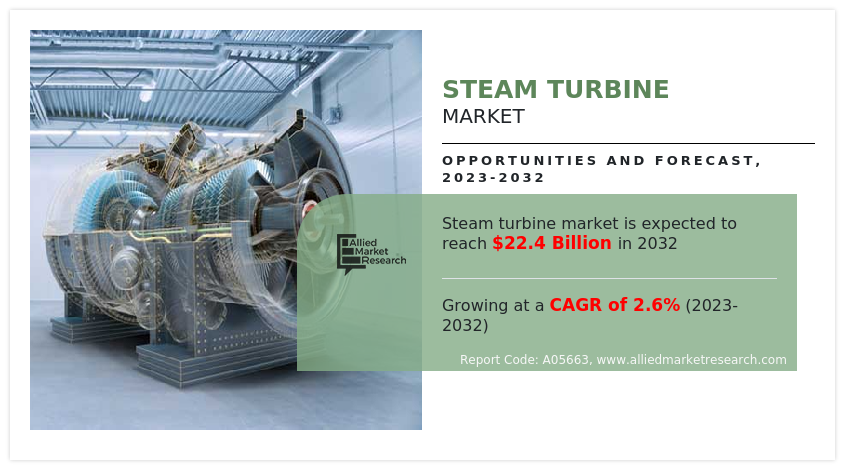
According to a new report published by Allied Market Research, the global Steam Turbine Market size was valued at $17.5 billion in 2022 and is projected to reach $22.4 billion by 2032, growing at a CAGR of 2.6% from 2023 to 2032. The steady increase in electricity consumption, expansion of thermal power plants, and industrial growth across emerging economies are key factors driving the Steam Turbine Market worldwide.
What Is a Steam Turbine?
A steam turbine is a mechanical device that converts thermal energy into mechanical energy and subsequently into electrical energy. It operates by heating water using energy sources such as coal, natural gas, nuclear power, or solar thermal energy until it becomes high-pressure steam. As the steam passes through turbine blades, it expands and cools, causing the blades to rotate.
This rotational motion drives a generator to produce electricity, making steam turbines a critical component of power generation systems. Their efficiency and reliability have made them indispensable in thermal, nuclear, and industrial power plants.
Download PDF Brochure: https://www.alliedmarketresearch.com/request-sample/6028
Key Drivers of Market Growth
One of the primary drivers of the Steam Turbine Market is the rising demand for electricity across the globe. Rapid urbanization, industrialization, and population growth—especially in developing countries—have significantly increased power consumption.
Governments and private companies are investing heavily in expanding power infrastructure to bridge the gap between electricity demand and supply. The development of new thermal power projects and modernization of existing plants are expected to boost demand for steam turbines during the forecast period.
Additionally, the oil & gas and petrochemical industries rely on steam turbines for mechanical drive applications such as compressors and pumps. Growing energy requirements in these sectors further support market expansion.
Impact of Energy Policies and Fuel Transition
Regulatory policies promoting cleaner fuels such as natural gas and biomass are also influencing the Steam Turbine Market. Compared to coal, these fuels produce lower emissions, enabling countries to balance energy security with environmental commitments.
However, stringent regulations aimed at reducing dependence on fossil fuels and accelerating the transition to renewable energy sources present a challenge. The declining cost of solar and wind technologies has led to increased adoption of renewable energy, which can limit the growth of conventional thermal power equipment.
Despite this, steam turbines remain essential in combined-cycle power plants, nuclear facilities, and industrial cogeneration systems, ensuring continued demand.
Technological Advancements and Efficiency Improvements
Technological innovation is another important factor shaping the Steam Turbine Market. Manufacturers are focusing on improving efficiency, durability, and operational flexibility through advanced materials and design enhancements.
High-efficiency turbines help reduce fuel consumption and emissions, making them attractive for modern power plants. Moreover, the growing interest in cogeneration (combined heat and power) systems—particularly in industries such as sugar and steel—has created additional opportunities.
Cogeneration plants utilize steam turbines to produce electricity while capturing waste heat for industrial processes, significantly improving overall energy efficiency.
Market Segmentation by Design
Based on design, the market is divided into impulse and reaction turbines.
The impulse segment dominated the market in 2022 and is expected to grow steadily due to its suitability for high-pressure applications. Reaction turbines are also gaining traction because of their high efficiency and lower noise levels, making them ideal for large-scale power generation.
As electricity demand continues to rise, both turbine types are expected to play vital roles in new and upgraded power facilities.
End-Use Industry Analysis
By end-use industry, the Steam Turbine Market is segmented into power generation, petrochemical, oil & gas, and others.
The power generation segment accounted for the largest market share in 2022 and is projected to maintain its dominance. Steam turbines are central to thermal, nuclear, and large-scale industrial power plants, ensuring stable baseload electricity supply.
According to the Central Electricity Authority, power generation from thermal, hydro, and nuclear plants remains a major contributor to global electricity supply. As energy demand grows, the need for reliable generation technologies such as steam turbines is expected to increase significantly.
Forging Capacity and Component Manufacturing
The market is also segmented based on forging capacity into large forging and ultra-large forging.
Large forging components dominated the market in 2022 and are expected to retain leadership. Critical turbine components such as rotor shafts, casings, blades, and diaphragms require high-strength materials capable of withstanding extreme pressure and temperature.
These components are typically manufactured using specialized alloys, including low-alloy steels and high-temperature materials, ensuring durability and performance over long operating periods.
Regional Insights
Asia-Pacific held the largest share of the Steam Turbine Market in 2022 and is anticipated to maintain its leadership through 2032. Rapid industrialization, expanding power infrastructure, and abundant fossil fuel resources in countries such as China and India are major growth drivers.
Governments in the region are investing in large-scale power plants to meet rising electricity demand from manufacturing, urban development, and digital infrastructure.
North America and Europe also represent significant markets, driven by modernization of aging power plants, investments in nuclear energy, and industrial applications.
Steam Turbine Market Competitive Landscape
The global Steam Turbine Market is highly competitive, with several leading manufacturers focusing on innovation, partnerships, and expansion strategies. Key players include General Electric, Siemens AG, Toshiba Corporation, Mitsubishi Power, Doosan Škoda Power, Elliott Group, TURBOCAM, Triveni Turbines, Chola Turbo Machinery International, and Arani Power Systems.
These companies are adopting strategies such as mergers, acquisitions, facility expansions, and new product launches to strengthen their market position. For example, Mitsubishi Hitachi Power Systems expanded service operations in Southeast Asia to support regional power generation facilities.
Get a Customized Research Report: https://www.alliedmarketresearch.com/request-for-customization/6028
Steam Turbine Market Future Outlook
Although renewable energy is growing rapidly, steam turbines will continue to play a crucial role in global energy systems. They provide reliable baseload power, support industrial processes, and integrate with advanced technologies such as combined-cycle plants and cogeneration systems.
Increasing electricity demand, infrastructure development, and modernization of existing power plants are expected to sustain steady growth in the Steam Turbine Market over the next decade.
Conclusion
The global Steam Turbine Market is poised for stable expansion through 2032, driven by rising energy consumption, industrial growth, and investments in power infrastructure. While environmental regulations and renewable energy competition present challenges, technological advancements and continued demand for reliable electricity generation ensure a positive long-term outlook.
As countries strive to balance energy security with sustainability, steam turbines will remain a vital component of modern power systems worldwide.
Other Trending Reports:-
About Us
Allied Market Research (AMR) is a full-service market research and business-consulting wing of Allied Analytics LLP based in Portland, Oregon. Allied Market Research provides global enterprises as well as medium and small businesses with unmatched quality of “Market Research Reports” and “Business Intelligence Solutions.” AMR has a targeted view to provide business insights and consulting to assist its clients to make strategic business decisions and achieve sustainable growth in their respective market domain.
Pawan Kumar, the CEO of Allied Market Research, is leading the organization toward providing high-quality data and insights. We are in professional corporate relations with various companies and this helps us in digging out market data that helps us generate accurate research data tables and confirms utmost accuracy in our market forecasting. Each and every data presented in the reports published by us is extracted through primary interviews with top officials from leading companies of domain concerned. Our secondary data procurement methodology includes deep online and offline research and discussion with knowledgeable professionals and analysts in the industry.




