

Hydrogen Infrastructure Market Overview
According to a new report published by Allied Market Research, the Hydrogen Infrastructure Market size was valued at $4.9 billion in 2022 and is projected to reach $13.5 billion by 2032, growing at a CAGR of 10% from 2023 to 2032. The rising demand for sustainable energy systems, increasing investments in hydrogen production technologies, and supportive government policies are major factors driving the expansion of the Hydrogen Infrastructure Market globally.
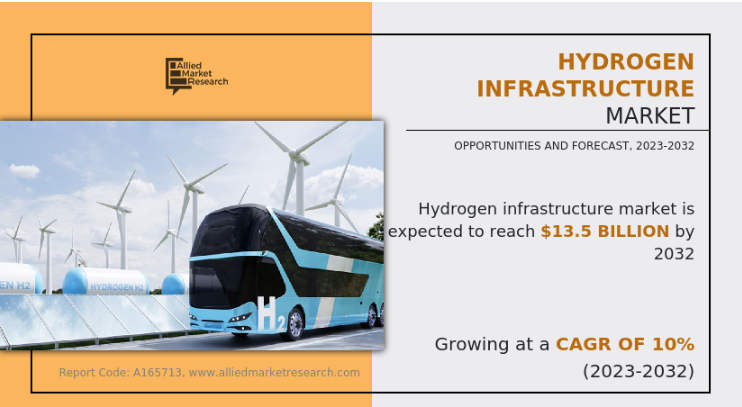
Understanding Hydrogen Infrastructure
Hydrogen infrastructure refers to the integrated network of technologies, facilities, and systems required to support hydrogen’s complete lifecycle as an energy carrier. This includes hydrogen production, storage, transportation, distribution, and end-use applications.
Hydrogen production involves generating hydrogen gas through several methods such as steam methane reforming, electrolysis, and biomass gasification. Among these technologies, steam methane reforming has historically been the most widely used due to its cost efficiency and established infrastructure.
Download PDF Brochure: https://www.alliedmarketresearch.com/request-sample/166197
Hydrogen storage is another essential component of the infrastructure ecosystem. Because hydrogen has a low volumetric energy density, specialized storage technologies such as compression and liquefaction are required to store and transport it efficiently.
Transportation and distribution systems move hydrogen from production facilities to industrial users, fueling stations, and energy networks. Hydrogen can be transported through pipelines, compressed gas trailers, or cryogenic tankers.
Finally, hydrogen utilization includes its use in fuel cells, combustion engines, and industrial applications such as refining and chemical production. The growing adoption of hydrogen fuel cell vehicles and hydrogen-powered transportation systems is expected to create significant opportunities within the Hydrogen Infrastructure Market.
Role of Hydrogen in the Clean Energy Transition
Hydrogen is increasingly recognized as a key component of the global energy transition. As governments and industries aim to reduce greenhouse gas emissions, hydrogen offers a promising alternative to conventional fossil fuels.
Hydrogen can be used as a zero-emission fuel when produced from renewable energy sources through electrolysis. This process, often referred to as green hydrogen production, uses renewable electricity to split water molecules into hydrogen and oxygen.
Green hydrogen plays a crucial role in decarbonizing sectors that are difficult to electrify, such as heavy industry, aviation, shipping, and long-distance transportation. These advantages are strengthening the long-term growth prospects of the Hydrogen Infrastructure Market.
Market Drivers
One of the major drivers supporting the growth of the Hydrogen Infrastructure Market is the increasing adoption of hydrogen-powered transportation. Hydrogen fueling stations are essential for supplying hydrogen fuel to fuel-cell electric vehicles (FCEVs), buses, trucks, and trains.
Governments worldwide are investing in hydrogen refueling infrastructure to support the expansion of hydrogen mobility solutions. The transportation sector represents one of the most promising applications for hydrogen energy due to its ability to deliver long driving ranges and quick refueling times.
In addition, hydrogen is widely used in industrial processes such as ammonia production, petroleum refining, and chemical manufacturing. The increasing use of hydrogen in these sectors is contributing to the demand for improved infrastructure systems.
Furthermore, the expansion of renewable energy capacity is creating opportunities for hydrogen production and storage. Hydrogen can serve as an energy storage medium that captures surplus renewable energy during periods of high production and releases it when demand increases.
Market Segmentation
The Hydrogen Infrastructure Market is segmented based on production method, storage technology, delivery method, and region.
By Production
Based on production method, the market is categorized into steam methane reforming, coal gasification, electrolysis, and others.
The steam methane reforming segment currently dominates the market due to its widespread industrial adoption and cost-effectiveness. However, the electrolysis segment is expected to grow rapidly during the forecast period as renewable energy technologies become more accessible and governments promote green hydrogen production.
By Storage
Based on storage technology, the market is segmented into compression, liquefaction, and material-based storage.
The compression segment accounted for the largest share of the Hydrogen Infrastructure Market and is expected to maintain its dominance during the forecast period. Compressed hydrogen storage systems are widely used due to their practicality and relatively lower cost compared to other storage technologies.
By Delivery
Based on delivery methods, the market is divided into transportation, refinery, power generation, and hydrogen refueling stations.
The transportation segment accounted for the largest market share in 2022 and is expected to grow at a strong rate during the forecast period. Hydrogen is increasingly used as a clean transportation fuel, particularly in heavy-duty vehicles and public transportation systems.
Regional Insights
Regionally, the Hydrogen Infrastructure Market is analyzed across North America, Europe, Asia-Pacific, and LAMEA.
North America held a significant market share in 2022 due to strong investments in hydrogen energy research and infrastructure development.
However, the Asia-Pacific region is expected to experience the fastest growth during the forecast period. Countries such as China, Japan, South Korea, and India are investing heavily in hydrogen production technologies and refueling infrastructure.
For example, the government of India has introduced the National Hydrogen Energy Mission to accelerate hydrogen production and infrastructure development across the country.
Similarly, Australia is actively investing in renewable hydrogen production and export projects due to its abundant renewable energy resources.
In France and across the European Union, government initiatives are supporting the expansion of hydrogen infrastructure to achieve long-term climate goals.
Global Hydrogen Initiatives
Several global initiatives are promoting hydrogen development and strengthening the Hydrogen Infrastructure Market.
The European Hydrogen Backbone project aims to establish a large-scale hydrogen pipeline network across Europe, enabling efficient hydrogen transport between regions.
The European Green Deal also highlights hydrogen as a key element in achieving carbon neutrality by 2050.
In addition, the H2@Scale initiative in the United States aims to accelerate the adoption of hydrogen technologies across multiple sectors.
These programs are expected to create a strong policy framework supporting the long-term growth of the Hydrogen Infrastructure Market.
Get a Customized Research Report: https://www.alliedmarketresearch.com/request-for-customization/A165713
Competitive Landscape
Major companies operating in the Hydrogen Infrastructure Market include Air Liquide, Linde plc, Nel Hydrogen, Plug Power, Shell plc, ITM Power, Ballard Power Systems, McPhy Energy, Cummins Inc., and Engie.
These companies are investing in hydrogen technologies, forming strategic partnerships, and expanding their hydrogen infrastructure projects to strengthen their global presence.
Conclusion
The Hydrogen Infrastructure Market is poised for strong growth as the global energy landscape shifts toward low-carbon and renewable energy systems. Increasing government initiatives, expanding hydrogen mobility solutions, and rising investments in green hydrogen technologies are key factors shaping the future of the market. As countries accelerate their efforts to build hydrogen ecosystems and achieve climate goals, the Hydrogen Infrastructure Market will play a vital role in enabling the transition to a sustainable and carbon-neutral energy future.
Other Trending Reports:-
About Us
Allied Market Research (AMR) is a full-service market research and business-consulting wing of Allied Analytics LLP based in Portland, Oregon. Allied Market Research provides global enterprises as well as medium and small businesses with unmatched quality of “Market Research Reports” and “Business Intelligence Solutions.” AMR has a targeted view to provide business insights and consulting to assist its clients to make strategic business decisions and achieve sustainable growth in their respective market domain.
Pawan Kumar, the CEO of Allied Market Research, is leading the organization toward providing high-quality data and insights. We are in professional corporate relations with various companies and this helps us in digging out market data that helps us generate accurate research data tables and confirms utmost accuracy in our market forecasting. Each and every data presented in the reports published by us is extracted through primary interviews with top officials from leading companies of domain concerned. Our secondary data procurement methodology includes deep online and offline research and discussion with knowledgeable professionals and analysts in the industry.




