
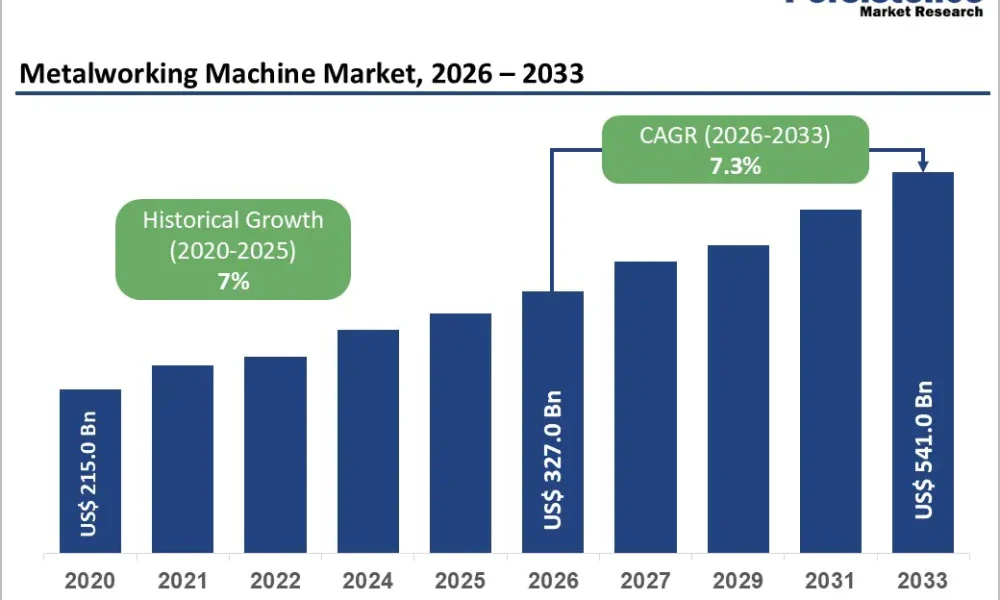
The metalworking machine market is witnessing strong growth as industrial sectors globally focus on enhancing manufacturing efficiency, precision, and throughput. According to recent estimates, the global metalworking machine market is likely to be valued at US$ 327.0 billion in 2026 and is projected to reach US$ 541.0 billion by 2033, growing at a compound annual growth rate (CAGR) of 7.3% during the forecast period. Metalworking machines—including lathes, milling machines, drilling machines, grinding machines, and cutting tools—play a critical role in shaping, forming, and processing metal components used across multiple industries. The increasing adoption of computer numerical control (CNC) machines, advanced machining centers, and automated metalworking equipment is revolutionizing production processes, enabling manufacturers to deliver high-precision components efficiently while reducing labor costs and material wastage.
The market’s growth is largely fueled by industrial expansion in automotive, aerospace, energy, and heavy machinery sectors, coupled with a rise in electric vehicle (EV) production and aircraft manufacturing. CNC machines and advanced machining centers are in high demand due to their ability to produce complex metal parts with high accuracy and repeatability. Among the product segments, CNC machining centers represent the leading segment, owing to their versatility, automation capability, and widespread application across multiple manufacturing industries. Geographically, Asia Pacific dominates the global metalworking machine market, driven by rapid industrialization, the presence of leading automotive and electronics manufacturers, and significant investments in domestic manufacturing infrastructure. Countries like China, Japan, South Korea, and India are expanding industrial capacities and modernizing production lines, which is further boosting the adoption of advanced metalworking equipment.
Key Highlights from the Report
• The global metalworking machine market is projected to grow at a CAGR of 7.3% between 2026 and 2033.
• CNC machining centers dominate the market due to their automation and precision capabilities.
• Rising automotive and aerospace manufacturing is a key driver for equipment demand.
• Asia Pacific leads the market with extensive industrialization and manufacturing investments.
• Technological advancements in robotics, AI, and IoT are enhancing metalworking efficiency.
• Increasing EV production and industrial modernization are fueling global market expansion.
𝐆𝐞𝐭 𝐚 𝐒𝐧𝐞𝐚𝐤 𝐏𝐞𝐞𝐤, 𝐒𝐚𝐦𝐩𝐥𝐞 𝐏𝐃𝐅 𝐈𝐧𝐬𝐢𝐝𝐞: https://www.persistencemarketresearch.com/samples/6799
Market Segmentation
The metalworking machine market can be segmented based on product type, end-user industry, and system capabilities. By product type, the market comprises CNC machining centers, lathes, milling machines, grinding machines, drilling machines, cutting tools, forming machines, and laser/EDM machines. Among these, CNC machining centers are leading due to their ability to automate complex tasks, improve precision, and reduce production cycle times. Grinding and cutting tools are essential for finishing operations, while forming and punching machines support shaping processes for heavy-duty industrial components. The growing emphasis on automation and high-speed production has further accelerated the adoption of integrated machining solutions that combine multiple operations in a single setup.
From an end-user perspective, the market serves industries such as automotive, aerospace, energy, heavy machinery, electronics, and general industrial manufacturing. The automotive sector is the largest consumer of metalworking machines, driven by the rising production of vehicles—including electric and hybrid models—which require precision-engineered metal components. Aerospace manufacturing is another key driver, as aircraft components demand highly precise machining and strict quality control. Energy and heavy machinery industries also contribute significantly to market growth, as turbine components, industrial equipment, and infrastructure hardware rely heavily on metalworking solutions for durability and performance.
Regional Insights
Asia Pacific is the leading region in the metalworking machine market, driven by rapid industrialization, expansion of automotive manufacturing, and government initiatives to strengthen domestic production capabilities. China, Japan, South Korea, and India are investing in state-of-the-art metalworking facilities, adopting advanced CNC platforms, and modernizing traditional machining operations. The region’s emphasis on industrial automation, cost-effective labor, and large-scale production further reinforces its market dominance.
North America is a mature market, with growth driven by advanced aerospace manufacturing, EV production, and ongoing modernization of industrial plants. The United States is witnessing increasing demand for high-precision metalworking machines to produce complex automotive and aerospace components efficiently. Europe also remains significant, supported by its strong industrial base, aerospace and defense manufacturing, and adoption of smart factory technologies. Germany, France, and Italy are investing in automation and robotic-assisted machining to enhance productivity.
Latin America and the Middle East & Africa are emerging markets, where industrial growth, infrastructure development, and manufacturing expansion are gradually boosting the adoption of metalworking machines. However, slower modernization rates and limited access to advanced CNC technology present challenges compared to developed regions.
𝐆𝐞𝐭 𝐚 𝐂𝐮𝐬𝐭𝐨𝐦𝐢𝐳𝐞𝐝 𝐌𝐚𝐫𝐤𝐞𝐭 𝐕𝐢𝐞𝐰 𝐢𝐧 𝐎𝐧𝐞 𝐂𝐥𝐢𝐜𝐤 : https://www.persistencemarketresearch.com/request-customization/6799
Market Drivers
The growth of the metalworking machine market is primarily driven by the increasing demand from automotive and aerospace industries. Rising electric vehicle production and the ongoing development of aircraft manufacturing facilities require high-precision metal components, making advanced machining centers and CNC platforms critical. Manufacturers are upgrading production lines to improve throughput, reduce cycle times, and enhance operational efficiency, which is creating consistent demand for metalworking equipment.
Additionally, industrial modernization and automation initiatives are accelerating market growth. Robotics, artificial intelligence, and IoT-enabled machining systems are enabling manufacturers to achieve higher productivity, improved accuracy, and lower operational costs. The expansion of industrial infrastructure in emerging economies is also supporting equipment replacement cycles and new installations, further bolstering the market.
Market Restraints
Despite strong growth, the metalworking machine market faces challenges. One of the main restraints is the high capital investment required for advanced machinery, particularly CNC machines and automated systems. Smaller manufacturers and SMEs may find the cost of acquisition and maintenance prohibitive, limiting adoption in certain regions.
Another challenge is the complexity of machine operation and maintenance, which requires skilled personnel. Improper handling or insufficient training can result in equipment downtime, production delays, and increased operational costs. Additionally, rapidly evolving metalworking technologies may require frequent upgrades, posing challenges for manufacturers in maintaining competitiveness.
Market Opportunities
The metalworking machine market offers significant opportunities in the emerging field of automation and smart manufacturing. Adoption of robotic-assisted machining, AI-driven quality control, and real-time process monitoring is enhancing production efficiency and reducing errors. Companies that develop integrated metalworking solutions with predictive maintenance and remote monitoring capabilities can capitalize on this trend.
Another opportunity lies in next-generation electric vehicle and aerospace manufacturing, where precision, high-speed, and multi-axis machining are in high demand. Growth in industrial infrastructure investments across Asia Pacific and emerging economies provides further potential for market expansion. Additionally, the push for energy-efficient and sustainable metalworking operations is creating demand for machines that optimize energy consumption while maintaining high productivity.
𝐁𝐮𝐲 𝐍𝐨𝐰 𝐭𝐡𝐞 𝐃𝐞𝐭𝐚𝐢𝐥𝐞𝐝 𝐑𝐞𝐩𝐨𝐫𝐭: https://www.persistencemarketresearch.com/checkout/6799
Company Insights
The metalworking machine market is highly competitive, with leading global and regional players focusing on product innovation, technology integration, and expansion into emerging markets. Key players are investing in CNC technology, robotic automation, and smart manufacturing solutions to strengthen market position.
• DMG Mori AG
• Makino Milling Machine Co., Ltd.
• Haas Automation, Inc.
• Okuma Corporation
• Mazak Corporation
• Doosan Machine Tools Co., Ltd.
• Amada Co., Ltd.
• Trumpf GmbH + Co. KG
• Hurco Companies, Inc.
• Hyundai Wia Corporation
Recent developments highlight technological advancements and strategic expansions. Several companies have launched multi-axis CNC machining centers capable of handling complex components with high precision, particularly for automotive and aerospace sectors. In addition, manufacturers are increasingly integrating AI and IoT-enabled solutions to provide real-time monitoring, predictive maintenance, and enhanced operational efficiency for industrial clients.
Conclusion
The global metalworking machine market is set for strong growth, with projections indicating an increase from US$ 327.0 billion in 2026 to US$ 541.0 billion by 2033, reflecting a CAGR of 7.3%. This growth is anchored in the essential role that metalworking machines play across automotive, aerospace, energy, and industrial manufacturing sectors. Rising demand for precision-engineered components, coupled with the adoption of CNC and automated machining centers, is driving investment in advanced metalworking equipment. Industrial modernization, expansion of EV production, and aerospace manufacturing are further fueling market demand, particularly in Asia Pacific. With ongoing innovations in automation, AI integration, and sustainable machining practices, the metalworking machine market is poised to remain a critical enabler of industrial productivity, precision, and global manufacturing competitiveness.




