
The global packaged LED market is witnessing steady expansion as industries increasingly shift toward energy-efficient lighting technologies and advanced display solutions. Light Emitting Diodes (LEDs) have revolutionized the lighting industry over the past decade, replacing conventional incandescent and fluorescent lighting with highly efficient and long-lasting alternatives. Packaged LEDs, which integrate the LED chip with protective housing and thermal management components, serve as the fundamental building blocks for a wide range of lighting and electronic applications.
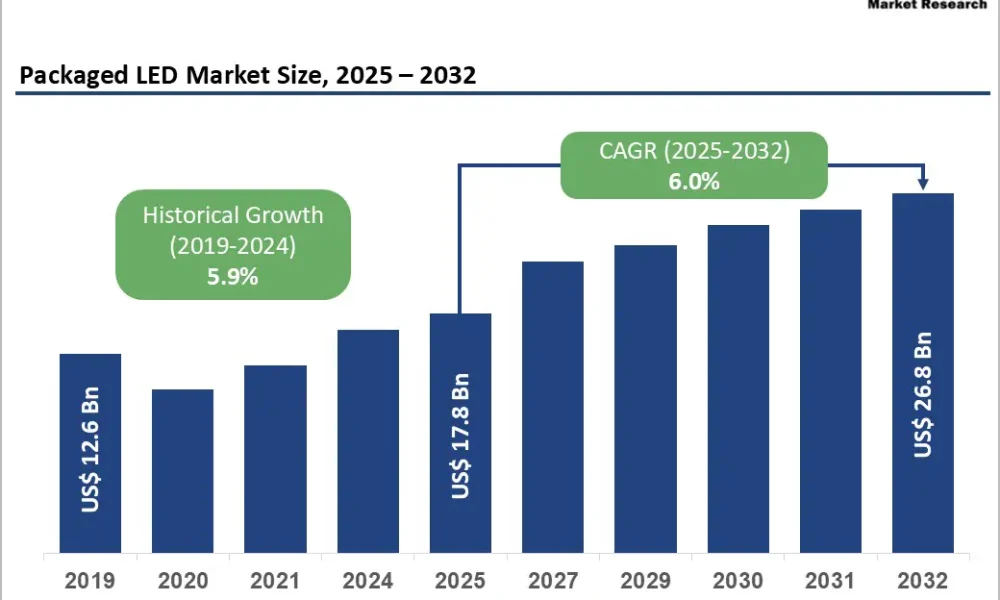
The global packaged LED market is expected to be valued at US$17.8 billion in 2025 and projected to reach US$26.8 billion by 2032, growing at a compound annual growth rate (CAGR) of 6.0% during the forecast period from 2025 to 2032. Market expansion is primarily driven by increasing demand for energy-efficient lighting systems, rapid advancements in miniaturized LED packaging technologies such as chip-scale packages (CSP) and chip-on-board (COB), and rising adoption across applications including smart lighting, automotive illumination, mini-LED displays, and industrial lighting systems.
Government initiatives promoting energy-efficient lighting, growing investments in smart city infrastructure, and the rapid adoption of LEDs in electric vehicles (EVs) and advanced display technologies are further supporting the long-term growth trajectory of the packaged LED industry.
Rising Demand for Energy-Efficient Lighting
One of the most important factors driving the growth of the packaged LED market is the increasing global emphasis on energy efficiency. Governments and environmental organizations worldwide are promoting the transition from traditional lighting systems to LED-based solutions to reduce electricity consumption and greenhouse gas emissions.
LED lighting systems consume significantly less energy compared to incandescent and fluorescent lights while delivering superior brightness and longevity. In addition, LEDs have a lifespan that can exceed 50,000 hours, reducing maintenance costs and replacement frequency.
These advantages have accelerated LED adoption in residential, commercial, and industrial sectors. Large-scale lighting retrofit programs in commercial buildings, warehouses, and public infrastructure are creating substantial demand for packaged LEDs.
Energy efficiency regulations and sustainability initiatives are particularly strong drivers in developed regions such as North America and Europe. At the same time, emerging economies are adopting LED technology as part of national energy conservation strategies, further expanding the market.
Technological Advancements and Miniaturization
Technological innovation and miniaturization are playing a transformative role in the packaged LED market. Continuous improvements in semiconductor materials, packaging architectures, and thermal management technologies are enabling LEDs to deliver higher performance in smaller form factors.
Innovations such as chip-scale packaging (CSP), flip-chip architectures, and advanced phosphor materials have significantly improved luminous efficiency, color consistency, and thermal stability. These technologies allow manufacturers to produce compact LED packages with higher brightness and improved reliability.
Wafer-level packaging techniques are also reducing the size of LED packages while enhancing electrical and thermal performance. These developments are enabling higher current densities and more efficient heat dissipation, making LEDs suitable for demanding applications such as automotive lighting and industrial illumination.
Miniaturization is particularly important in display technologies. Mini-LED and micro-LED displays rely on ultra-small packaged LEDs to deliver exceptional brightness, contrast, and color accuracy. These displays are increasingly being used in televisions, gaming monitors, laptops, and smartphones.
Beyond displays, miniaturized LEDs are finding applications in wearable electronics, medical devices, optical sensors, and advanced imaging systems where space efficiency and precision lighting are essential.
Smart Lighting and IoT Integration
The rapid emergence of smart lighting systems is creating new growth opportunities for the packaged LED market. Smart lighting combines LED technology with sensors, wireless communication modules, and automation platforms to deliver intelligent and energy-efficient lighting environments.
IoT-enabled lighting systems can automatically adjust brightness levels based on occupancy, daylight availability, or user preferences. These systems also enable remote monitoring, predictive maintenance, and centralized energy management.
Smart lighting solutions are increasingly being deployed in commercial buildings, corporate campuses, retail environments, warehouses, and urban infrastructure projects. Municipal governments are investing heavily in smart street lighting systems that integrate sensors and communication networks for improved energy management and public safety.
The integration of LEDs with IoT technologies is expanding their functionality beyond illumination. Modern LED systems can serve as data transmission nodes within smart building ecosystems, supporting advanced applications such as environmental monitoring and indoor positioning.
As smart city initiatives expand worldwide, the demand for advanced packaged LED solutions capable of supporting intelligent lighting systems is expected to grow significantly.
Elevate your business strategy with comprehensive market data. Request a sample report now: https://www.persistencemarketresearch.com/samples/32843
Market Challenge: Pricing Pressure and Market Saturation
Despite strong demand, the packaged LED industry faces significant challenges related to pricing pressure and market saturation. Over the past decade, rapid expansion of manufacturing capacity—particularly in Asia—has created an oversupply of LED products.
China, which has become one of the largest LED manufacturing hubs globally, has significantly increased production capacity, leading to declining average selling prices for many LED categories. This intense competition has compressed profit margins across the industry.
Market saturation is another challenge in mature lighting segments such as general illumination. In many developed countries, LED penetration is already high, which reduces the growth potential in replacement markets. Because LEDs have long operational lifespans, replacement demand is lower than with traditional lighting technologies.
As a result, manufacturers are increasingly shifting their focus toward high-value segments such as automotive lighting, specialty LEDs, mini-LED displays, and smart lighting solutions. These segments offer higher margins and stronger growth prospects compared to conventional lighting markets.
Packaging Type Insights
Among packaging technologies, Surface-Mount Device (SMD) LEDs dominate the market, accounting for approximately 50% of total revenue in 2025. SMD LEDs are widely used due to their versatility, cost efficiency, and compatibility with automated high-volume manufacturing processes.
These LEDs are commonly deployed in consumer electronics, residential lighting, commercial lighting systems, and display panels. Their compact size, efficient heat dissipation, and stable performance make them suitable for a wide range of applications.
For instance, SMD LEDs are widely used in modern televisions, mobile devices, and LED panel lights. Their widespread use in LED retrofitting projects and general lighting applications continues to reinforce their leading position in the market.
Chip-On-Board (COB) LEDs represent the fastest-growing packaging technology. COB packaging integrates multiple LED chips into a single module, delivering higher light output and improved thermal management.
COB LEDs are commonly used in industrial lighting systems, warehouse high-bay fixtures, automotive headlights, and outdoor floodlights. Their ability to deliver high brightness with uniform light distribution makes them ideal for high-intensity lighting applications.
Chip-scale package (CSP) technology is also gaining momentum due to its compact size and high efficiency, particularly in automotive signaling and mini-LED backlighting applications.
Power Range Analysis
Based on power range, mid-power LEDs (0.5–1 W) dominate the packaged LED market, accounting for more than 45% of total revenue in 2025. These LEDs provide an optimal balance between brightness, energy efficiency, and cost, making them ideal for mainstream lighting applications.
Mid-power LEDs are widely used in residential lighting fixtures, panel lights, downlights, and office illumination systems. Their moderate heat generation and energy efficiency make them suitable for large-scale lighting installations.
However, high-power LEDs (above 1 W) represent the fastest-growing segment. These LEDs are increasingly being adopted in automotive lighting systems, industrial lighting, and outdoor infrastructure.
In automotive applications, high-power LEDs are used in adaptive headlights, daytime running lights (DRLs), and signal lamps. Their ability to produce high luminous flux while maintaining durability under extreme conditions makes them ideal for vehicle lighting systems.
Similarly, outdoor lighting applications such as street lights, stadium lighting, and architectural illumination are increasingly adopting high-power LED modules to achieve brighter and more energy-efficient lighting solutions.
Application Insights
General lighting remains the largest application segment, accounting for approximately 38% of market revenue in 2025. The continued replacement of traditional lighting systems with LED technology is the primary driver of this segment.
Residential buildings, commercial facilities, industrial plants, and public infrastructure projects are increasingly adopting LED lighting solutions to reduce energy consumption and operational costs. Government initiatives supporting energy-efficient lighting retrofits further reinforce this trend.
However, automotive lighting is the fastest-growing application segment. The automotive industry is rapidly transitioning from halogen and xenon lighting systems to LED-based lighting technologies.
LEDs offer several advantages in automotive applications, including higher brightness, lower energy consumption, improved durability, and enhanced design flexibility. Modern vehicles increasingly use LED lighting in headlights, taillights, interior ambient lighting, and advanced driver assistance systems (ADAS).
In addition to automotive lighting, digital signage and display applications are emerging as major growth areas. Mini-LED displays and large-format LED panels are being widely adopted in advertising, entertainment venues, and sports stadiums.
Regional Insights
Asia Pacific
Asia Pacific dominates the global packaged LED market, accounting for approximately 68% of total market share. The region benefits from a strong manufacturing ecosystem, cost advantages, and extensive government support for LED technology adoption.
Countries such as China, Japan, South Korea, and Taiwan are home to many leading LED manufacturers and component suppliers. The region also hosts large-scale electronics manufacturing clusters, which drive demand for packaged LEDs in consumer electronics and display technologies.
Rapid urbanization and large-scale smart city initiatives in China and India are further fueling demand for LED lighting systems.
North America
North America is the fastest-growing regional market. Strong government regulations promoting energy efficiency and large-scale LED retrofit programs are driving adoption across residential, commercial, and industrial sectors.
The region is also a major hub for technological innovation and smart lighting development. Increasing adoption of IoT-enabled lighting systems in corporate buildings, smart homes, and municipal infrastructure is creating new opportunities for advanced packaged LED solutions.
Europe
Europe represents another significant market for packaged LEDs. Stringent environmental regulations and sustainability goals are accelerating the transition toward energy-efficient lighting technologies.
The region’s strong automotive manufacturing industry is also contributing to demand for advanced LED lighting systems. Emerging applications in horticulture lighting, medical lighting, and UV-LED technologies are further expanding the market.
Competitive Landscape
The global packaged LED market is moderately fragmented, featuring a mix of multinational corporations and specialized regional manufacturers. Leading companies compete through technological innovation, advanced manufacturing capabilities, and strategic partnerships across the electronics value chain.
Key companies operating in the packaged LED market include:
- Nichia Corporation
- OSRAM Opto Semiconductors
- Lumileds Holding B.V.
- Signify Holding
- Samsung Electronics
- Seoul Semiconductor
- Cree LED
- Lextar Electronics
- Bolb Inc.
These companies invest heavily in research and development to improve LED efficiency, thermal performance, and packaging technologies. Strategic collaborations with automotive manufacturers, display producers, and electronics companies are also strengthening their market positions.
Future Outlook
The packaged LED market is expected to continue its steady growth trajectory as energy efficiency, smart infrastructure, and advanced electronics drive demand for high-performance lighting technologies.
Emerging innovations such as micro-LED displays, smart lighting ecosystems, and AI-enabled building management systems will expand the role of packaged LEDs beyond traditional lighting applications.
As industries continue to prioritize sustainability, energy savings, and intelligent automation, packaged LEDs will remain a critical component in the global transition toward more efficient and connected technologies.
With strong demand across lighting, automotive, display, and industrial applications, the global packaged LED market is poised to remain a vital segment of the semiconductor and electronics industries in the coming decade.
Related Reports:




