
The AI Laptop Market is emerging as a transformative segment within the global computing industry as artificial intelligence becomes deeply embedded into everyday productivity tools. AI-powered laptops integrate dedicated neural processing units (NPUs), advanced machine learning frameworks, and intelligent software optimization to deliver faster on-device AI computing. These systems enable features such as real-time language translation, intelligent power management, AI-driven security monitoring, and adaptive performance tuning. The growing demand for smarter computing devices across enterprises, education, and remote work environments is accelerating adoption worldwide. Organizations increasingly require devices capable of handling AI workloads locally, reducing dependency on cloud infrastructure while enhancing data security and processing speed.
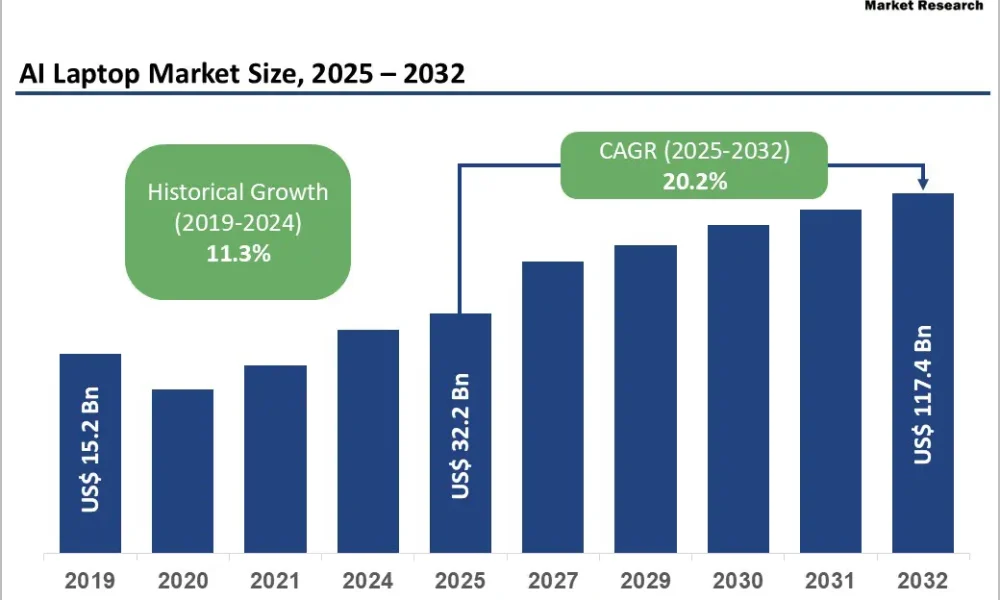
According to Persistence Market Research, the global AI laptop market is expected to reach US$32.2 billion in 2025 and is projected to expand to US$117.4 billion by 2032, registering a CAGR of 20.2% during the forecast period from 2025 to 2032. The rapid expansion of this market is primarily driven by the convergence of enterprise digital transformation initiatives, continuous advancements in neural processing architectures, and the widespread adoption of hybrid work models that require intelligent, high-performance computing devices. AI laptops are increasingly being adopted by enterprises, developers, designers, and data professionals who require devices capable of executing machine learning workloads directly on the device. In terms of market dynamics, AI-enabled premium laptops represent the leading segment due to their high processing capabilities, while North America currently dominates the market owing to strong technology adoption, presence of major hardware manufacturers, and early integration of AI-driven productivity tools across corporate ecosystems.
Download Your Free Sample & Explore Key Insights : https://www.persistencemarketresearch.com/samples/35898
Key Highlights from the Report
➤ The global AI laptop market is expected to reach US$32.2 billion in 2025 and expand to US$117.4 billion by 2032.
➤ The market is projected to grow at a CAGR of 20.2% between 2025 and 2032, reflecting strong demand for AI-enabled personal computing devices.
➤ Increasing enterprise digital transformation initiatives are accelerating the integration of AI-powered computing hardware across industries.
➤ Advancements in neural processing architectures are enabling faster on-device AI computing and improved power efficiency in laptops.
➤ The expansion of hybrid work models is driving demand for intelligent laptops that can support productivity, collaboration, and automation features.
➤ Growing adoption of AI-driven applications such as real-time analytics, smart security, and intelligent performance optimization is shaping the future of the AI laptop market.
Market Segmentation
The AI laptop market can be segmented based on product type, processor architecture, end-user industry, and deployment environment. From a product perspective, the market is largely divided into premium AI laptops and mainstream AI-enabled notebooks. Premium devices equipped with advanced NPUs, high-performance GPUs, and specialized AI chips dominate the market due to their ability to process complex workloads such as data analytics, machine learning model execution, and creative applications like video rendering and design automation. Meanwhile, mid-range AI-enabled laptops are gradually entering the market, offering intelligent performance management and AI-powered features for general consumers and small businesses. As hardware manufacturers continue to integrate AI accelerators directly into processors, the boundary between traditional and AI-enabled laptops is rapidly diminishing.
From an end-user perspective, enterprises represent the largest segment due to their increasing reliance on intelligent computing systems for workflow automation, cybersecurity monitoring, and advanced analytics. The education sector is also witnessing strong adoption as universities and research institutions deploy AI laptops for data science training and AI development projects. Creative professionals, including designers and media producers, are adopting AI-enabled laptops for tasks such as automated editing, image recognition, and generative design. Additionally, independent developers and software engineers are increasingly relying on these devices to test and deploy AI applications locally without constant cloud connectivity, further expanding the potential customer base.
Customize This Report for Your Exact Requirements : https://www.persistencemarketresearch.com/request-customization/35898
Regional Insights
North America continues to lead the AI laptop market due to its strong technology ecosystem, high enterprise digitalization rates, and the presence of leading laptop manufacturers and AI software developers. Businesses in the United States and Canada are rapidly adopting AI-powered computing devices to enhance productivity, automate workflows, and improve cybersecurity capabilities. The region also benefits from strong investment in artificial intelligence research and semiconductor innovation, which accelerates the development of next-generation laptop processors equipped with neural engines.
Asia-Pacific is emerging as a rapidly growing region for AI laptop adoption due to expanding technology infrastructure, increasing demand for advanced computing devices, and the rapid growth of digital economies. Countries such as China, Japan, and South Korea are investing heavily in AI research and semiconductor manufacturing, which is expected to boost production and adoption of AI-enabled computing devices. The rising population of technology professionals and students in the region further strengthens demand for intelligent laptops capable of supporting advanced AI applications and development tools.
Market Drivers
The primary driver fueling the AI laptop market is the increasing demand for enterprise digital transformation across industries. Organizations are rapidly adopting artificial intelligence to automate repetitive tasks, enhance data analytics, and improve operational efficiency. AI-enabled laptops allow employees to run intelligent applications locally, reducing latency and improving productivity. Features such as AI-powered meeting transcription, predictive scheduling, and smart security monitoring are becoming essential productivity tools for modern workplaces.
Another major factor driving the market is the continuous advancement in neural processing architectures. Semiconductor companies are developing specialized AI chips and neural engines designed specifically for on-device machine learning workloads. These processors significantly improve AI performance while maintaining energy efficiency, enabling laptops to execute complex AI algorithms without relying entirely on cloud-based processing. As these technologies become more affordable and widely available, AI laptops are expected to penetrate broader consumer and enterprise segments.
Market Restraints
Despite rapid growth, the AI laptop market faces several challenges that may limit adoption in the short term. One of the key restraints is the high cost of AI-enabled hardware components, including specialized processors and neural accelerators. Advanced AI chips significantly increase manufacturing costs, making these laptops more expensive than traditional devices. For many small businesses and budget-conscious consumers, the price gap remains a major barrier to widespread adoption.
Another challenge involves software optimization and ecosystem maturity. While hardware capabilities are advancing rapidly, many applications are still not fully optimized to utilize on-device AI processing effectively. Developers must adapt software frameworks to take advantage of neural processing units and AI accelerators. Until software ecosystems evolve to fully support these capabilities, some organizations may hesitate to invest in AI laptops due to uncertain performance benefits.
Market Opportunities
The AI laptop market presents substantial opportunities as organizations increasingly seek computing devices capable of handling intelligent workloads independently. One significant opportunity lies in the integration of generative AI tools into everyday productivity software. AI laptops can run generative models locally for tasks such as automated content creation, intelligent coding assistance, and advanced data visualization. This capability reduces reliance on cloud services and improves data privacy for businesses handling sensitive information.
Another promising opportunity is the rapid expansion of hybrid and remote work environments. Employees working across distributed locations require devices that can support real-time collaboration, smart scheduling, and AI-driven productivity enhancements. AI laptops equipped with intelligent noise reduction, camera optimization, and meeting transcription features can significantly improve remote work experiences. As hybrid work becomes a long-term norm for many organizations, the demand for intelligent computing devices is expected to rise substantially.
Get Instant Access – Complete Your Purchase : https://www.persistencemarketresearch.com/checkout/35898
Company Insights
Key players operating in the AI laptop market include:
- Lenovo Group Limited
- HP Inc.
- Dell Technologies Inc.
- Apple Inc.
- ASUSTeK Computer Inc.
- Acer Inc.
- Microsoft Corporation (Surface)
- MSI (Micro-Star International Co., Ltd.)
- Samsung Electronics Co., Ltd.
- LG Electronics Inc.
- Razer Inc.
- Huawei Technologies Co., Ltd.
- Xiaomi Corporation
- HONOR Device Co., Ltd.
- Getac Technology Corporation
January 2025 – Lenovo introduced a new series of AI-enabled laptops equipped with advanced neural processing capabilities designed for enterprise productivity and AI-driven workflows.
September 2024 – HP Inc. launched AI-powered productivity laptops featuring integrated AI accelerators aimed at supporting hybrid work environments and intelligent collaboration tools.
Future Opportunities and Growth Prospects
The future of the AI laptop market looks highly promising as artificial intelligence continues to reshape the personal computing landscape. The increasing integration of AI accelerators into mainstream processors will gradually reduce costs and make AI-powered laptops more accessible to broader user groups. As businesses adopt intelligent automation and advanced analytics, demand for on-device AI computing capabilities will continue to expand.
Additionally, rapid advancements in generative AI, edge computing, and machine learning frameworks are expected to create new use cases for AI-enabled laptops across industries. From software development and data science to content creation and enterprise productivity, these devices will become essential tools for professionals seeking high-performance, intelligent computing systems. With continuous innovation in hardware design and AI software ecosystems, the AI laptop market is poised for strong long-term growth through 2032




