
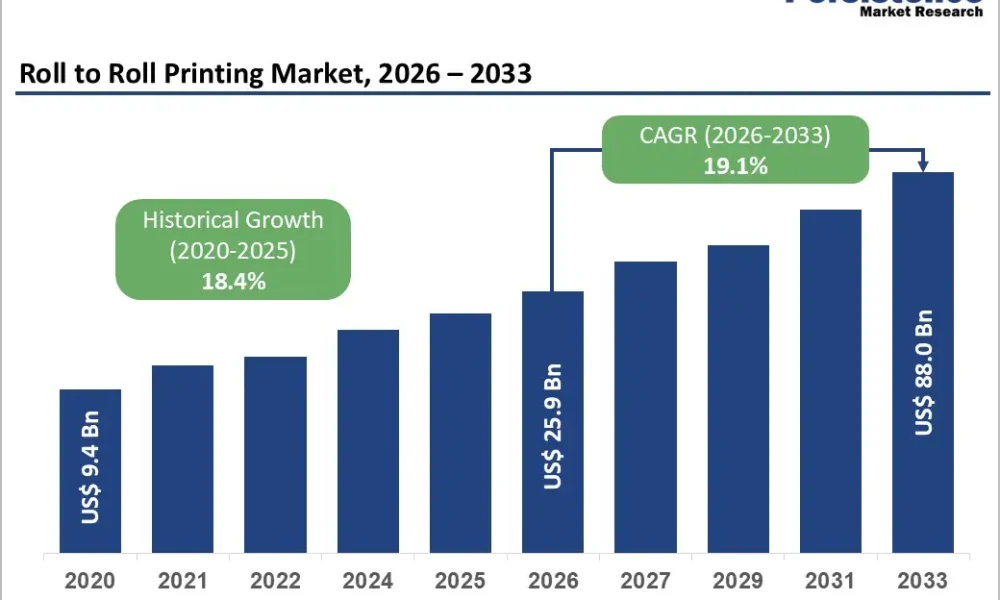
The global roll-to-roll (R2R) printing market is entering a transformative growth phase, projected to expand from US$ 25.9 billion in 2026 to US$ 88.0 billion by 2033, registering a robust CAGR of 19.1% during the forecast period. This remarkable trajectory is fueled by accelerating demand for flexible electronics, foldable displays, wearable healthcare devices, smart packaging, and IoT-enabled components.
Roll-to-roll printing has evolved from a conventional high-volume printing method into a cornerstone technology for advanced electronics manufacturing. By enabling continuous, high-speed processing on flexible substrates, R2R delivers cost efficiency, scalability, reduced material waste, and compatibility with next-generation electronic architectures.
Market Dynamics
- Rapid Expansion of Flexible & Wearable Electronics
Flexible electronics represent the most powerful growth engine for roll-to-roll printing. Foldable OLED smartphones are redefining display design, with global shipments surpassing 23 million units in 2024. Industry leaders such as Samsung Display are scaling production aggressively, including projected supply of nearly 11 million panels for foldable smartphones in 2026.
Wearable healthcare is another major catalyst. The global wearable medical devices market is expanding rapidly, creating strong demand for:
- Flexible printed circuits
- Lightweight conductive traces
- Stretchable sensor arrays
- Conformable electrode layers
Roll-to-roll systems allow high-speed, continuous fabrication of these components on PET, PEN, and polyimide substrates—making advanced wearables commercially viable at scale.
- Sustainability and Regulatory Pressure Driving Adoption
Environmental regulations are accelerating the transition to cleaner manufacturing technologies. In Europe, frameworks such as RoHS, REACH, and extended producer responsibility mandates are pushing OEMs toward:
- Reduced material scrap
- Improved recyclability
- Lower chemical toxicity
- Enhanced product traceability
Roll-to-roll processes can reduce material waste by 30–40% compared to subtractive etching methods. Additionally, advancements in eco-friendly conductive inks—such as carbon-based and bio-derived formulations—support ESG goals across electronics supply chains.
Sustainability is no longer optional; it is becoming a core competitive differentiator.
Market Restraints
High Capital Requirements
Roll-to-roll production lines require advanced web handling, tension control, drying, curing, and multilayer registration systems. Equipment from industry leaders such as:
- BOBST
- Windmöller & Hölscher
- PCMC
often involves multimillion-dollar investments.
Lead times can exceed 24 months due to precision engineering requirements and strong global demand. This creates significant entry barriers for small and mid-sized converters.
Multilayer Alignment and Yield Challenges
Producing OLED displays, RFID antennas, and multilayer flexible circuits requires micrometer-level alignment at high web speeds. Variations in:
- Temperature
- Substrate shrinkage
- Ink viscosity
- Humidity
can cause defects such as open circuits or luminance inconsistencies. Maintaining industrial-grade yields requires substantial investments in inline inspection systems and AI-driven process control.
Emerging Opportunities
- Printed Sensors and RFID in Smart Supply Chains
The rapid digitization of logistics and retail is driving demand for printed RFID and smart labels. Hospitals implementing RFID asset tracking have reported:
- 20–30% inventory cost reductions
- Significant decreases in medication errors
Roll-to-roll printing enables mass production of:
- Printed antennas
- Temperature sensors
- Tamper-evident seals
- Smart packaging electronics
As IoT adoption accelerates globally, R2R printing becomes indispensable for high-volume, low-cost electronics integration.
- Printed Displays: E-Paper and Flexible OLED
E-paper adoption is surging across retail chains deploying electronic shelf labels (ESLs). Meanwhile, foldable and rollable OLED displays are expanding rapidly.
Chinese panel manufacturers such as:
- BOE Technology
- TCL CSOT
- Visionox
are investing heavily in OLED capacity expansion compatible with inkjet and R2R deposition technologies.
This capital infusion reinforces Asia Pacific’s dominance and strengthens the long-term growth outlook.
Category-Wise Analysis
Component Insights
Roll-to-roll printers account for approximately 62% of total component revenue. Screen printing remains essential for thicker conductive layers, while digital inkjet systems are the fastest-growing segment due to:
- Maskless processing
- Fine-line patterning
- Variable data printing
- Rapid prototyping flexibility
Inkjet-based R2R solutions are increasingly preferred for mid-volume and customized electronics production.
Application Insights
Displays lead with 58% market share. Major growth contributors include:
- Foldable smartphones
- Tablets
- AR/VR devices
- Electronic shelf labels
Beyond displays, automotive HMIs and industrial control panels are gaining momentum, integrating flexible circuits and printed sensors into vehicle interiors and automation systems.
Elevate your business strategy with comprehensive market data. Request a sample report now: https://www.persistencemarketresearch.com/samples/32299
Material Insights
Conductive inks represent over 51% of material revenue, with silver inks dominating high-performance applications. However, copper, carbon, and hybrid nanomaterial inks are emerging as cost-efficient alternatives.
Advanced substrates such as:
- Polyimide
- Flexible glass
- Barrier-coated films
are gaining adoption in OLED and high-reliability sensor stacks.
Industry Insights
Consumer Electronics – 48% Share
Smartphones, tablets, wearables, and AR/VR devices remain the largest consumers of R2R-printed components. The shift toward thinner, lighter, and flexible devices directly benefits roll-to-roll manufacturing platforms.
Healthcare – Fastest Growing Sector
Remote monitoring patches, disposable biosensors, and diagnostic wearables are expanding rapidly. Roll-to-roll-printed electrodes and flexible circuits enable:
- Continuous glucose monitoring
- Cardiac rhythm tracking
- Sweat-based diagnostics
- Remote patient monitoring
The expansion of telehealth ecosystems is expected to accelerate healthcare-driven demand.
Regional Insights
Asia Pacific – 34.6% Market Share
Asia Pacific dominates global production. Countries leading the market include:
- China
- South Korea
- Japan
South Korea’s premium OLED innovation ecosystem, led by LG Display and Samsung Display, continues to push flexible display technologies forward.
Japan contributes advanced films and substrate materials critical to flexible electronics manufacturing.
Emerging hubs such as India and ASEAN nations are benefiting from electronics manufacturing incentives, strengthening regional supply chains.
North America – 32.5% Share
North America remains a strong player, supported by aerospace, defense, and medical device sectors. The region benefits from:
- Advanced R&D infrastructure
- Government-backed semiconductor initiatives
- Sustainability-driven manufacturing mandates
Companies like Applied Materials support advanced material deposition and precision processing technologies aligned with R2R innovation.
Europe – Strong Regulatory and Automotive Influence
Europe is projected to grow at a 23.5% CAGR, driven by automotive electronics and sustainability mandates.
Automotive OEMs such as:
- BMW
- Mercedes-Benz
are integrating flexible HMIs, printed sensors, and advanced lighting systems into next-generation vehicles.
Strong collaboration between research institutes and equipment manufacturers continues to enhance Europe’s innovation ecosystem.
Competitive Landscape
The roll-to-roll printing market is moderately consolidated, with 15–20 major players dominating global revenue.
Key companies include:
- BOBST
- Windmöller & Hölscher
- PCMC
- Hirano Tecseed
- Wuxi Lead
- Mark Andy
- Kobe Steel
- Nordmeccanica
- Applied Materials
- Manz
Competition focuses on:
- Higher web speeds
- Improved multilayer registration
- AI-driven quality control
- Industry 4.0 integration
- Modular production flexibility
Strategic collaborations, joint R&D programs, and material co-development partnerships are becoming central to competitive positioning.
Key Market Developments
- In 2025, Samsung Display showcased stretchable and rollable OLED concepts at MWC, highlighting future high-volume opportunities.
- Kobe Steel expanded high-performance materials production supporting flexible electronics.
- DuPont launched next-generation conductive and dielectric inks tailored for high-speed roll-to-roll systems.
These developments reflect accelerating innovation across both materials and equipment segments.
Future Outlook: The Next Phase of Industrial Printing
Looking ahead to 2033, roll-to-roll printing will move beyond displays and wearables into:
- Flexible energy storage components
- Printed solar cells
- Smart textiles
- Edge AI sensor networks
- Biodegradable electronics
As demand for lightweight, scalable, and sustainable electronic manufacturing intensifies, R2R technology will increasingly displace traditional batch and subtractive fabrication techniques.
The convergence of digital inkjet precision, advanced nanomaterials, automation, and AI-driven process control is expected to unlock new performance benchmarks.
Conclusion
The global roll-to-roll printing market is on a powerful upward trajectory, expected to grow from US$ 25.9 billion in 2026 to US$ 88.0 billion by 2033 at a CAGR of 19.1%.
Driven by flexible electronics, sustainable manufacturing mandates, printed displays, and healthcare wearables, R2R printing is transitioning from a niche capability to a core enabling technology in next-generation electronics production.
Asia Pacific leads in scale and investment, North America excels in innovation, and Europe drives sustainability-focused adoption. As materials science and digital printing technologies continue to evolve, roll-to-roll printing will play a central role in shaping the future of flexible, intelligent, and connected devices worldwide.
Related Reports:




